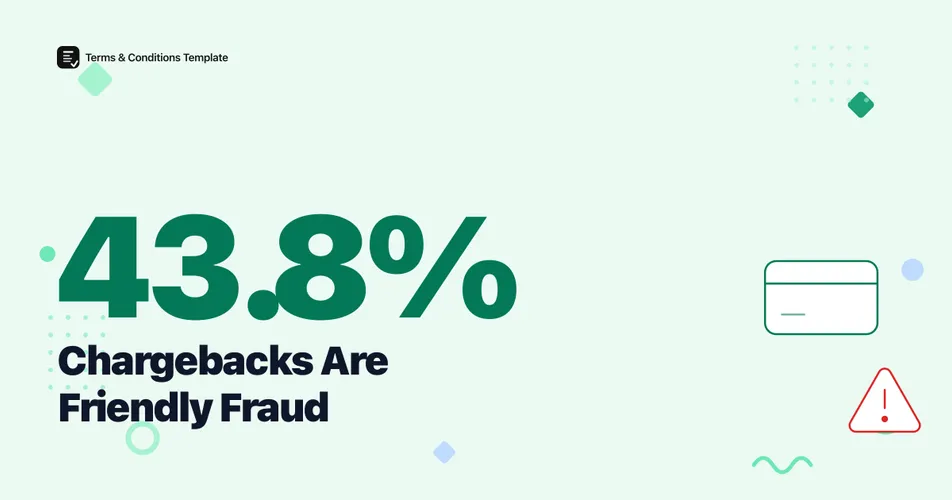
Merchants estimate that 43.8% of their chargebacks are friendly fraud, according to Chargebacks911’s 2026 Chargeback Field Report, a survey of more than 250 merchants. That is the most current, directly-sourced answer to the question, but it is far from the only number in circulation, and the gap between what merchants believe and what card networks report is itself the more interesting story.
Ask a different source and the share moves by a factor of three. Mastercard’s own chargeback data has merchants attributing just 21% of disputes to first-party fraud and issuers only 13%. Cybersource’s annual fraud report lands in between, at roughly 20% to 30%. None of these agree, and understanding why is more useful than picking a single number to repeat.
What percentage of chargebacks are friendly fraud, according to merchants?
Merchants who track their own dispute data put friendly fraud at 43.8% of chargebacks on average, per Chargebacks911’s 2026 Chargeback Field Report. The report’s own analysis flags that this is likely an undercount: “industry data shows the rate to be considerably higher, meaning merchants are significantly underestimating the scale of the problem.”
The same report found 83.4% of enterprise merchants and 73.7% of all surveyed merchants reported an increase in friendly fraud over the past three years, and 74.4% now describe it as a moderate or significant business concern. Merchant self-estimates are a starting point, not a ceiling.
Figure 1: Friendly fraud share of chargebacks, by named source and reporting party. Sources: Chargebacks911 2026 Chargeback Field Report; Cybersource 2025 Global eCommerce Payments & Fraud Report; Mastercard 2025 State of Chargebacks Report.
Merchant surveys consistently run higher than card-network data. That gap is not noise, it reflects who is answering and how disputes get labeled once they reach a bank.
Why do card networks report a much lower friendly fraud rate?
Mastercard’s 2025 State of Chargebacks Report shows merchants and issuers disagree sharply on what causes a dispute in the first place, and first-party fraud is a minority category on both sides. Merchants attribute 21% of disputes to first-party fraud, non-fraud disputes at 38%, and third-party fraud at 25%. Issuers see it differently: third-party fraud at 59%, first-party fraud at just 13%.
| Dispute type | Merchant-reported | Issuer-reported |
|---|---|---|
| Non-fraud disputes | 38% | 28% |
| Third-party fraud | 25% | 59% |
| First-party fraud | 21% | 13% |
| Low-dollar write-offs | 16% | not reported |
Source: Mastercard 2025 State of Chargebacks Report.
Figure 2: How merchants attribute their own chargebacks by cause. Source: Mastercard 2025 State of Chargebacks Report.
Issuers process the dispute paperwork and tend to code ambiguous cases as third-party fraud unless a merchant proves otherwise, which likely explains part of why their first-party fraud number runs so much lower than the merchant-reported figure. A clear, easy-to-find refund policy at checkout is one of the few levers a merchant has to shift that classification in their own favor: publishing a refund policy generator-built policy with plain return terms gives you the documentation card networks look for when you dispute a friendly fraud claim.
Is friendly fraud actually growing, or is reporting just improving?
Both are true, and the fraud category one level up shows the clearest evidence of real growth. LexisNexis Risk Solutions’ 2025 Cybercrime Report, based on analysis of more than 104 billion global transactions processed in 2024, found first-party fraud made up 36% of all reported global fraud in 2024, up from 15% in 2023. First-party fraud is the umbrella category that includes friendly fraud chargebacks along with false non-delivery claims and misrepresented loan applications, so it is not a one-to-one match with the chargeback-specific figures above, but the direction is the same across every source in this article: up.
Figure 3: Global chargeback volume trajectory. Source: Mastercard 2025 State of Chargebacks Report; Mastercard’s earlier 2023 forecast projected 337 million by 2026, later revised down.
Mastercard’s own volume forecast was revised downward between its 2023 and 2025 reports, from a projected 337 million chargebacks by 2026 to a 2028 projection of 324 million. Volume is still climbing, just not as steeply as the earliest projections suggested.
Is the “75% of chargebacks are friendly fraud” claim real?
This figure appears across dozens of payments blogs, usually attributed loosely to “Visa” with no report name, year, or sample size attached. We could not trace it to a specific, dated Visa publication. Visa’s own corporate materials on friendly fraud do not state a percentage; the nearest traceable figure carrying Visa’s name is Cybersource’s 2025 Global eCommerce Payments & Fraud Report, co-published with Visa Acceptance Solutions, the Merchant Risk Council, Verifi, and B2B International, which puts friendly fraud at roughly 20% of all fraudulent disputes globally and up to 30% for high-volume online merchants.
Warning
Treat the “up to 75%” and “86%” figures that circulate widely with real suspicion. Chargebacks911’s own site cites an internal 86% estimate with no disclosed sample size or methodology, separate from its sourced 2026 Field Report figure of 43.8%. When a friendly fraud statistic has no named report, year, or sample size attached, it is not a fact you can cite, no matter how often it gets repeated.
Figure 4: The evidentiary test that separates a real fraud claim from friendly fraud. Source: synthesized from Visa Compelling Evidence 3.0 criteria and Mastercard dispute categories above.
The honest answer is that no single, well-sourced study puts friendly fraud above roughly a third of chargebacks. Every number over that comes from either an undisclosed internal estimate or a broader fraud category being mislabeled as chargeback-specific.
How does refund abuse compare to chargeback friendly fraud?
Refund abuse is a related but separate problem, and it is large in its own right. Chargebacks911’s 2026 Chargeback Field Report estimates 27.1% of returns are abusive refund requests, and 62% of surveyed merchants call refund abuse a moderate or significant concern, close to the 74.4% who say the same about friendly fraud chargebacks specifically. Both problems trace back to the same root cause for a merchant: policy terms that are missing, vague, or buried where a customer or a card issuer cannot find them.
Figure 5: Timeline of major friendly fraud and chargeback data points. Sources: Mastercard, LexisNexis Risk Solutions, Cybersource, Chargebacks911.
Merchants that keep a dedicated chargeback team see better outcomes on both fronts, but only 34% of merchants in the 2026 Field Report have one. Most are fighting both refund abuse and friendly fraud with the same thin documentation trail. For the full picture on dispute volume, win rates, and cost per chargeback beyond just the friendly fraud share, see our chargeback statistics for 2026.
The Bottom Line
There is no single correct percentage for how many chargebacks are friendly fraud. Merchants who track their own data land at 43.8%, card networks land between 13% and 21% depending on who is asked, and the widely repeated 75% to 86% figures cannot be traced to a dated, disclosed methodology. What every sourced study agrees on is the direction: first-party fraud climbed from 15% to 36% of global fraud in a single year, and 83.4% of enterprise merchants say the problem is getting worse. A clear, current refund policy will not eliminate friendly fraud, but it is the documentation that shifts dispute outcomes when a claim is contested, and it is one of the few variables a merchant fully controls.
Frequently Asked Questions
What percentage of chargebacks are friendly fraud? Merchants estimate 43.8% of their chargebacks are friendly fraud on average, according to Chargebacks911’s 2026 Chargeback Field Report, a survey of more than 250 merchants. Card-network data puts the figure lower: Mastercard’s 2025 State of Chargebacks report has merchants attributing 21% of disputes to first-party fraud, and issuers only 13%.
Is friendly fraud the same as first-party fraud? Mostly, yes. First-party fraud is the broader category, and friendly fraud chargebacks are its main form in ecommerce. LexisNexis Risk Solutions’ 2025 Cybercrime Report found first-party fraud made up 36% of all reported global fraud in 2024, up from 15% in 2023, based on analysis of more than 104 billion transactions.
Is it true that 75% of chargebacks are friendly fraud? That figure circulates widely but cannot be traced to a specific, dated Visa report with disclosed methodology. The closest sourced figure is Cybersource’s 2025 Global eCommerce Payments & Fraud Report, which puts friendly fraud at around 20% of fraudulent disputes globally and up to 30% for high-volume online merchants, a meaningfully lower number.
How much do abusive refund claims add to the problem? 27.1% of returns are estimated to be abusive refund requests, separate from chargeback disputes, according to Chargebacks911’s 2026 Chargeback Field Report. Refund abuse and friendly fraud chargebacks are related but distinct problems that both start with unclear or hard-to-find policy terms.
Sources and References
- Chargebacks911. (2026). “2026 Chargeback Field Report.” Survey of 250+ merchants.
- Mastercard. (2025). “2025 Global Chargebacks Outlook / State of Chargebacks Report.”
- Cybersource / Visa Acceptance Solutions. (2025). “Global eCommerce Payments & Fraud Report,” co-published with the Merchant Risk Council, Verifi, and B2B International.
- LexisNexis Risk Solutions. (2025). “Cybercrime Report.” Analysis of 104 billion+ global transactions, January-December 2024.
- Visa. “Friendly Fraud Explained: Prevention and Solutions.” Compelling Evidence 3.0 program details.
Note: All figures verified as of August 2026. Chargeback and friendly fraud estimates vary significantly by source and methodology, so headline figures in this article are refreshed at least twice a year.