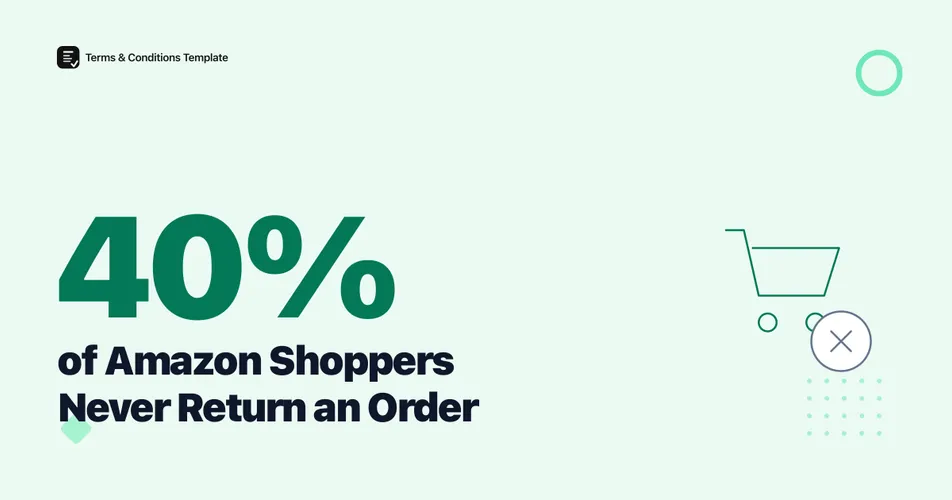
Amazon does not publish its own aggregate return rate, but survey data fills the gap. According to Consumer Intelligence Research Partners (CIRP), 40% of US Amazon shoppers say they have never returned a purchase to Amazon, and only about a third made one in the prior six months. Here is the 2026 data on how shoppers actually return items, what Amazon’s return window and restocking-fee rules say, and what changed in the return process over the last two years.
How many Amazon shoppers actually return something?
Most Amazon shoppers are not serial returners. CIRP, a research firm that surveys recent US Amazon customers, found that 40% report they have never returned a purchase, while only about a third made a return within the prior six months. CIRP does not disclose the exact sample size for this specific figure in its public post, so treat 40% as a directional survey finding rather than an audited return-behavior count.
Figure 1: Share of US Amazon shoppers who report ever returning a purchase versus never returning one. Source: Consumer Intelligence Research Partners, January 2024 shopper survey.
That 60/40 split matters for how sellers should think about return volume. A minority of highly active returners likely drives a disproportionate share of total return traffic, which is consistent with how CIRP frames its own data: most customers barely touch the returns system at all.
How do Amazon shoppers send items back?
When an Amazon shopper does return something, shipping it themselves is still the default. CIRP’s December 2025 survey found that 59% of returns go through UPS, The UPS Store, FedEx, or USPS, compared with 17% dropped at a Kohl’s and 9% at a Whole Foods Market. CIRP attributes the gap partly to store footprint: Kohl’s operates more than 1,000 US locations, while Whole Foods has roughly 500.
Figure 2: How Amazon shoppers physically send a return back, by drop-off method. Source: CIRP, December 2025 shopper survey.
Traditional shipping carriers still carry the majority of Amazon’s return volume, even after several years of Amazon steering customers toward free, label-free retail drop-offs.
How long is Amazon’s return window?
Most items bought on Amazon can be returned within 30 days of delivery, per Amazon’s own return policy, provided the item is unused and in its original condition. That window is not universal. Digital purchases such as ebooks and downloadable software must be returned within 7 days if unread or undownloaded, while Apple-brand products and Amazon Haul items over $3 get 15 days. Some categories run much longer: select Amazon Renewed products, most nonperishable baby items, and non-owner registry purchases get 90 days, wedding registry purchases by a guest get 180 days, and baby registry purchases by a guest can go a full 365 days.
| Purchase type | Return window |
|---|---|
| Digital books, textbooks, songs | 7 days |
| Apple brand, Boost Infinite, Amazon Haul (over $3) | 15 days |
| Standard items | 30 days |
| Select Renewed products, nonperishable baby items | 90 days |
| Wedding registry (non-owner purchase) | 180 days |
| Baby registry (non-owner purchase) | 365 days |
Source: Amazon official return policy, current as of research in 2026.
Figure 3: Amazon’s return window in days, by purchase type. Source: Amazon official return policy.
Amazon’s own default rules only cover items sold and fulfilled through Amazon.com. A seller running listings on their own site, or fulfilling orders outside Amazon’s marketplace, still needs a clear, published refund policy that states its own return window and condition requirements, since Amazon’s category exceptions do not automatically extend to a seller’s other sales channels.
What are Amazon’s restocking fees?
Most Amazon returns are free, but the exceptions carry real weight. Amazon’s official return policy allows a restocking fee of up to 100% of the item price for opened or activated software, video games, and items missing parts or accessories, as well as for collectible cards, board games, or variant figurines that have been opened. A return made more than 30 days after the deadline also forfeits the full price. Items returned damaged, dirty, or heavily used through no fault of the seller can be docked up to 50%, or the full 100% for luxury items.
Figure 4: How Amazon’s restocking fee tiers apply to a return. Source: Amazon official return policy.
For sellers building their own returns beyond Amazon’s marketplace, our Amazon sellers, sales, and market share data covers the broader base of businesses whose refund terms these rules do not automatically cover.
How does Amazon’s return behavior compare with ecommerce overall?
Amazon does not disclose a comparable figure, so the closest benchmark comes from the wider industry. An estimated 19.3% of online purchases were returned in 2025, well above the 15.8% blended rate across all retail channels, according to the National Retail Federation (NRF) and Happy Returns’ joint 2025 Retail Returns Landscape survey. That industry-wide rate sits alongside, not in place of, Amazon’s own behavioral numbers, since Amazon has never published an equivalent return-rate figure for its own marketplace.
| Metric | Amazon (CIRP survey) | Ecommerce overall (NRF) |
|---|---|---|
| Never returned a purchase | 40% | not disclosed |
| Returned in the prior 6 months | about a third | not disclosed |
| Online return rate | not disclosed | 19.3% (2025) |
| Blended retail return rate | not disclosed | 15.8% (2025) |
Source: Consumer Intelligence Research Partners (2024); National Retail Federation and Happy Returns (2025).
Return rates also vary sharply by product category across ecommerce broadly, from apparel running 20% to 40% down to beauty at 4% to 12%, according to Appriss Retail and Deloitte’s 2024 Consumer Returns in the Retail Industry report. Amazon does not break out its own category-level return rates publicly, but apparel and electronics, two of its largest categories, sit at opposite ends of that industry range.
What changed in Amazon’s return policy recently?
Amazon’s return network has expanded and gotten cheaper for Amazon to run, even as it introduced its first return-related customer fee. In April 2024, Amazon began charging a $1 fee for returns dropped at The UPS Store whenever a free option, such as Whole Foods, Kohl’s, or Amazon Fresh, is closer to the customer’s delivery address. An Amazon spokesperson said at the time: “We always offer a free option for customers to return their item. If a customer would prefer to return their item at a UPS Store when there is a free option closer to their delivery address, a very small amount of customers may incur a one dollar fee.”
Figure 5: Recent changes to Amazon’s return drop-off network and fees. Source: Amazon corporate announcements, 2023 to 2026.
Amazon’s return network now covers more than 10,000 US drop-off locations, and the company says four out of five US customers live within 5 miles of one. Whole Foods locations also offer self-service kiosks that Amazon says complete a return in 60 seconds or less. For context on the membership base generating much of that return volume, our Amazon Prime membership and spending data covers how many shoppers hold a Prime account and what they spend each year.
The Bottom Line
Amazon’s return story is less dramatic than the “returns are out of control” narrative suggests: 40% of shoppers say they have never returned anything, and shipping a box back yourself is still more common than dropping it at a store. What has changed is the mechanics around the edges, a new $1 fee for UPS Store returns near a free alternative, a bigger free drop-off network, and restocking fees that can reach 100% for opened media or a very late return. Any seller operating outside Amazon’s own marketplace rules should not assume Amazon’s 30-day window or fee structure applies to their store; publishing a clear, current refund policy is what actually sets those terms.
Frequently Asked Questions
What percentage of Amazon shoppers have never made a return? 40% of US Amazon shoppers say they have never returned a purchase to Amazon, and only about a third made a return in the prior six months, according to Consumer Intelligence Research Partners (CIRP) survey data.
How long do you have to return something to Amazon? Most items can be returned within 30 days of delivery, per Amazon’s own return policy. The window shrinks to 7 days for digital purchases and 15 days for Apple-brand and Amazon Haul items, and stretches to 90, 180, or 365 days for select Renewed products, wedding registry gifts, and baby registry gifts.
Does Amazon charge a restocking fee? Most returns are free, but Amazon can charge up to 100% of the item price for opened software, video games, or missing parts, and for returns made more than 30 days late. Damaged or heavily used items can be docked up to 50%, or 100% for luxury items, per Amazon’s official return policy.
Why does Amazon charge $1 for some UPS Store returns? Amazon added a $1 fee in April 2024 for returns dropped at The UPS Store when a free option, such as Whole Foods, Kohl’s, or Amazon Fresh, sits closer to the customer’s address. Amazon says a free option is always available; the fee only applies when a customer chooses the paid one over a closer free one.
Sources and References
- Consumer Intelligence Research Partners (CIRP). (2024). “Amazon Has Streamlined Returns for Most, but Not All, Shoppers.” 40% of surveyed US Amazon shoppers report never returning a purchase; about a third returned one in the prior six months. Sample size not disclosed in the public post.
- Consumer Intelligence Research Partners (CIRP). (2025). “Returns at Whole Foods: Where Amazon Grocery and Logistics Meet.” December 2025 shopper survey; 59% of returns shipped via UPS/FedEx/USPS, 17% via Kohl’s, 9% via Whole Foods.
- Amazon. “About Our Return Policies.” Official return window and restocking fee policy, current as of 2026; live policy page, subject to change.
- Amazon. (2026). “Amazon Expands Free Returns to Over 10,000 U.S. Drop-off Locations.” Network expansion details including FedEx Office and Rent-A-Center additions.
- The Penny Hoarder. (2024). “Amazon Starts Charging a $1 Fee for Some UPS Returns.” Reporting with Amazon spokesperson statement on the April 2024 fee change.
- National Retail Federation and Happy Returns. (2025). “2025 Retail Returns Landscape.” Survey of 2,006 consumers and 358 ecommerce professionals at large US merchants, conducted summer 2025.
- Appriss Retail and Deloitte. (2024). “2024 Consumer Returns in the Retail Industry Report.” Survey of 150 North American retail executives, 1,000 consumers, and US Census Bureau data.
Note: All figures verified as of October 2026. Amazon does not publish an official aggregate return rate; the CIRP figures above are survey-based estimates, not audited counts, and this page is refreshed at least twice a year as newer survey data becomes available.