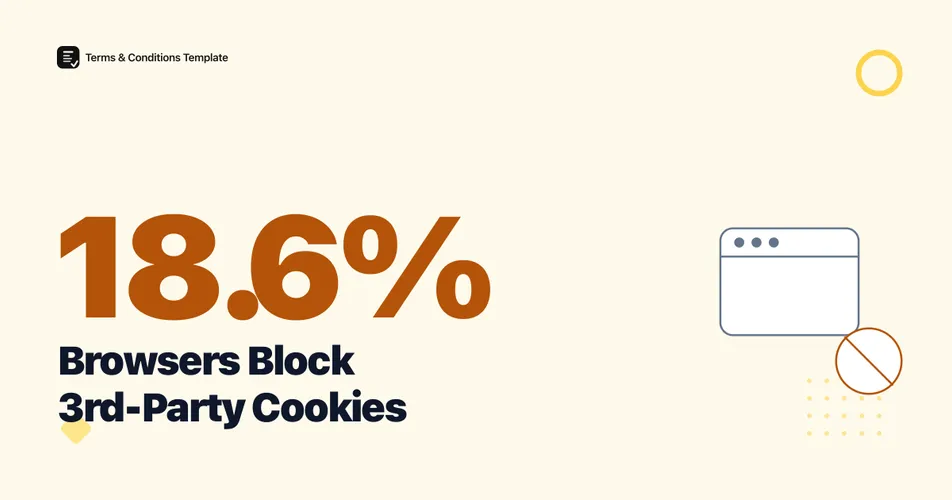
Only 18.6% of global browser traffic blocks third-party cookies by default in 2026, according to StatCounter Global Stats’ June 2026 browser market share data, which credits Safari (15.31%) and Firefox (3.33%) as the only major browsers with blocking turned on out of the box. That blended figure hides a much larger split underneath: mobile blocks at more than double the rate of desktop, and the browser most people think of as “the blocking one” understates the real reach of Apple’s rules.
If you publish a cookie policy, the practical question is not the global average, it is which of your visitors land on a browser that already blocks the trackers your site is trying to disclose.
What percentage of browsers block third-party cookies overall?
18.6% of global browser traffic blocks third-party cookies by default, the combined share of Safari (15.31%) and Firefox (3.33%) in StatCounter’s June 2026 worldwide browser market share data. The remaining 81.4%, led by Chrome at 69.65% and Edge at 5.21%, allows third-party cookies unless a visitor changes the setting themselves.
Figure 1: Global browser traffic split by default third-party cookie behavior. Source: StatCounter Global Stats, June 2026.
Samsung Internet and Opera are both Chromium-based and inherit Chrome’s default of allowing third-party cookies, so the blocking side of the chart belongs entirely to Safari and Firefox.
Does the blocking rate differ between desktop and mobile?
Yes, sharply. On desktop, only 11.49% of browser traffic blocks third-party cookies by default (Firefox 6.31% plus Safari 5.18%), while on mobile the blocking share climbs to 24.77% (Safari 24.07% plus Firefox 0.70%), per StatCounter’s June 2026 device-level breakdowns. The gap comes down to one browser: mobile Safari alone carries more blocking traffic than the entire desktop blocking share combined.
Figure 2: Third-party cookie blocking rate by platform. Source: StatCounter Global Stats, June 2026, desktop and mobile breakdowns.
A site that gets most of its traffic from phones is dealing with a fundamentally different cookie landscape than a desktop-heavy site, even before accounting for region or industry.
Why does iOS block more traffic than Safari’s browser share suggests?
Because Apple’s platform rules require every browser distributed on iOS, not just the one called Safari, to run on Apple’s WebKit rendering engine, and WebKit has blocked third-party cookies by default since Safari 13.1 shipped on March 24, 2020. StatCounter attributes only 24.07% of mobile traffic to apps labeled “Safari,” but iOS itself accounts for 30.79% of worldwide mobile OS traffic in June 2026. The roughly 6.7 percentage-point gap between those two numbers is largely Chrome-for-iOS, Firefox-for-iOS, and Edge-for-iOS users, whose apps carry a different name and icon but still run WebKit underneath and still block third-party cookies the same way Safari does.
Figure 3: iOS’s full device share versus the narrower share credited to apps labeled Safari. Source: StatCounter Global Stats, June 2026, mobile OS and mobile browser market share.
This matters for anyone reading browser statistics literally: a “Safari share” number undercounts how much mobile traffic is actually subject to WebKit’s cookie rules, because it only counts users who kept Apple’s own browser icon on their home screen.
Which browsers block third-party cookies by default, and which allow them?
The determining factor is rendering engine, not brand. WebKit (Safari and every other iOS browser) and Gecko (Firefox, via Total Cookie Protection) block by default. Chromium, the engine behind Chrome, Edge, Samsung Internet, and Opera on desktop and Android, allows them by default unless a user or IT policy changes the setting.
Figure 4: The rendering engine, not the browser name, decides the third-party cookie default.
| Browser | Engine | Global share | Blocks third-party cookies by default |
|---|---|---|---|
| Chrome | Chromium | 69.65% | No |
| Safari | WebKit | 15.31% | Yes |
| Edge | Chromium | 5.21% | No |
| Firefox | Gecko | 3.33% | Yes |
| Samsung Internet | Chromium | 1.95% | No |
| Opera | Chromium | 1.74% | No |
Table 1: Default third-party cookie behavior by browser and engine. Source: StatCounter Global Stats, June 2026.
A Cookie Policy Generator still needs to disclose every tracker a site sets, regardless of which row of that table a given visitor falls into, since the legal obligation to disclose runs on privacy law, not on which engine happens to block the tracker anyway.
Is the EU’s Digital Markets Act changing this?
Not yet, in practice. The EU’s Digital Markets Act took effect on March 7, 2024 and legally requires Apple to let iOS developers ship browsers built on non-WebKit engines inside the EU. Apple added a browser choice screen to iOS 17.4 in response, and Firefox reported daily active users up 99% in Germany and 111% in France after it launched. But more than two years later, Open Web Advocacy’s tracking found that no browser vendor has actually shipped a non-WebKit engine on iOS anywhere, in or out of the EU. The legal door opened; the WebKit-only reality on the ground has not moved.
Figure 5: Key milestones in browser engine policy and third-party cookie defaults. Sources: WebKit, Mozilla, Google Privacy Sandbox, Open Web Advocacy.
Warning
Treat any precise market-share figure for Brave, DuckDuckGo, or Vivaldi with caution. Brave’s own user-agent design and its absence from StatCounter’s headline browser table make its exact global share hard to pin down, with secondary sources citing anywhere from under 1% to over 2%. All three block third-party cookies by default, which would push the true global blocking share slightly above 18.6%, but we could not trace a single, current, methodology-disclosed figure for any of them, so they are excluded from the numbers in this article rather than estimated.
The Bottom Line
The honest answer to “what percentage of browsers block third-party cookies” depends on which slice you are asking about. Globally it is 18.6%, on desktop it drops to 11.49%, and on mobile it rises to 24.77%, all from StatCounter’s June 2026 data. The iOS WebKit mandate means the real mobile figure runs even higher than app-labeled “Safari” traffic suggests, since Chrome and Firefox on iPhone still block the same way Safari does. None of this removes the disclosure requirement on the 81.4% of traffic that still allows tracking by default. Publishing a clear cookie policy that names every tracker still matters regardless of which engine a given visitor’s browser happens to run, and pairing it with accurate consent banner data is covered in more detail in our third-party cookie phase-out numbers post.
Frequently Asked Questions
What percentage of browsers block third-party cookies by default? About 18.6% of global browser traffic blocks third-party cookies by default in 2026, according to StatCounter Global Stats’ June 2026 browser market share data. Safari (15.31%) and Firefox (3.33%) are the only major browsers with blocking turned on out of the box.
Do more phones or desktops block third-party cookies? Phones do, by a wide margin. On mobile, 24.77% of browser traffic blocks third-party cookies by default (mostly Safari at 24.07%), versus 11.49% on desktop, per StatCounter’s June 2026 device-level data.
Why does iOS block more traffic than Safari’s browser share suggests? Apple requires every browser distributed on iOS, including apps labeled Chrome and Firefox, to run on its WebKit rendering engine, which blocks third-party cookies by default. StatCounter counts iOS at 30.79% of mobile OS share in June 2026, wider than the 24.07% it attributes to apps labeled Safari.
Has the EU’s Digital Markets Act let other engines onto iPhone? Legally, yes, since March 2024. In practice, no vendor has shipped a non-WebKit browser engine on iOS more than two years later, according to Open Web Advocacy’s tracking, so WebKit’s cookie-blocking default still applies to nearly all iOS browsing worldwide.
Sources and References
- StatCounter Global Stats. (2026). “Browser Market Share Worldwide.” Data for June 2026.
- StatCounter Global Stats. (2026). “Desktop Browser Market Share Worldwide.” Data for June 2026.
- StatCounter Global Stats. (2026). “Mobile Browser Market Share Worldwide.” Data for June 2026.
- StatCounter Global Stats. (2026). “Mobile Operating System Market Share Worldwide.” Data for June 2026.
- WebKit. (2020). “Full Third-Party Cookie Blocking and More.” Safari 13.1 / iOS 13.4 announcement, March 24, 2020.
- Mozilla. (2022). “Firefox Rolls Out Total Cookie Protection By Default To All Users Worldwide.”
- Open Web Advocacy. (2026). “The Digital Markets Act Is Delivering Real Wins, But Not Yet for Browser Engines.”
- Apple. “About the browser choice screen in the EU.” Developer documentation on iOS 17.4 browser choice compliance.
Note: All figures verified as of August 2026. Browser and OS market share shift monthly and browser engine policy is an active regulatory area, so headline figures in this article are refreshed at least twice a year.