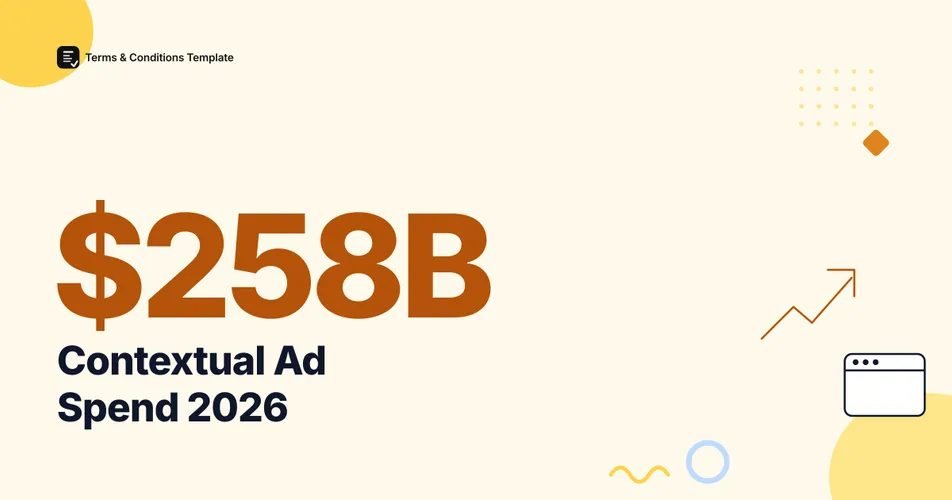
Global contextual advertising spend is on pace to hit $258.32 billion in 2026, up 10.4% from $233.89 billion in 2025, according to The Business Research Company’s January 2026 market report. That growth is not happening in a vacuum. It tracks closely with advertisers hunting for a working substitute for cookie-based targeting, one Google itself declined to force on the industry when it walked back Chrome’s third-party cookie phase-out in April 2025.
For a site owner, the practical question is not whether contextual advertising is growing. It clearly is. The question is what that means for the cookie disclosures your site still has to make, and whether the ad dollars now chasing “context” instead of “identity” actually change your compliance obligations.
How much is spent on contextual advertising in 2026?
Global contextual ad spend is forecast to reach $258.32 billion in 2026, up from $233.89 billion in 2025, a 10.4% year-over-year increase, according to The Business Research Company’s “Contextual Advertising Market Report 2026,” published in January 2026. The same report projects the market to keep climbing to $379.84 billion by 2030, a 10.1% compound annual growth rate over that stretch.
Figure 1: Global contextual ad spend, 2025 to 2030. Source: The Business Research Company, “Contextual Advertising Market Report 2026,” January 2026.
Warning
Market-size estimates for contextual advertising vary by research firm, and not by a small margin. Statista’s compiled forecast puts global contextual spend at $227.38 billion in 2023 (actual) and projects it will more than double to $562.1 billion by 2030, a 13.8% annual growth rate, a materially different trajectory than The Business Research Company’s numbers above. Neither source discloses a full underlying sample or primary methodology beyond citing secondary industry data, which is typical for market-sizing reports in this space. Treat any single “the market is worth $X” figure as directional rather than exact, and note which firm produced it.
Regardless of which forecast proves closer, the direction is the same across every source we checked: contextual ad spend is rising, not shrinking, heading into 2027.
Why are advertisers shifting budget toward contextual targeting?
Advertisers are not moving to contextual targeting because cookies disappeared. They are moving because cookies became unreliable enough to hedge against, even after Google confirmed on April 22, 2025 that Chrome would keep third-party cookies on by default rather than force a deprecation prompt. Nearly half of marketers still planned to rely primarily on cookie-free targeting methods by the end of 2025, and more than three-quarters of survey respondents were already building first-party data strategies, according to WARC’s August 2025 programmatic research, which cites Comscore data.
Figure 2: Milestones behind the shift toward contextual targeting. Sources: Google Privacy Sandbox blog; GumGum/Brand Innovators 2022 survey; WARC “Future of Programmatic 2025”; The Business Research Company, January 2026.
If your site runs any kind of tracking or ad pixel, the disclosure obligation does not change based on which targeting method an advertiser prefers this year. A Cookie Policy Generator still needs to list every tracker a page sets and explain what each one does, contextual, behavioral, or otherwise. For the fuller picture of why Chrome’s reversal did not settle the underlying compliance question, see our third-party cookie statistics for 2026.
Budget does not move on sentiment alone. Advertisers are backing contextual with real dollars because the alternative, betting on a cookie ecosystem that keeps changing shape, has gotten harder to plan around.
Do consumers actually prefer contextual ads to behavioral ones?
Yes, by a wide margin. 94% of consumers across the US, UK, and Canada prefer contextually relevant ads over ones based on their browsing history, according to GumGum’s February 2025 survey of 3,000 consumers. 42% said ads related to their current interests were the most valuable type of advertising, and about 80% said they were more likely to engage with an ad that matched the content they were already viewing.
Figure 3: Consumer preference for contextual vs. identity-based ads. Source: GumGum, February 2025, n=3,000 consumers across the US, UK, and Canada.
Privacy is a real factor in that preference, not just a side note. About a third of the same respondents ranked privacy as the single most important factor in how they judge advertising, and another third rated privacy and relevance as equally important. That is consistent with a pattern this site’s own research keeps finding: people notice when an ad appears to know too much about them, and contextual targeting, which reacts to the page rather than the person, does not trigger that reaction the same way.
Is contextual advertising actually more efficient than a typical programmatic buy?
The case for contextual is not only about consumer sentiment. It is also about where the money goes. Only about 36 cents of every dollar spent through a typical open-programmatic buy reaches the consumer, according to the Association of National Advertisers’ Programmatic Media Supply Chain Transparency Study, published in December 2023 and based on 21 brands, $123 million in ad spend, and 35.5 billion impressions collected between September 2022 and January 2023. The rest is lost to transaction fees, non-viewable impressions, and made-for-advertising inventory across the supply chain.
Figure 4: Where a typical programmatic ad dollar goes, and why advertisers are shopping for simpler paths to the page. Source: ANA Programmatic Media Supply Chain Transparency Study, December 2023.
That study was not a comparison of contextual against behavioral targeting specifically. It measured waste across the open programmatic supply chain broadly. But it explains part of why advertisers are receptive to a simpler pitch: match the ad to the page, skip several layers of identity resolution, and more of the budget survives the trip.
Which companies are driving contextual ad growth?
Independent contextual ad-tech vendors are growing faster than the market average. Seedtag, a self-described “neuro-contextual” advertising company, reported 46% year-over-year revenue growth in North America for 2025, with its US business up 35% year-over-year in January 2026 and its CTV product line up 157% year-over-year in 2025. That is company-specific, self-reported growth, not a market-wide figure, but it is a useful signal for how fast a contextual-first vendor can scale against a market growing at roughly 10% a year overall.
Figure 5: Contextual ad growth rates, market average vs. one vendor. Sources: The Business Research Company (market CAGR); Seedtag press release, reported 2026.
The same privacy-first infrastructure shift shows up on the publisher side too. Server-side tagging, which keeps more of a page’s tracking logic off the visitor’s browser, is seeing similar momentum; see our server-side tracking statistics for 2026 for the adoption numbers behind that trend.
How do the two leading spend forecasts compare?
| Source | Base-year figure | Growth rate | 2030 forecast |
|---|---|---|---|
| The Business Research Company (Jan 2026) | $258.32B (2026) | 10.4% CAGR (2025-2026) | $379.84B |
| Statista compiled forecast | $227.38B (2023, actual) | 13.8% CAGR (2022-2030) | $562.1B |
Both sources agree contextual ad spend is climbing well into the next decade. They disagree on how fast, which is why this article cites both instead of picking the more dramatic number.
The Bottom Line
Contextual advertising is not a niche alternative anymore. It is a $258.32 billion global market in 2026, growing faster than overall ad spend, and preferred by 94% of the consumers GumGum surveyed. None of that changes what a cookie policy has to disclose. Contextual placements can still set cookies, still run through ad-tech vendors, and still need to be named in your site’s disclosures the same way a behaviorally targeted ad does. What has changed is the budget math: advertisers are increasingly willing to pay for relevance without personal tracking, and that shift is measurable in real spend, not just survey sentiment.
Frequently Asked Questions
How much will be spent on contextual advertising in 2026? An estimated $258.32 billion globally, up 10.4% from $233.89 billion in 2025, according to The Business Research Company’s January 2026 market report. The same report projects the market to reach $379.84 billion by 2030.
Do consumers actually prefer contextual ads over behavioral ads? Yes, by a wide margin. GumGum’s February 2025 survey of 3,000 consumers across the US, UK, and Canada found 94% prefer contextually relevant ads over ones based on browsing history.
Why are advertisers shifting budget toward contextual targeting? Largely because cookie-based targeting became unreliable even without a full ban. WARC’s August 2025 programmatic research, citing Comscore data, found nearly half of marketers planned to rely primarily on cookie-free targeting by the end of 2025, and over three-quarters were already building first-party data strategies.
How much of a typical programmatic ad dollar actually reaches the consumer? About 36 cents. The Association of National Advertisers’ December 2023 study of 21 brands, $123 million in spend, and 35.5 billion impressions found the rest was lost to fees and waste across the ad-tech supply chain.
Sources and References
- The Business Research Company. (2026). “Contextual Advertising Global Market Report 2026.” Published January 2026.
- Statista. “Global Contextual Ad Spend, 2022-2030.” Compiled forecast, 2023 actual and 2030 projection.
- GumGum. (2025). “94% of Consumers Across the US, UK, and Canada Prefer Contextual Ads Over Identity-Based Ads.” Published February 20, 2025. Survey of 3,000 consumers.
- WARC. (2025). “Trends in Programmatic Advertising and Contextual Targeting in 2025.” Citing Comscore data. Published August 2025.
- Association of National Advertisers. (2023). “Programmatic Media Supply Chain Transparency Study.” 21 brands, $123 million ad spend, 35.5 billion impressions, data collected September 2022 to January 2023. Published December 2023.
- Google Privacy Sandbox. (2025). “Next steps for Privacy Sandbox and tracking protections in Chrome.” Published April 22, 2025.
- Seedtag. (2026). “Seedtag Reports 46% Year-Over-Year Growth in North America.” Company press release.
- IAB / PwC. (2025). “Internet Advertising Revenue Report: Full Year 2024.” Programmatic ad revenue up 20.5% year-over-year to $162.4 billion.
Note: All figures verified as of September 2026. Market-size forecasts vary by research firm and ad-tech vendor growth is self-reported, so headline figures in this article are refreshed at least twice a year.