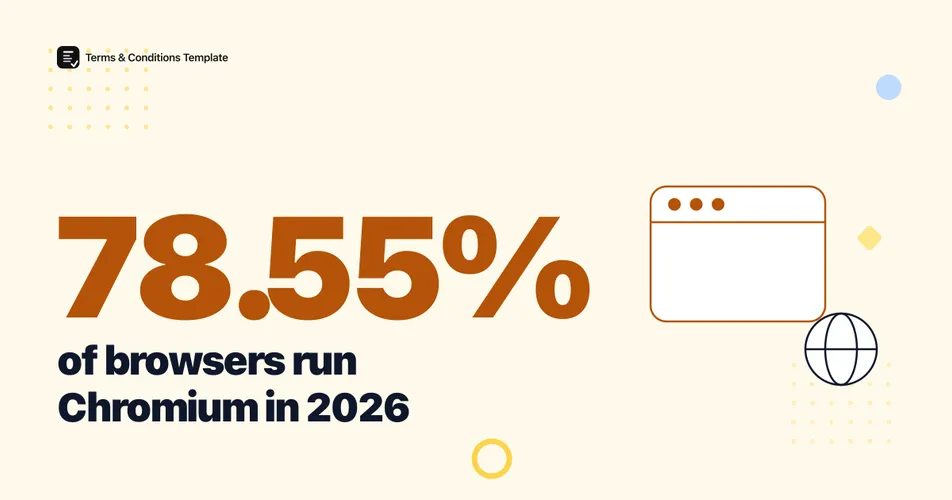
Chrome, Edge, Samsung Internet, and Opera together made up 78.55% of global browser traffic in June 2026, according to StatCounter Global Stats, and every one of them runs Google’s Chromium engine and allows third-party cookies by default. That single engine’s dominance, not any one company’s cookie policy in isolation, is the biggest reason most web traffic still carries third-party cookies in 2026. The two browsers built to block by default, Safari and Firefox, together hold barely a quarter of Chrome’s traffic on their own.
If you publish a cookie policy, the practical question is not just which browsers exist. It is how much of your traffic sits on the allow side of that split, and whether that split looks different depending on which country your visitors are in.
Which browser has the biggest share of the web in 2026?
Chrome, at 69.65% of global browser traffic in June 2026, is not close to a rival. Safari sits a distant second at 15.31%, followed by Edge at 5.21%, Firefox at 3.33%, Samsung Internet at 1.95%, and Opera at 1.74%, all per StatCounter Global Stats’ worldwide browser market share data.
Four of those six names, Chrome, Edge, Samsung Internet, and Opera, are Chromium-based and share the same default cookie behavior, which matters more for a cookie policy than any individual browser’s name recognition.
How does the full browser leaderboard break down?
Ranking all six major browsers by share shows a steep drop-off after Chrome, then a long, thin tail. Samsung Internet passed Opera for fourth place in 2026, both Chromium-based, both allowing third-party cookies by default.
Figure 1: Global browser market share leaderboard, June 2026. Source: StatCounter Global Stats.
A cookie policy needs to disclose every tracker a site sets no matter where a visitor’s browser lands on this leaderboard, since the legal disclosure obligation runs on privacy law, not on any single browser’s market position.
How much of the web runs on Chromium?
Chromium, the open-source engine Google maintains and Chrome, Edge, Samsung Internet, and Opera all build on, powers 78.55% of global browser traffic in June 2026. WebKit, via Safari, accounts for 15.31%. Gecko, via Firefox, accounts for 3.33%. The remaining 2.81% is split across smaller engines and browsers StatCounter tracks outside its six-browser headline table, including UC Browser, Yandex, and KaiOS-based browsers.
Figure 2: Global browser traffic grouped by rendering engine. Source: StatCounter Global Stats, June 2026.
One company’s engine choices now shape the default cookie experience for more than three-quarters of the web, which is a very different story than “Chrome is popular.”
Which browsers block third-party cookies by default?
Only Safari and Firefox, among the six browsers StatCounter tracks at a global level, block third-party cookies by default. Ranking browsers by share against their blocking status shows how lopsided the split really is: the four largest browsers by combined traffic all allow tracking cookies unless a visitor changes the setting.
Figure 3: Each browser’s June 2026 global share (StatCounter, normalized 0-1) plotted against whether it blocks third-party cookies by default.
| Rank | Browser | Global share | Blocks third-party cookies by default |
|---|---|---|---|
| 1 | Chrome | 69.65% | No |
| 2 | Safari | 15.31% | Yes |
| 3 | Edge | 5.21% | No |
| 4 | Firefox | 3.33% | Yes |
| 5 | Samsung Internet | 1.95% | No |
| 6 | Opera | 1.74% | No |
Table 1: The full browser leaderboard ranked by June 2026 global share. Source: StatCounter Global Stats.
Reading the leaderboard and the blocking column together, the browsers that block are ranked second and fourth, not first and second, which is easy to miss if a headline only quotes the aggregate blocking percentage. Our companion piece on what percentage of browsers block third-party cookies breaks that aggregate number down by desktop, mobile, and the iOS WebKit mandate in more depth.
Does browser market share change by country?
Yes, and Safari is the clearest example. In the United States, Safari held 25.91% of browser traffic in June 2026, a full 10.6 percentage points above its 15.31% worldwide share, while Chrome’s US share, 52.26%, ran well below its 69.65% global figure. Firefox and Edge both ran higher in the US than globally too, at 8.78% and 7.54% respectively, per StatCounter’s country-level data.
Figure 4: Safari and Chrome market share, United States versus worldwide. Source: StatCounter Global Stats, June 2026, worldwide and United States browser market share pages.
The gap traces back to iPhone ownership, which runs higher in the US than the global average, and every iOS browser inherits Safari’s WebKit engine and its cookie-blocking default regardless of which icon a user taps.
How big is Brave, the browser most rankings leave out?
Brave is Chromium-based, like Chrome, but its Shields system blocks third-party cookies and cross-site trackers by default, a setting Brave has shipped since its first public release on January 20, 2016, according to Brave’s own privacy features page and Wikipedia’s sourced history of the browser. StatCounter does not include Brave in its headline worldwide browser table, but its US-specific data puts Brave at 2.06% of US browser traffic in June 2026, an independent, third-party-measured figure. Brave’s own transparency report separately cites 120.9 million monthly active users and 51.2 million daily active users worldwide as of June 30, 2026.
Warning
Brave’s 120.9 million MAU figure is self-reported by Brave in its own transparency report, not independently audited, and Brave does not publish the methodology behind that count. Treat it as a vendor-disclosed number rather than a measured market-share percentage. StatCounter’s 2.06% US figure is independently measured but does not cover Brave’s worldwide share, since Brave sits outside StatCounter’s headline six-browser table globally. Both figures point the same direction, meaningful and growing usage, but neither one alone answers “what percentage of the web runs Brave.”
That gap between a real, independently measured regional number and a vendor’s own worldwide user count is common for smaller browsers, and it is worth naming rather than picking whichever number sounds bigger.
When did each blocking browser turn blocking on by default?
Firefox and Safari reached full third-party cookie blocking on different timelines, years apart, while Brave shipped with blocking on from its very first release.
Figure 5: Default third-party cookie blocking milestones by browser, 2016 to 2026. Sources: Brave, Mozilla, WebKit, StatCounter.
Eleven years after Brave’s launch and six years after Safari’s full blocking rollout, the browsers built to block cookies by default still carry less than a fifth of global traffic between them.
The Bottom Line
Chrome’s size, not its cookie policy alone, is what shapes the default web experience in 2026. Chromium-based browsers combined, 78.55% of global traffic, all allow third-party cookies unless a user changes the setting, while Safari and Firefox, the two blockers, sit second and fourth on the leaderboard rather than first. That split shifts meaningfully by country: Safari’s US share runs 10.6 percentage points above its global number, so a US-heavy site sees more blocked traffic than the worldwide average suggests. None of this changes what a cookie policy needs to say. A Cookie Policy Generator that names every tracker a site sets still matters for the 78.55% of visitors whose browser will not block anything on its own, and it is worth reading alongside our breakdown of the third-party cookie phase-out numbers and Google’s Privacy Sandbox adoption data for the fuller picture of where cookie tracking stands this year.
Frequently Asked Questions
What browser has the biggest global market share in 2026? Chrome, with 69.65% of global browser traffic in June 2026, according to StatCounter Global Stats. Safari is a distant second at 15.31%.
What percentage of web traffic runs on Chromium-based browsers? 78.55% of global browser traffic in June 2026 ran on a Chromium-based browser: Chrome (69.65%), Edge (5.21%), Samsung Internet (1.95%), and Opera (1.74%) combined, per StatCounter Global Stats. None of the four blocks third-party cookies by default.
Does Brave really block cookies, even though it is built on Chrome’s engine? Yes. Brave runs on the Chromium engine but its Shields system blocks third-party cookies and cross-site trackers by default, unlike Chrome, Edge, Samsung Internet, and Opera. StatCounter’s most specific published figure puts Brave at 2.06% of US browser traffic in June 2026, and Brave’s own transparency report cites 120.9 million monthly active users worldwide as of June 30, 2026.
Is browser market share different in the United States than globally? Yes, especially for Safari. Safari held 25.91% of US browser traffic in June 2026 versus 15.31% worldwide, a 10.6 percentage-point gap driven by higher iPhone ownership in the American market, per StatCounter Global Stats.
Sources and References
- StatCounter Global Stats. (2026). “Browser Market Share Worldwide.” Data for June 2026.
- StatCounter Global Stats. (2026). “Browser Market Share in United States of America.” Data for June 2026.
- Brave Software. (2026). “Transparency Report.” Monthly and daily active user figures as of June 30, 2026.
- Brave Software. “Privacy Features.” Statement on default third-party cookie and tracker blocking via Brave Shields.
- Mozilla. (2019). “Today’s Firefox Blocks Third-Party Tracking Cookies and Cryptomining by Default.” September 3, 2019.
- Mozilla. (2022). “Firefox Rolls Out Total Cookie Protection By Default To All Users Worldwide.” June 14, 2022.
- WebKit. (2020). “Full Third-Party Cookie Blocking and More.” Safari 13.1 / iOS 13.4 announcement, March 24, 2020.
- Wikipedia. “Brave (web browser).” Sourced history of Brave’s January 20, 2016 public launch.
Note: All figures verified as of September 2026. Browser market share shifts monthly and country-level splits move with device sales cycles, so headline figures in this article are refreshed at least twice a year.