Third-party cookies did not disappear in 2026. About 81% of global browser traffic still allows them by default, because Chrome and Edge, together carrying roughly three-quarters of the market, never switched deprecation on. Google confirmed on April 22, 2025 that it would keep its current third-party cookie settings rather than roll out the standalone opt-out prompt it had spent years building. The story of 2026 is not a phase-out. It is a split web, where Safari and Firefox users are cookie-free by default and everyone else is not.
If you publish a cookie policy or run a consent banner, this split matters more than any single number. The rules a visitor experiences now depend entirely on which browser they opened.
What percentage of browsers still allow third-party cookies?
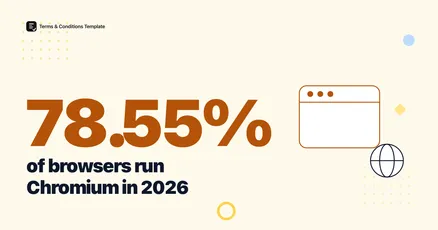
About 81% of global browser sessions allow third-party cookies by default, based on StatCounter’s June 2026 global browser market share data. Chrome holds 69.65% of that traffic and Edge adds 5.21%, and neither browser blocks third-party cookies out of the box. Safari (15.31%) and Firefox (3.33%) are the exceptions, together accounting for the 18.6% of sessions where third-party cookies are blocked by default.
That gap did not close in 2026, it held roughly steady, because the browser most people use made a deliberate decision not to change.
Why did Chrome cancel the third-party cookie phase-out?
Chrome kept third-party cookies because Google concluded a single mandatory phase-out could not satisfy publishers, advertisers, regulators, and privacy advocates at once. On April 22, 2025, Google’s Privacy Sandbox team wrote that it had “made the decision to maintain our current approach to offering users third-party cookie choice in Chrome, and will not be rolling out a new standalone prompt for third-party cookies.” The plan being scrapped was itself already a retreat: Google’s original 2020 deprecation target of 2022 slipped to 2024, then to a “user choice” prompt model in mid-2024, before being abandoned outright in April 2025.
Figure 1: Key milestones in Chrome’s reversed cookie deprecation plan. Source: Google Privacy Sandbox blog, 2020-2025 announcements.
Following the announcement, the UK Competition and Markets Authority noted that Google had restated its intention not to restrict third-party cookies and moved to release the related Privacy Sandbox commitments it had previously required. Regulatory pressure did not force the U-turn. If anything, one of the regulators most invested in Privacy Sandbox stood down alongside Google.
Which browsers block third-party cookies by default, and since when?
Safari and Firefox are the only major browsers that block third-party cookies without any user configuration, and both got there years before Chrome’s plan was even announced. WebKit shipped full third-party cookie blocking in Safari 13.1 and iOS 13.4 on March 24, 2020, stating plainly that “cookies for cross-site resources are now blocked by default across the board.” Firefox followed with Total Cookie Protection, which confines every cookie to the site that set it and rolled out by default to all Firefox desktop users worldwide starting in 2022.
Figure 2: Global browser market share by engine. Chrome and Edge allow third-party cookies by default; Safari and Firefox block them. Source: StatCounter Global Stats, June 2026.
A site owner running a Cookie Policy Generator needs to account for both defaults in the same document, since the same visitor journey now behaves differently depending on which of these six browsers loaded the page.
Is the industry ready for a cookieless internet?
Not yet, by the industry’s own admission. IAB Europe’s Post-Third-Party Cookie Survey, published in February 2024 and drawing on responses from over 160 European digital advertising professionals, found that 76% of respondents still relied on third-party cookies for their business, and 55% had not tested Privacy Sandbox APIs at all. Only 51% described themselves as prepared for deprecation, even before Google shelved the plan a year later.
Figure 3: Advertiser and publisher self-reported readiness ahead of the planned phase-out. Source: IAB Europe Post-Third-Party Cookie Survey, February 2024.
Warning
Treat “X% of advertisers have moved to cookieless targeting” claims from marketing-tech vendor blogs with caution. Several roundups cite figures like 61% first-party data adoption or 70%+ of ad spend shifting to first-party data by 2026, but none of the pages repeating those numbers link to a named, methodology-disclosed primary survey. The IAB Europe and Privacy Sandbox adoption figures in this article are the ones we could trace to a named report with a stated sample; the broader “everyone has already moved on” narrative has not been.
Programmatic buyer adoption of Google’s own replacement tools tells a similar story. Industry reporting on Privacy Sandbox usage in early 2025 put active use of Sandbox APIs in live campaigns at around 32% of programmatic buyers, well short of the near-universal adoption Google’s original 2022 timeline assumed the industry would reach before deprecation.
Figure 4: Where each major browser sits on market reach versus default cookie posture. Source: StatCounter June 2026 share plotted against each vendor’s own default-blocking policy.
How does third-party cookie policy differ by region?
Regional rules layer on top of the browser split. In the European Economic Area, ePrivacy and GDPR require consent before any non-essential cookie, including first-party analytics cookies, regardless of which browser a visitor uses. California, Colorado, and a growing list of US states instead give users an opt-out right, often exercised automatically through the Global Privacy Control signal, rather than requiring opt-in consent up front. Neither regime depends on Chrome’s engineering choices, which is why the compliance obligation exists independently of whatever a given browser blocks by default.
| Requirement | EU / EEA (GDPR, ePrivacy) | California / US state laws | Browser default |
|---|---|---|---|
| Consent model | Opt-in before setting cookies | Opt-out (Global Privacy Control honored) | N/A, law governs regardless |
| Applies to first-party cookies | Yes | Only for “sale/share” of data | N/A |
| Third-party cookies allowed | Only with consent | Only if disclosed and opt-out honored | Chrome/Edge: yes by default. Safari/Firefox: blocked |
| Enforcement body | National DPAs (e.g. CNIL) | State AGs / CPPA | N/A |
A cookie policy has to satisfy the legal requirement in every row of that table at once, since a single site typically serves visitors from all three columns in the same week.
Figure 5: The compliance path a cookie policy has to cover, combining regional law with browser default. Source: synthesized from GDPR/ePrivacy, US state privacy law, and browser vendor policies above.
The Bottom Line
Third-party cookies did not end in 2026, they fractured. About 81% of browser traffic still allows them by default because Chrome backed out of its own deprecation plan on April 22, 2025, while Safari and Firefox, 18.6% of traffic, have blocked them since 2020 and 2022 respectively. The advertising industry’s own survey data shows most of it was not ready for full deprecation anyway, with 76% still dependent on third-party cookies and only about a third of programmatic buyers using the replacement APIs. For a site owner, the practical result is that consent requirements have not gone away just because Chrome kept the cookies on. A current Cookie Policy Generator still needs to disclose exactly which trackers a site sets, since the legal obligation to disclose runs on GDPR and state law, not on browser engineering decisions.
Frequently Asked Questions
Are third-party cookies still allowed in 2026? Yes, in the browser with the largest share. Chrome, which carried 69.65% of global browser traffic in June 2026 per StatCounter, allows third-party cookies by default after Google confirmed on April 22, 2025 that it would not deprecate them.
What percentage of browsers block third-party cookies by default? About 18.6% of global browser traffic runs on Safari (15.31%) or Firefox (3.33%), the two major browsers that block third-party cookies by default, per StatCounter’s June 2026 data. Chrome and Edge, roughly 74.9% combined, allow them by default.
Why did Google cancel the Chrome third-party cookie phase-out? Google said on April 22, 2025 that it would maintain its current approach to third-party cookie choice in Chrome and would not roll out a new standalone deprecation prompt, citing divergent feedback from publishers, developers, regulators, and the ads industry.
Are advertisers ready for a cookieless internet? Not fully. IAB Europe’s 2024 Post-Third-Party Cookie Survey of over 160 industry professionals found 76% of respondents still relied on third-party cookies, and 55% had not yet tested Privacy Sandbox APIs as an alternative.
Sources and References
- StatCounter Global Stats. (2026). “Browser Market Share Worldwide.” Data for June 2026.
- Google Privacy Sandbox. (2025). “Next steps for Privacy Sandbox and tracking protections in Chrome.” Published April 22, 2025.
- WebKit. (2020). “Full Third-Party Cookie Blocking and More.” Safari 13.1 / iOS 13.4 announcement, March 24, 2020.
- Mozilla. (2022). “Firefox Rolls Out Total Cookie Protection By Default To All Users Worldwide.”
- IAB Europe. (2024). “Post-Third-Party Cookie Survey Results.” Over 160 European digital advertising professionals surveyed, published February 2024.
- Global Privacy Control. Browser-level opt-out signal recognized under California and other US state privacy laws.
Note: All figures verified as of July 2026. Browser market share shifts monthly and Privacy Sandbox adoption figures are self-reported industry survey data, so headline figures in this article are refreshed at least twice a year.