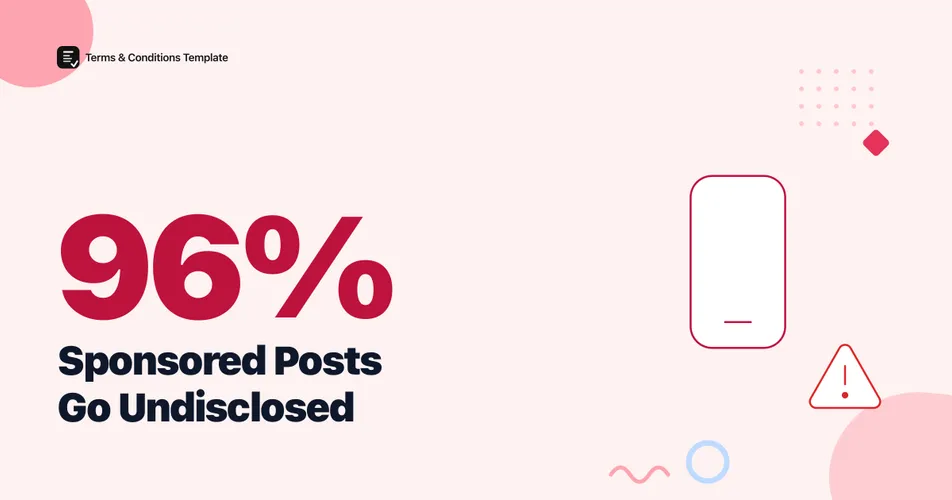
Most sponsored content online still is not labeled as an ad. A peer-reviewed 2025 study published in Marketing Science analyzed more than 100 million brand-related posts on Twitter/X from 268 brands between 2014 and 2021, and found that 96% of sponsored posts carried no disclosure. That figure is not a fringe estimate. It comes from a machine-classification method built specifically to detect sponsorship that influencers did not flag themselves.
The gap between what regulators require and what creators actually post is the throughline of the data below: disclosure rates that vary tenfold by country, an FTC that keeps sending warning letters instead of writing large checks, and engagement numbers that undercut the excuse that disclosure kills reach.
What share of influencer posts go undisclosed?
The clearest answer comes from Ershov, He, and Seiler’s study in Marketing Science (accepted December 2024, published March 2025), which classified sponsorship across more than 100 million Twitter posts from 268 brands spanning 2014 to 2021. The headline finding: 96% of posts the model identified as sponsored had no disclosure, with even a conservative lower-bound classification method still putting the undisclosed share at 82%.
Figure 1: Share of sponsored posts with no disclosure, upper-bound classification. Source: Ershov, He & Seiler, Marketing Science, 2025, n=100M+ posts, 268 brands.
The same paper found the undisclosed share barely moved over the seven-year window despite growing regulatory attention, and that undisclosed posts skew toward younger, larger-following brands rather than small or established ones. Disclosure on the platform that hosted this study remains the exception, not the norm.
How does Instagram disclosure data compare?
Instagram tells a similar story with a different magnitude. A 2024 multi-country longitudinal study by Bertaglia, Goanta, Spanakis, and Iamnitchi analyzed 1,006,253 posts from 400 creators across the US, Brazil, the Netherlands, and Germany, spanning October 2010 to September 2022. Only 3.45% of posts across the whole dataset carried an explicit sponsorship disclosure tag such as #ad or a platform partnership label.
Using a machine-learning classifier trained to detect sponsorship the creators themselves did not flag, the researchers identified an additional 123,600 posts, 12.3% of the entire dataset, as undisclosed ads. Combined, disclosed and undisclosed sponsored content together made up roughly 15.8% of all posts studied. That means for every post an audience could clearly identify as sponsored, more than three went unlabeled.
A creator posting sponsored content without a clear FTC-compliant disclosure is not just risking a platform strike; a written disclaimer covering sponsored and affiliate content closes the gap between what a post says and what the law expects a reasonable viewer to understand.
Does disclosure practice vary by country?
Sharply. The same Bertaglia et al. dataset breaks disclosure rates down by country and creator tier, and the spread is close to tenfold. German creators disclosed sponsorship at 18.16% of posts for micro-influencers and 14.70% for mega-influencers, the highest rates in the study. Dutch creators sat at the opposite end, disclosing just 1.44% (micro) and 1.06% (mega) of posts.
| Country | Micro-influencer disclosure rate | Mega-influencer disclosure rate |
|---|---|---|
| Germany | 18.16% | 14.70% |
| United States | 1.41% | 2.14% |
| Brazil | 1.22% | 3.25% |
| Netherlands | 1.44% | 1.06% |
Source: Bertaglia, Goanta, Spanakis & Iamnitchi, “Influencer Self-Disclosure Practices on Instagram,” 2024, n=1,006,253 posts, 400 creators.
Figure 2: Explicit sponsorship disclosure rate by country, micro-influencer tier. Source: Bertaglia et al., 2024, n=400 creators.
The authors tie Germany’s outlier rate directly to national legislation: Germany has pursued disclosure enforcement against creators more aggressively than the other three countries in the study, and the data shows it. Legal exposure, not platform policy, appears to be the strongest predictor of whether a creator bothers to disclose.
Is FTC enforcement actually catching undisclosed sponsorships?
Enforcement has escalated from broad warnings toward individual accountability, but actual monetary penalties against influencers themselves remain rare. In April 2023 the FTC sent letters to more than 700 companies generally, reminding them that deceptive endorsement practices could trigger civil penalties. In November 2023 it went further, sending warning letters directly to a dozen social media influencers and two trade associations, the American Beverage Association and the Canadian Sugar Institute, over posts promoting sugar and aspartame consumption without adequate disclosure of paid relationships.
Figure 3: The minimum disclosure test the FTC applies to a sponsored post. Source: FTC Endorsement Guides, 2023 update.
The financial stakes keep rising even without a wave of individual fines. The FTC’s maximum civil penalty tied to a Notice of Penalty Offenses violation increased from $51,744 in 2024 to $53,088 in 2025, adjusted annually for inflation, and the agency has stated each individual undisclosed post can be treated as a separate violation rather than one blanket penalty per campaign.
Figure 4: Inflation-adjusted maximum civil penalty per Notice of Penalty Offenses violation. Source: FTC Federal Register notices, 2024 and 2025.
Warning
The FTC has not yet imposed a large individual civil penalty on a single influencer for a first-time disclosure failure; the November 2023 letters and the broader 2023 sweep were warnings, not fines. Treat the per-violation dollar figure as the ceiling regulators have reserved for repeat or willful violations, not a typical outcome, and expect this to shift if the agency escalates enforcement in 2026 and beyond.
Does disclosure actually hurt engagement?
The evidence says no, or at most marginally. Bertaglia et al.’s 2024 Instagram data found disclosed sponsored posts averaged 56,300 engagements across the four countries studied, compared to 52,000 for undisclosed sponsored posts, a gap of roughly 8%. Sponsored posts of any kind underperform organic posts on average, but adding a clear disclosure on top of an already-sponsored post did not meaningfully compound that drop.
Figure 5: Key research and enforcement milestones shaping today’s disclosure data. Sources: FTC press releases; Marketing Science, 2025; Bertaglia et al., 2024.
That finding removes the most common excuse creators give for skipping disclosure. If a clear “#ad” or paid-partnership label cost meaningful reach, the incentive to hide it would be obvious. The data says the actual engagement cost is small enough that legal exposure, not audience reaction, should be the deciding factor.
The Bottom Line
The two largest disclosure studies available, a 100-million-post peer-reviewed Twitter analysis and a million-post four-country Instagram dataset, land on the same conclusion from different angles: most sponsored content online is still not labeled as sponsored. Ershov, He, and Seiler’s 96% undisclosed figure and Bertaglia et al.’s 12.3% machine-detected undisclosed rate measure different platforms and different eras, but neither supports the idea that disclosure has become routine. Country-level enforcement, like Germany’s, moves the needle far more than platform-native disclosure tools do. For any business running an affiliate program or paying creators, a clear, current disclaimer covering sponsored content and material connections is the cheapest insurance available against a growing per-violation penalty and a regulator that has already shown it is willing to name names.
Frequently Asked Questions
What percentage of sponsored influencer posts are not disclosed? 96% of sponsored posts in a peer-reviewed study of over 100 million brand-related tweets from 268 brands (2014-2021) carried no disclosure, per Ershov, He, and Seiler, published in Marketing Science (2025). A separate 2024 Instagram study found a lower but still substantial 12.3% undisclosed rate using machine-detected sponsorship across a million-post dataset.
How many influencers has the FTC warned about disclosure violations? In November 2023 the FTC sent warning letters to a dozen social media influencers and two trade associations over inadequate sponsorship disclosures, and in April 2023 it sent letters to more than 700 companies generally over deceptive endorsement practices.
What is the maximum FTC penalty for an undisclosed sponsorship? The FTC’s maximum civil penalty for violations tied to its Notice of Penalty Offenses rose to $53,088 per violation in 2025, up from $51,744 in 2024, with each individual undisclosed post potentially counted as a separate violation.
Does disclosing a sponsorship actually hurt engagement? Not meaningfully. A 2024 multi-country Instagram study found disclosed sponsored posts averaged 56,300 engagements versus 52,000 for undisclosed sponsored posts, meaning disclosure did not measurably reduce audience response.
Sources and References
- Ershov, He & Seiler. (2025). “How Much Influencer Marketing Is Undisclosed? Evidence from Twitter.” Marketing Science, Vol. 44, Issue 3, pp. 505-515. n=100M+ posts, 268 brands, 2014-2021.
- Bertaglia, Goanta, Spanakis & Iamnitchi. (2024). “Influencer Self-Disclosure Practices on Instagram: A Multi-Country Longitudinal Study.” n=1,006,253 posts, 400 creators, US/Brazil/Netherlands/Germany, 2010-2022.
- Federal Trade Commission. (2023). “FTC Warns Two Trade Associations and a Dozen Influencers About Social Media Posts Promoting Consumption of Aspartame or Sugar.” Official press release.
- Federal Trade Commission. (2025). “FTC Publishes Inflation-Adjusted Civil Penalty Amounts for 2025.” Official press release.
- Federal Trade Commission. “Disclosures 101 for Social Media Influencers.” FTC business guidance.
Note: All figures verified as of July 2026. Disclosure rates and enforcement posture shift as new studies and FTC actions are published, so headline figures here are refreshed at least twice a year.

![$68.6B: Amazon Advertising 2026 [Spend Data]](/_astro/amazon-advertising-2026.DFxB0rDi_1ebTR.webp)

![Amazon Affiliate Rate Falls to 10% in 2026 [Full List]](/_astro/commission-programs-2026.DvBRm6Oc_Z44gbJ.webp)