California’s AI Transparency Act, known as CAITA, became operative on August 2, 2026. The law was originally supposed to take effect on January 1, 2026, but the California State Assembly delayed it in 2025 to give covered companies more runway, and to line the compliance clock up closer to the EU AI Act’s own transparency enforcement timeline. As of this week, the delay is over: the first wave of disclosure and detection requirements is now live law, not a future deadline.
CAITA does not touch most website owners directly. It targets large generative AI providers, not the businesses that use their tools. But if your site publishes AI-generated images, video, voiceovers, or synthetic media, and especially if you use tools built by a covered provider, this law changes what disclosures now travel with that content, and it is worth understanding exactly who it binds before assuming it does not apply to you.
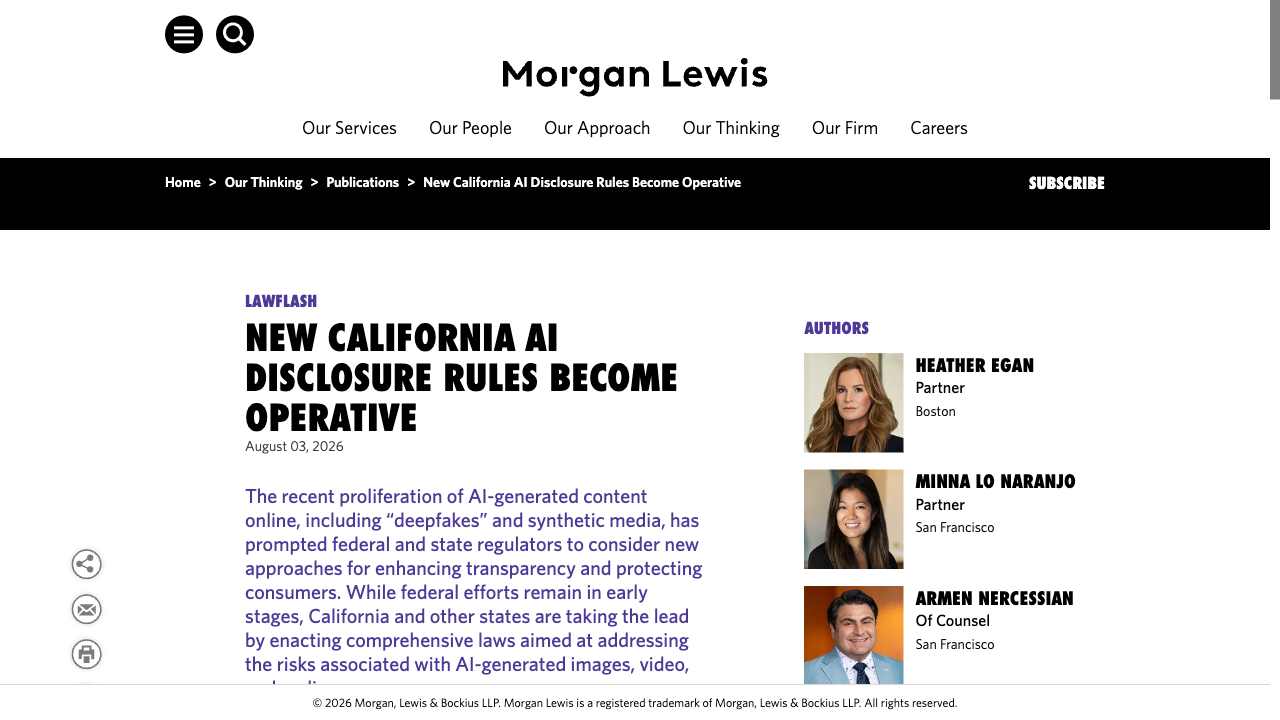
Source: Morgan Lewis, “New California AI Disclosure Rules Become Operative”, captured August 2026.
What actually took effect on August 2
CAITA, enacted in 2024 as SB 942 and substantially amended in 2025 by AB 853, imposes three core obligations on what the statute calls “covered providers”: companies that create, code, or otherwise produce a generative AI system with more than one million monthly visitors or users that is publicly accessible in California.
Figure: The civil penalty CAITA sets for each violation, with every day of continued noncompliance counted as a separate violation.
Covered providers must now offer, at no cost, a publicly accessible AI detection tool that lets anyone upload content, submit a URL, or query an API to check whether that image, video, or audio was created or altered by the provider’s system. They must offer users the option to add a “manifest disclosure,” a visible label identifying the content as AI-generated, conspicuous and, to the extent technically feasible, permanent or extraordinarily difficult to remove. And they must embed a “latent disclosure,” machine-readable metadata baked into the file itself, in every piece of AI-generated image, video, or audio content their system produces, whether or not the user opted into the visible label.
The law reaches licensees too. A covered provider that licenses its generative AI system to a third party has to contractually require that licensee to preserve the latent disclosure capability, and if the provider learns a licensee has stripped it out, it has 96 hours to revoke that license.
Who this actually binds, and who it does not
The one-million-monthly-user threshold is the detail most coverage glosses over, and it is the one that determines whether any of this touches your business directly. CAITA’s first wave of obligations sits entirely on the shoulders of large generative AI providers, the companies building the image, video, and audio generation tools, not the businesses or individuals using them.
| Entity | Bound by CAITA’s August 2026 requirements? |
|---|---|
| A generative AI provider with 1M+ monthly CA users (image/video/audio tools) | Yes, directly |
| A small or mid-size business using a covered provider’s AI tool to generate marketing images or video | No direct obligation, but content may now carry the provider’s disclosures |
| A blog or e-commerce site publishing AI-generated product photos or graphics | No direct obligation under CAITA itself |
| A licensee of a covered provider’s generative AI system | Bound by contract to preserve latent disclosures, not by CAITA directly |
| Text-only AI content (blog posts, product copy, chatbot replies) | Outside CAITA’s scope entirely; the law covers image, video, and audio only |
That narrow scope is a real and deliberate design choice, not a loophole. The legislature built CAITA to regulate the handful of platforms with the reach to make deepfakes and synthetic media a mass problem, not to impose a labeling mandate on every business that generates a product photo with an AI tool. Two more waves are still coming: starting January 1, 2027, large online platforms have to detect and surface embedded provenance data, and generative AI hosting platforms can no longer knowingly distribute systems that skip the latent disclosure requirement. From January 1, 2028, manufacturers of cameras, microphones, and other capture devices sold in California have to let users add CAITA disclosures to captured content by default. If your business fits any of those later categories, the runway is still open, but it is closing on a fixed schedule.
What this means for your disclaimer, practically
Even a business with no direct CAITA obligation has a reason to look at this law: it changes what “using AI content responsibly” looks like to a California visitor, and a disclaimer is where that gets communicated. If your site uses AI-generated images, video, or voiceovers, whether from a covered provider’s tool or not, three things are worth addressing in your AI content disclosure:
Say plainly whether any images, video, or audio on your site were created or substantially altered with generative AI tools, and roughly how you use them (illustrations, product mockups, marketing video, and so on). This is good practice independent of CAITA, but the law’s public awareness push makes readers more likely to ask.
If you use a covered provider’s tool, that content may now carry a visible label or embedded metadata you did not add yourself. Your disclaimer does not need to explain CAITA’s mechanics, but it should not contradict what a reader can now verify for themselves with a provider’s free detection tool.
Keep the disclosure current as your AI tool stack changes. A disclaimer written before a business adopted AI-generated visuals, or one that has not been touched since, is the kind of gap CAITA’s public detection tools make easier for a visitor, or a journalist, to notice.
Bottom line
CAITA’s August 2 deadline is a story about a small number of large generative AI companies, not a new labeling mandate for the businesses that use their tools. But it is a useful trigger to check whether your own AI-content disclosure still matches reality. If your site publishes AI-generated images, video, or audio and your disclaimer has not been updated to say so, our Disclaimer Generator can help you add clear AI-content disclosure language alongside the rest of your site’s liability and accuracy disclaimers.
The information in this article is for informational purposes only and should not be construed as legal advice on any matter, and does not create an attorney-client relationship.

![$68.6B: Amazon Advertising 2026 [Spend Data]](/_astro/amazon-advertising-2026.DFxB0rDi_1ebTR.webp)

![Amazon Affiliate Rate Falls to 10% in 2026 [Full List]](/_astro/commission-programs-2026.DvBRm6Oc_Z44gbJ.webp)