Nearly 57% of full-time content creators earn less than $44,000 a year, the US living-wage benchmark used in the Creator Earnings Report published by NeoReach and Influencer Marketing Hub in July 2026, based on a survey of over 3,000 creators with a combined 1.1 billion followers. The platforms themselves report record payout totals, YouTube alone says it has paid creators over $100 billion in four years, but that money concentrates hard. Below is a platform-by-platform look at who actually captures it.
If you run a channel, a podcast, or a paid subscription of any kind, the numbers below cover what creators earn across the biggest platforms, how that income has grown or stalled, and the disclosure obligations that apply the same way whether a creator makes $500 or $500,000 a year.
How much does the average creator actually make?
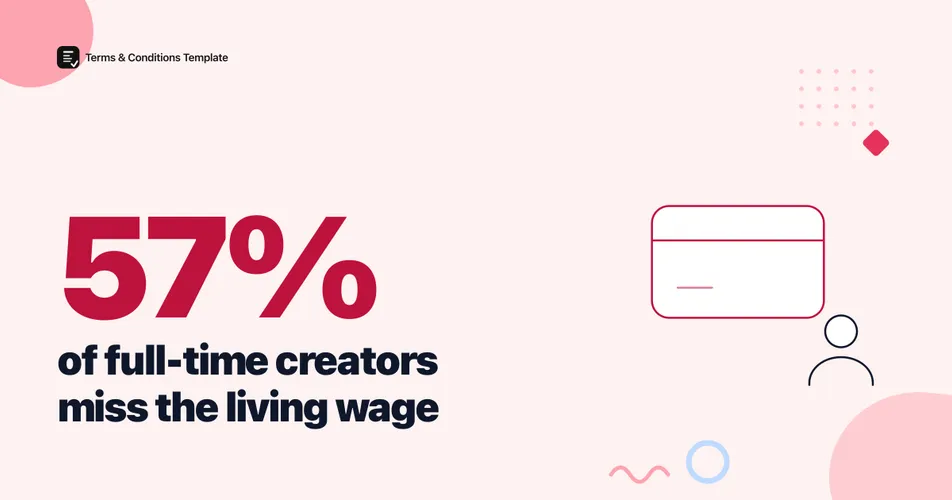
Most creators fall well short of a full-time living. The Creator Earnings Report found that over 50% of all surveyed creators, including part-time and hobbyist creators, earn under $15,000 a year, up two percentage points from 48% in 2023. Narrow that to full-time creators only, and nearly 57% still earn less than the $44,000 benchmark the report uses for a US living wage.
Figure 1: Share of full-time creators earning below the $44,000 US living-wage benchmark. Source: NeoReach / Influencer Marketing Hub, Creator Earnings Report, published July 2026, n=3,000+ creators.
The report identifies roughly $15,000 a year as a “monetization barrier,” a point after which income tends to accelerate rather than climb steadily. Creators who own a product line or brand average close to $100,000 a year, and those who rank financial gain as their top priority average over $132,000, more than double the income of creators who describe themselves as primarily passion-driven. Owning something beyond a single platform’s ad-share program is the clearest split between the 57% below the line and everyone above it.
Which platform pays creators the most?
Income varies sharply by platform, and not just because audience sizes differ. The same 2025/2026 Creator Earnings Report found Instagram shows the highest average creator income of any platform surveyed, though that average is pulled upward by a small number of very high earners rather than reflecting a typical Instagram creator’s pay. YouTube shows a larger share of higher-earning creators than TikTok, while TikTok carries the heaviest concentration of creators in the lowest income brackets among the platforms the report compares.
Figure 2: Three annual income reference points from the same report: the living-wage benchmark most full-time creators fall under, the average among creators who own a business or brand, and the average among creators who rank financial gain as their top priority. Source: NeoReach / Influencer Marketing Hub, Creator Earnings Report, 2025/2026 data.
YouTube’s own disclosures put a number on the platform’s total flow of money without settling the “who gets it” question. YouTube CEO Neal Mohan wrote in his January 2026 letter that the platform has paid over $100 billion to creators, artists, and media companies in the past four years, but only about 3 million of YouTube’s roughly 115 million channels are monetized under the YouTube Partner Program, a monetization rate of about 2.6%. A creator who never disclosed a paid partnership properly could lose access to that program entirely on top of any FTC exposure, which is one reason a disclaimer covering sponsored and affiliate content is worth having in place before a brand deal closes, not after a platform strike arrives.
The same earnings-inequality pattern shows up across the wider creator economy beyond any single platform; see our breakdown of creator economy market size and earnings for how the individual numbers here compare against the roughly $250 billion to $480 billion market-size estimates researchers use for the industry as a whole.
How has Patreon’s creator payout grown over time?
Patreon is a useful case study because the platform has disclosed annual payout totals for nearly a decade. Platform-wide creator payouts grew from $150 million in 2017 to $300 million in 2018, $500 million in 2019, $800 million in 2020, and roughly $2 billion in 2025, a more than 13-fold increase over eight years, according to Patreon’s own company statements and Graphtreon’s tracking data.
Figure 3: Patreon’s total annual creator payouts, platform-wide, 2017 to 2025. Source: Patreon company disclosures and TechCrunch reporting, compiled by Backlinko via Graphtreon data.
Growth has flattened more recently than the multi-year chart suggests. Graphtreon’s monthly tracking put Patreon’s total creator payouts at $23.97 million in January 2026, essentially flat against $24.14 million in January 2025. Meanwhile the number of creators with at least one paying member reached 286,287 as of February 2026, up roughly 114% from February 2021, according to Graphtreon. More creators are splitting a payout pool that has stopped growing month over month, even as the multi-year total keeps climbing.
Patreon in Four Numbers
How does Substack’s revenue split compare?
Substack takes a different approach than an ad-share or tip-based model: writers keep 90% of subscription revenue, with Substack taking the remainder to cover payment processing and platform costs. The platform reports more than 5 million paid subscriptions across all its newsletters combined, according to Substack’s own current published figures. Substack does not disclose an aggregate total paid to writers or a median per-writer income, which is itself a data gap worth naming plainly rather than filling with a guess.
A subscription-revenue model still carries the same disclosure obligations as an ad-share one whenever a newsletter runs sponsored content or affiliate links alongside its paid tier. That overlap is common enough among mid-size newsletters that treating disclosure as an ad-platform-only concern misses a real share of where creator income and legal exposure actually meet.
Audio creators sit in a similar position. Most of the roughly 4.69 million podcasts that exist in 2026 are not earning meaningful money at all, since only about 10% of indexed shows are still actively releasing episodes, but the shows that do run sponsor reads carry the identical FTC disclosure obligation covered below.
What legal risk comes with undisclosed sponsored content, at any income level?
Roughly 49% of surveyed creators say brand deals make up most of their income, down from a higher share in 2023 as ad revenue and self-owned business income pick up ground, per the Creator Earnings Report. Whatever the income split, the FTC’s disclosure rule does not scale with earnings: a creator making $500 from one brand deal carries the same disclosure obligation as one running six-figure sponsorship contracts.
Figure 4: The disclosure test that applies to any creator income source, regardless of platform or earnings level. Source: FTC Endorsement Guides, 2025 penalty adjustment.
| Income source | Share of creators relying on it most | Disclosure obligation |
|---|---|---|
| Brand deals / sponsorships | 49% (down from a higher 2023 share) | Material connection disclosure required |
| Ad revenue share (platform payouts) | Rising share since 2023 | No disclosure required for the payout itself |
| Owned products / brand | Reported among the ~45% who own a business | Standard consumer-protection rules apply to the product |
| Affiliate links | Not separately broken out in the 2026 report | Material connection disclosure required |
Source: NeoReach / Influencer Marketing Hub, Creator Earnings Report, 2025/2026; FTC Endorsement Guides.
Figure 5: Dated creator-payout and earnings-report milestones across the platforms covered in this article. Sources: Patreon company disclosures, YouTube CEO letters, NeoReach / Influencer Marketing Hub.
The pattern across every platform above is the same shape even though the dollar figures differ: a growing total payout pool, concentrated among a small share of creators, sitting next to a much larger group still below a basic living-wage line. Broader independent-work trends, including gig-economy income patterns outside the content-creation space specifically, show a similar concentration effect, though that comparison deserves its own dedicated data rather than a passing mention here.
How do the platforms compare side by side?
| Platform | Headline earnings signal | Scale | Data year |
|---|---|---|---|
| Full-time creators overall | 57% earn under $44,000 (US living wage) | 3,000+ creators surveyed, 1.1B+ combined followers | 2025/2026 |
| YouTube | $100B+ paid to creators in the past 4 years; ~2.6% of channels monetized | ~115 million channels, ~3 million monetized | 2024-2026 |
| Patreon | Annual payouts grew from $150M (2017) to $2B (2025) | 286,287 creators with a paying member (Feb 2026) | 2017-2026 |
| Substack | Writers keep 90% of subscription revenue | 5 million+ paid subscriptions platform-wide | 2026 |
The Bottom Line
Every platform in this data tells the same two-part story: a headline payout number that keeps growing, and a distribution of that money that leaves most individual creators well short of a living wage. YouTube’s $100 billion and Patreon’s climb from $150 million to $2 billion a year are both real and both true at the same time as 57% of full-time creators earning under $44,000. None of that changes what a creator owes the FTC once a paid partnership is involved. Whether a channel makes $500 a month or $50,000, the disclosure standard, and the penalty for skipping it, is identical.
Frequently Asked Questions
What percentage of full-time creators actually earn a living wage? Nearly 57% of full-time creators earn less than $44,000 a year, the US living-wage benchmark used in the NeoReach / Influencer Marketing Hub Creator Earnings Report, published July 2026 from a survey of 3,000+ creators with 1.1 billion combined followers.
Which platform pays creators the most? Instagram shows the highest average creator income, though the figure is pulled upward by a small number of top earners, per the 2025/2026 Creator Earnings Report. YouTube has paid over $100 billion to creators, artists, and media companies in the past four years, but only about 3 million of its roughly 115 million channels are monetized.
How much has Patreon’s creator payout grown over time? Patreon’s platform-wide annual creator payouts grew from $150 million in 2017 to $2 billion in 2025, more than a 13-fold increase, according to Patreon’s own company disclosures and Graphtreon’s tracking data.
Do low-earning creators still have to disclose sponsored content? Yes. The FTC’s Endorsement Guides apply the same disclosure standard regardless of income, and the maximum civil penalty for a deceptive endorsement is $53,088 per violation, a ceiling set in a January 2025 Federal Register adjustment and unchanged for 2026.
Sources and References
- NeoReach / Influencer Marketing Hub. Creator Earnings Report. Published July 2026. Survey of 3,000+ creators, 1.1B+ combined followers.
- YouTube / Neal Mohan. (2026). “The Future of YouTube,” CEO letter for 2026. Official YouTube Blog.
- Fortune, reporting Neal Mohan’s 2024 letter on YouTube Partner Program monetized channel count.
- Backlinko, citing Graphtreon tracking data and Patreon/TechCrunch company disclosures. Patreon creator count and annual/monthly payout figures, 2017-2026.
- Substack. “About Substack.” Official platform page; revenue share and paid subscription totals as published.
- Federal Trade Commission. (2025). “FTC Publishes Inflation-Adjusted Civil Penalty Amounts for 2025.” Official FTC press release.
Note: All figures verified as of September 2026. Patreon’s monthly and creator-count figures come from Graphtreon’s continuously updated dashboard rather than a fixed report and should be re-checked before each refresh. Platform payout and monetization figures shift with policy changes, so headline figures here are scheduled for review at least twice a year.
![$68.6B: Amazon Advertising 2026 [Spend Data]](/_astro/amazon-advertising-2026.DFxB0rDi_1ebTR.webp)


![Amazon Affiliate Rate Falls to 10% in 2026 [Full List]](/_astro/commission-programs-2026.DvBRm6Oc_Z44gbJ.webp)