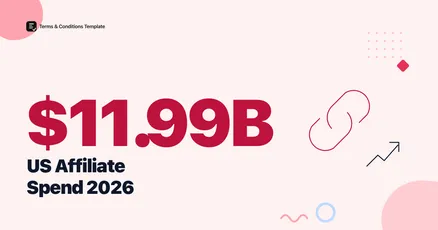
Affiliate links convert at just 0.5% to 1% on average, according to Awin, one of the internet’s largest affiliate networks. That is the quiet reality behind a channel where US spend is projected to reach $13.81 billion in 2026, per eMarketer: most clicks on an affiliate link still do not turn into a sale.
The gap between how much money moves through affiliate programs and how rarely an individual click converts is the story the data below tells, alongside where commission rates land, which publisher types are capturing the growth, and what the FTC expects an affiliate link to disclose before a reader ever clicks it.
What is the average click-through rate for affiliate links?
A click-through rate of around 1.9% is typical for an affiliate link across industries, according to Awin’s own published guidance for brands running affiliate programs. That means for roughly every 1,000 people who see a link, button, or recommendation pointing to an affiliate offer, about 19 click through to the merchant’s site.
Figure 1: Average affiliate link click-through rate. Source: Awin, industry benchmark guidance.
CTR on an affiliate link behaves less like a search or display ad metric and more like a referral metric: it depends heavily on how much trust the publisher has already built with an audience before the link ever appears. A product review embedded in an article a reader sought out performs very differently from a banner ad or a coupon-site listing, even though both technically count as affiliate traffic in aggregate reporting.
Awin does not publish a disclosed sample size behind the 1.9% figure, so treat it as directional guidance from a major network’s own book of business rather than an independently audited study. It remains one of the only concrete CTR benchmarks a working affiliate network has put a number on.
What percentage of affiliate link clicks actually convert into sales?
Only 0.5% to 1% of affiliate link clicks are considered average by Awin’s own conversion benchmark, meaning most people who click through to a merchant’s site leave without buying anything. On a typical run of 1,000 clicks, that puts a normal outcome somewhere between 5 and 10 completed sales.
Warning
Comparative conversion-rate-by-channel figures circulating online vary enormously depending on whether they measure clicks-to-purchase on the merchant’s site, a publisher’s own tracked link performance, or a network-wide blended average, and few disclose their methodology. The most detailed public multi-channel breakdown we could locate, Custora’s Q3 2016 E-Commerce Pulse report, found affiliate traffic converted at 11.4% of orders, well behind organic search (21.8%), paid search (19.9%), and email (19.8%), though still ahead of social (2.1%) and display (0.9%). That data is a decade old and channel mixes have shifted since, so treat the ranking as a historical signal rather than a current 2026 benchmark.
The pattern that holds across both the old and new data is consistent: affiliate clicks convert at a real but modest rate, and the channel’s value comes from volume and low acquisition cost rather than a high per-click hit rate.
How much is being spent on affiliate marketing in 2026?
US affiliate marketing spend is projected to reach $13.81 billion in 2026, up 11.3% from $12.42 billion in 2025, according to eMarketer. That spend is expected to generate an estimated $241.03 billion in US ecommerce sales this year, a figure that captures purchases eMarketer attributes at least partly to an affiliate or partner link somewhere in the path to checkout.
Figure 2: US affiliate marketing spend, 2025 vs 2026. Source: eMarketer, 2026 forecast.
Growth at that pace outstrips overall US retail ecommerce growth, which eMarketer puts at 6.7% for the same period, so affiliate is capturing a larger share of the marketing budget even as ecommerce as a whole keeps expanding. None of that spend growth changes the click-level math above: more dollars are moving through the channel, but each individual click still converts at roughly the same modest rate it always has.
What return do brands get from affiliate programs?
Affiliate marketing returns about $13 for every $1 a brand invests, based on survey data Awin ran with Forrester among senior marketers already running affiliate programs. That is a strong headline ROI figure, though it reflects brands that have already built a working program rather than the average outcome for someone launching one from zero.
Figure 3: Affiliate marketing growth and platform milestones. Sources: FTC, Amazon Associates Central, Awin via eMarketer.
Scale on the supply side backs up the demand-side enthusiasm. Awin alone now hosts more than 1 million affiliates on its network, and over 20,000 influencers joined the platform in 2023 alone, per eMarketer’s reporting on Awin’s own platform figures. That combination, rising spend, a reported double-digit ROI, and a fast-growing pool of publishers, explains why affiliate marketing keeps expanding even though individual click-through and conversion rates have not meaningfully improved.
What are typical affiliate commission rates?
Commission rates vary more by product category than almost anything else in affiliate marketing. Amazon Associates, the affiliate program most publishers join first, pays standard commissions of 1% to 10% depending on category, with a small number of categories like Amazon Games paying as much as 20%, according to Amazon’s own published rate table.
| Program type | Typical commission | Source |
|---|---|---|
| Amazon Associates, most categories | 1% to 10% | Amazon Associates Central |
| Amazon Associates, top categories | up to 20% | Amazon Associates Central |
| SaaS / subscription, first-year (median) | around 22.5% | Aggregated network data |
| Ecommerce, order value (median) | around 8.4% | Aggregated network data |
Subscription and software programs sit at the opposite end of the spectrum. Aggregated data compiled across several of the largest affiliate networks puts the median SaaS first-year commission at around 22.5% of revenue, often paid on a recurring basis for as long as the referred customer stays subscribed, compared with a median of roughly 8.4% of order value for standard ecommerce programs.
Figure 4: Median affiliate commission rate, SaaS vs ecommerce. Source: aggregated affiliate network data.
Warning
The SaaS and ecommerce median figures above come from a secondary compilation of major network data rather than a single network’s own published rate card, and no network publishes one unified commission table across the industry. Treat them as a reasonable directional split between low-margin physical goods and higher-margin subscription products, not a precise industry-wide average.
The gap matters for how a publisher builds a business: a link to a $30 physical product at a 5% commission pays out $1.50 once, while a link to a $50-a-month SaaS subscription at 20% recurring pays $10 a month for as long as the customer stays, which is a major reason high-traffic affiliates increasingly favor software and subscription offers even when the underlying click-through rate looks similar to a retail product link.
Which publisher types are capturing affiliate revenue growth?
Cashback, loyalty, and rewards platforms captured about 35% of US affiliate ad spend in 2024, more than any other publisher category, according to eMarketer. Content publishers, meaning sites and creators who write reviews, roundups, and recommendations, accounted for a smaller 16% of spend over the same period, while technology and integration partners have grown from about 5% of budgets in 2021 to roughly 7% today.
Figure 5: Share of 2024 US affiliate ad spend by publisher type. Source: eMarketer.
Discount and coupon publishers are the fastest-growing category on a revenue basis: they generated 42.4% of US affiliate revenue in the first half of 2025, up from 39.7% a year earlier, per eMarketer. Every one of these publisher types, cashback sites, coupon codes, and content reviews alike, earns a commission on the same click a reader makes, which means every one of them carries the same FTC disclosure obligation regardless of format.
Creator-driven affiliate revenue is growing too. On Awin’s network specifically, the share of revenue attributable to creators rose from 15.9% to 19.5% year over year. Repetition appears to help creator-driven clicks in particular: eMarketer reports that YouTube creators who mention the same affiliate product across multiple videos see click-through rates rise by a factor of 1.8 by the eighth integration compared with the first, evidence that an audience needs to see a recommendation more than once before it converts into a click. Our native advertising spend data covers a related shift, sponsored and native placements pulling budget away from standard display in a similar pattern.
Do affiliate links need an FTC disclosure?
Yes. Any affiliate link that pays a commission counts as a material connection under the FTC’s Endorsement Guides, and that connection has to be disclosed clearly and conspicuously, near the link itself, not buried in a footer or an about page a reader is unlikely to find. The requirement applies whether the link sits in a blog post, a video description, or a single social media caption.
Figure 6: The FTC’s basic disclosure test for an affiliate link. Source: FTC Endorsement Guides, applied to affiliate link placement.
The same standard covers influencer posts that include an affiliate or referral link rather than a flat sponsorship fee, which is the subject of our influencer disclosure data, where the majority of sponsored posts still fail to disclose clearly. A short, plain-language disclaimer you can generate for your own affiliate content and place near every link is the fastest way to close that gap, and it costs little next to the revenue a working affiliate program can generate.
Affiliate link performance at a glance
| Metric | Value | Year | Source |
|---|---|---|---|
| Average affiliate link CTR | around 1.9% | 2025 | Awin |
| Average affiliate link conversion rate | 0.5% to 1% | 2025 | Awin |
| US affiliate marketing spend | $13.81B, +11.3% YoY | 2026 | eMarketer |
| Affiliate-driven US ecommerce sales | $241.03B | 2026 | eMarketer |
| Reported affiliate program ROI | $13 per $1 spent | n/a | Awin / Forrester |
The Bottom Line
The affiliate marketing numbers for 2026 tell two different stories depending on which layer you look at. At the channel level, spend is growing fast, on track for $13.81 billion in the US this year, reported ROI comes in around $13 for every $1 spent, and the publisher base keeps expanding. At the individual click level, almost nothing has changed: a click-through rate near 1.9% and a conversion rate of 0.5% to 1% describe an affiliate link today about as well as they would have described one a few years ago. Neither number is a reason to avoid the channel, low individual conversion is normal for referral-style traffic, but it is a reason to build volume and disclosure discipline into a program rather than expecting a handful of links to carry a business. A conspicuous, accurate disclaimer on every affiliate placement protects the modest share of clicks that do convert from turning into a regulatory problem instead of a sale.
Frequently Asked Questions
What is the average click-through rate for affiliate links? Awin, one of the largest affiliate networks, considers a click-through rate of around 1.9% typical for affiliate links across industries, though it varies widely by niche, placement, and traffic source.
What percentage of affiliate link clicks actually convert into sales? Awin considers conversion rates of 0.5% to 1% average for affiliate links, meaning roughly 1 in 100 to 1 in 200 clicks becomes a completed sale.
How much is spent on affiliate marketing in 2026? US affiliate marketing spend is projected to reach $13.81 billion in 2026, up 11.3% from $12.42 billion in 2025, according to eMarketer, generating an estimated $241.03 billion in US ecommerce sales.
What commission rate do affiliate programs typically pay? Amazon Associates pays 1% to 10% on most categories and up to 20% on a handful of categories, according to Amazon’s own rate table, while SaaS and subscription programs commonly pay a median of around 22.5% of first-year revenue, often as a recurring commission.
Sources and References
- Awin. “How to Use Affiliate Marketing to Drive Low-Cost Conversions for Your Brand.” Network benchmark guidance citing average CTR (1.9%) and conversion rate (0.5% to 1%).
- eMarketer. (2026). “FAQ on Affiliate Marketing: How AI and Creators Are Reshaping the Channel in 2026.” US affiliate spend, ecommerce sales generated, and publisher category shares.
- eMarketer, featuring Awin and Forrester survey data. “How Affiliate Marketing Is Ushering in a New Era.” The $13-per-$1 ROI figure and Awin’s affiliate and influencer platform totals.
- Econsultancy, reporting on Custora’s Q3 2016 E-Commerce Pulse Report. Historical multi-channel conversion rate comparison.
- Amazon Associates Central. Standard Commission Income Statement, official rate table by product category.
- Digital Applied. (2026). Aggregated SaaS and ecommerce median commission rate compilation across major affiliate networks.
- Federal Trade Commission. (2023). “FTC Announces Updated Advertising Guides to Combat Deceptive Reviews and Endorsements.” Official Endorsement Guides disclosure standard.
Note: All figures verified as of October 2026. Affiliate spend forecasts, network commission tables, and publisher-category shares change with each platform update, so headline figures here are refreshed at least twice a year.