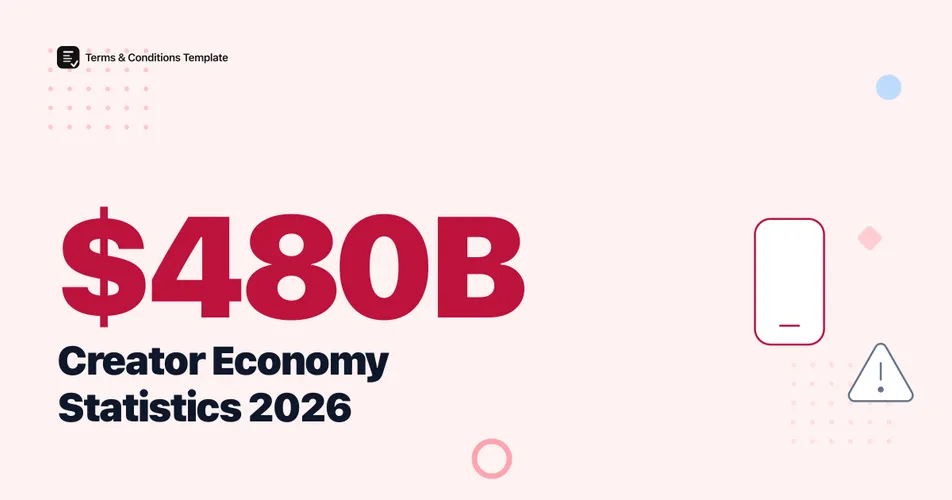
The creator economy’s total addressable market could nearly double from roughly $250 billion today to $480 billion by 2027, according to Goldman Sachs Research’s 2025 analysis. That headline growth number sits uneasily next to the individual reality: more than half of working creators still earn under $15,000 a year. Both numbers are true at once, and the gap between platform-level growth and creator-level income is the real story behind the 2026 data.
If you create content, sell products through creator partnerships, or run a business that pays influencers, the numbers below cover market size, platform payouts, earnings distribution, and the disclosure rules that come with getting paid to talk about a product.
How big is the creator economy in 2026?
Estimates vary by a wide margin because research firms define “creator economy” differently, some counting only direct creator monetization and others including the surrounding ad-tech, platform, and tooling infrastructure. Goldman Sachs Research’s 2025 report frames its figure as a total addressable market: roughly $250 billion currently, projected to reach $480 billion by 2027. Separate 2026 market-sizing reports from Grand View Research and Research and Markets put the narrower creator economy market between $310 billion and $323 billion for 2026 alone.
The scale difference matters when you cite a number. A platform-infrastructure estimate and a direct-creator-monetization estimate are not measuring the same thing, even when both get labeled “creator economy.”
Warning
Treat any single “creator economy is worth $X” figure with caution unless the source states its scope. Estimates for 2025 and 2026 alone range from $160 billion to over $250 billion across different research firms, driven entirely by differences in what counts as creator economic activity, not by disagreement over the underlying data.
Whichever scope a report uses, the growth direction is consistent: every major estimate shows continued year-over-year expansion into 2027.
How much does the average creator actually earn?
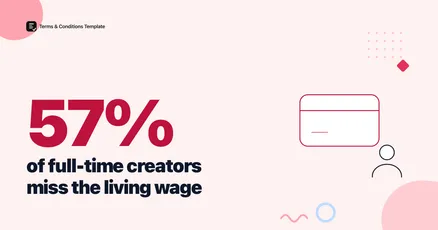
Most individual creators earn far less than the market-size headlines suggest. The 2025 Creator Earnings Report from NeoReach and Influencer Marketing Hub, based on a survey of more than 3,000 creators representing over 1.1 billion combined followers, found that over 50% of creators earn under $15,000 annually, up two percentage points from 48% in 2023. Among full-time creators specifically, nearly 57% earn below the report’s $44,000 US living-wage benchmark.
Figure 1: Creators earning under the $15,000 monetization threshold, by survey year. Source: NeoReach / Influencer Marketing Hub, 2025 Creator Earnings Report, n=3,000+ creators.
The same report identifies a “monetization barrier” around the $15,000 mark, after which creator income tends to accelerate. Creators who own their own product line average close to $100,000 a year, and those who name financial gain as their top priority average over $132,000, showing that income above the barrier concentrates among creators who diversify beyond ad-share payouts into products, brand deals, and subscriptions.
Median earnings sit far below the average, since a small number of top creators pull the mean upward. A written disclaimer covering sponsored content and affiliate relationships becomes more important, not less, at every income level, since FTC disclosure obligations apply the same way to a creator earning $500 a month as to one earning $500,000.
How many creators are actually monetized?
Most people who post content are not earning from a platform’s built-in monetization program. YouTube CEO Neal Mohan stated in a 2024 letter that 3 million channels are monetized under the YouTube Partner Program, against a platform total of roughly 115 million channels, meaning fewer than 3% of all YouTube channels currently qualify for ad-revenue sharing. In his January 2026 letter, Mohan disclosed that YouTube has paid over $100 billion to creators, artists, and media companies in the past four years.
Figure 2: Share of YouTube’s roughly 115 million channels monetized under the YouTube Partner Program. Source: YouTube CEO Neal Mohan’s 2024 letter; total channel count per Social Blade-derived estimates.
Patreon shows a similar concentration pattern on a smaller platform. 286,287 creators had at least one paying member as of February 2026, per Graphtreon’s tracking data, and Patreon’s own reporting states creators have earned over $10 billion lifetime on the platform, with more than $2 billion paid out annually as of 2025.
Warning
Graphtreon’s creator and payout counts are pulled from a continuously updated dashboard, not a fixed annual report. Treat the exact figures above as accurate as of February 2026, subject to change on Patreon’s own reporting cadence.
Monetization eligibility, not follower count alone, is the real gate most creators run into before they see any of the market-size numbers above.
How does creator income compare to the broader freelance and independent-work economy?
Creators sit inside a larger population of independent workers, and the closest disclosed baseline for that broader group comes from Upwork’s Freelance Forward research. Upwork’s own 2024 investor release states that 64 million Americans freelanced in 2023, contributing an estimated $1.27 trillion to the US economy. Follow-up Upwork research for 2025 and 2026 shows the freelance share of the US workforce continuing to climb, reported at 35% in 2025 and 39% in 2026, though these later year-over-year figures come from Upwork’s own workforce index rather than the disclosed-methodology Freelance Forward series and should be read as directional.
Figure 3: Freelance share of the US workforce. Source: Upwork Freelance Forward (2023 data) and Upwork Future Workforce Index (2025, 2026 data).
The overlap between “freelancer” and “creator” is not cleanly measured by any single source, since a creator who also does brand consulting or coaching counts in both populations depending on which survey asks the question. What is consistent across every dataset is that independent income, whether from freelancing or content, keeps growing as a share of how people earn money.
How has the creator economy’s growth trajectory shifted since 2021?
The market’s shape has changed since the term “creator economy” entered mainstream business coverage. Early creator-fund era platforms paid flat per-view rates that critics called unsustainable; by 2025 and 2026, most major platforms had shifted toward revenue-share and commerce-linked payout models.
Figure 4: Key creator economy monetization milestones, 2021 to 2026. Sources: Goldman Sachs Research, YouTube CEO letters, NeoReach/Influencer Marketing Hub.
The direction is toward more total dollars flowing through platforms, paired with monetization access that still excludes most people who post content regularly.
What are the legal risks of undisclosed sponsored content?
Getting paid to promote a product creates a disclosure obligation regardless of a creator’s income level or follower count. The FTC’s Endorsement Guides require clear, conspicuous disclosure of any “material connection” between a creator and a brand, and the maximum civil penalty for a deceptive endorsement violation is $53,088 per violation, a ceiling the FTC set in a January 2025 Federal Register adjustment and left unchanged for 2026.
| Disclosure requirement | What it means for creators |
|---|---|
| Material connection disclosure | Any payment, free product, or affiliate commission must be disclosed |
| Platform tag alone is not sufficient | In-caption or in-video disclosure language is required alongside platform tags |
| Individual creator liability | Creators, not only brands, can be named in enforcement actions |
| Maximum civil penalty | $53,088 per violation, effective 2025, unchanged for 2026 |
Figure 5: The disclosure test the FTC’s Endorsement Guides apply to sponsored creator content. Source: FTC Endorsement Guides, 2025 penalty adjustment.
A creator earning under the $15,000-a-year median described earlier faces the same disclosure requirement, and the same $53,088-per-violation exposure, as a creator inside the $480 billion market-size projection. Most creators who run brand partnerships, even informally, need a disclaimer covering sponsored and affiliate content that states how material connections are disclosed across the accounts they run.
The Bottom Line
The creator economy’s headline growth, a near-doubling to $480 billion projected by Goldman Sachs for 2027, describes platform-level and market-level expansion, not what the typical individual creator takes home. Over half of creators still earn under $15,000 a year, and fewer than 3% of YouTube’s channels qualify for the platform’s own monetization program. The businesses and creators actually capturing the growth are the ones treating content as a real income stream: diversifying beyond a single platform’s ad-share program, and keeping disclosure and terms documentation current as paid partnerships scale past a side-project level.
Frequently Asked Questions
How big is the creator economy in 2026? Goldman Sachs estimates the creator economy’s total addressable market at roughly $250 billion today, projected to nearly double to $480 billion by 2027. Independent market-research firms put the narrower 2026 market between $310 billion and $323 billion, depending on what activities are counted.
How much does the average content creator actually earn? More than half of creators earn under $15,000 a year, according to the 2025 Creator Earnings Report from NeoReach and Influencer Marketing Hub (n=3,000+ creators), up from 48% in 2023. Nearly 57% of full-time creators earn less than the $44,000 US living-wage benchmark the report uses.
How many creators are monetized on YouTube? YouTube CEO Neal Mohan stated in 2024 that 3 million channels are monetized under the YouTube Partner Program, out of roughly 115 million total channels on the platform. YouTube has paid over $100 billion to creators, artists, and media companies in the past four years, per Mohan’s January 2026 letter.
What happens if a creator does not disclose a paid partnership? The FTC can seek civil penalties of up to $53,088 per violation for deceptive endorsements, a ceiling set in a January 2025 Federal Register adjustment and left unchanged for 2026. The FTC’s Endorsement Guides make individual creators, not just brands, independently liable for missing or unclear disclosure.
Sources and References
- Goldman Sachs Research. (2025). “The creator economy could approach half-a-trillion dollars by 2027.”
- NeoReach / Influencer Marketing Hub. (2025). “Creator Earnings Report 2025.” Survey of 3,000+ creators, 1.1B+ combined followers.
- YouTube / Neal Mohan. (2026). “The Future of YouTube,” CEO letter for 2026. Official YouTube Blog.
- Fortune, reporting Neal Mohan’s 2024 creator letter. (2024). YouTube Partner Program monetized channel count.
- Backlinko, citing Graphtreon and Patreon company data. (2026). Patreon creator count, February 2026, and lifetime payout figures.
- Upwork Inc.. (2024). “Upwork Study Finds 64 Million Americans Freelanced in 2023, Adding $1.27 Trillion to U.S. Economy.” Official investor press release.
- Upwork. (2025). “The Future Workforce Index: Evolving Talent Trends in 2025 and Beyond.”
- Federal Trade Commission. (2025). “FTC Publishes Inflation-Adjusted Civil Penalty Amounts for 2025.” Official FTC press release; $53,088 maximum civil penalty per violation, unchanged for 2026 per OMB guidance.
Note: All figures verified as of July 2026. Creator earnings and market-size estimates shift with platform monetization policy changes, so headline figures are refreshed at least twice a year. Patreon creator and payout figures are pulled from a continuously updated dashboard and should be re-checked before each refresh.
![$68.6B: Amazon Advertising 2026 [Spend Data]](/_astro/amazon-advertising-2026.DFxB0rDi_1ebTR.webp)


![Amazon Affiliate Rate Falls to 10% in 2026 [Full List]](/_astro/commission-programs-2026.DvBRm6Oc_Z44gbJ.webp)