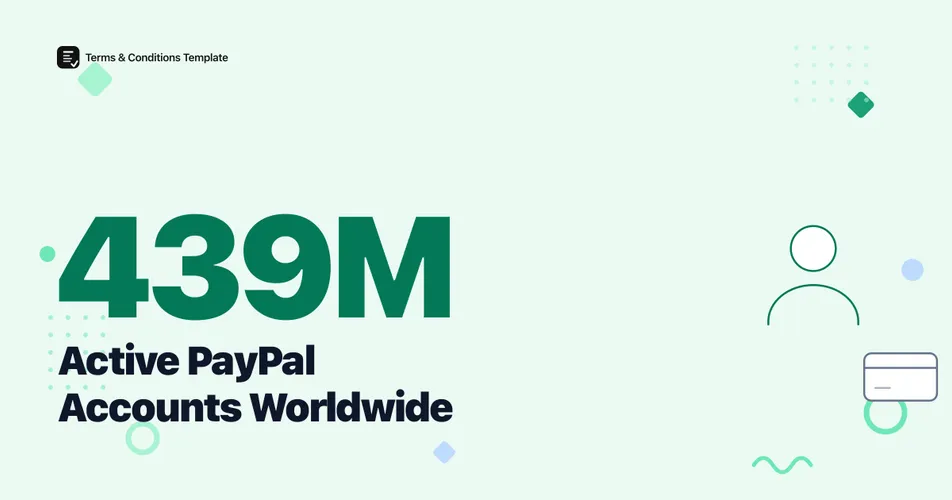
PayPal ended 2025 with 439 million active accounts and $1.79 trillion in total payment volume, according to the company’s own Q4 and full-year 2025 earnings release published February 3, 2026. That volume figure grew 7% year over year even though the number of individual transactions fell, which tells you exactly where PayPal’s growth is actually coming from in 2026.
For any store owner who accepts PayPal at checkout, these numbers matter beyond curiosity. Buyer protection limits, dispute rates, and BNPL adoption all flow directly into how a refund policy should be written.
How many people use PayPal?
PayPal reported 439 million active accounts as of December 31, 2025, up 1% from 434 million a year earlier, per its official Q4/FY2025 results. That is a modest growth rate for a company at this scale, and it continues a multi-year pattern of active-account growth slowing from the double-digit gains PayPal posted in the early 2020s.
Venmo, PayPal’s separately branded peer-to-peer app, crossed 100 million active accounts in 2025 and grew revenue roughly 20% to $1.7 billion. Venmo is increasingly doing the heavy lifting on PayPal’s growth story, even though its account count is still less than a quarter of the parent brand’s.
Figure 1: Year-end active account counts. Source: PayPal Holdings 10-K and Q4/FY2025 earnings release.
Warning
PayPal’s active account count dipped in 2023 before recovering, a fact some aggregator sites omit when they describe account growth as steady. The 2023 decline reflected PayPal’s own account-cleanup efforts to remove low-engagement accounts, not a sudden drop in usage, per the company’s own investor commentary at the time.
Account growth alone will not tell you how healthy PayPal’s business is. Volume and transaction data fill in the rest of the picture.
How much money moves through PayPal each year?
PayPal processed $1.79 trillion in total payment volume during 2025, up 7% from 2024, according to its Q4/FY2025 earnings release. That is the highest annual TPV figure the company has ever reported, and it arrived even as total payment transactions fell.
Payment transactions dropped 4% year over year to 25.4 billion in 2025. Put those two figures together and the average transaction value rose meaningfully, consistent with PayPal’s own commentary about leaning into larger-ticket categories like Buy Now, Pay Later and branded checkout for bigger-basket ecommerce orders.
Figure 2: Annual total payment volume. Source: PayPal Holdings Q4/FY2025 earnings release, February 2026.
Fewer, bigger transactions is the defining shift in PayPal’s 2025 numbers, and it is the reason BNPL volume grew so much faster than the core business.
How big is PayPal’s Buy Now, Pay Later business?
PayPal’s Buy Now, Pay Later volume topped $40 billion in 2025, growing more than 20% year over year, per the company’s Q4/FY2025 results. That growth rate is roughly three times the 7% pace of PayPal’s overall TPV, making BNPL the fastest-growing product line the company discloses separately.
BNPL’s growth matters for refund policy writers specifically. Installment purchases create a longer window where a customer might request a refund mid-payment-plan, and a refund policy that does not address partial-payment or installment purchases leaves a gap that a support team ends up filling ad hoc.
Store owners taking PayPal Pay in 4 or a similar installment option should state clearly, in the refund policy, how a return is handled when payments are still in progress. That single clause prevents most of the confused support tickets that installment refunds otherwise generate.
What is PayPal’s share of the online payments market?
Market-tracking aggregators, which measure payment technology detected on live checkout pages rather than PayPal’s own transaction ledger, place PayPal at roughly 44% of the global online payment processing market in 2025, more than double the next-closest competitor’s share. PayPal does not publish an official market share percentage itself, so this figure should be read as a directional estimate from third-party web-technology scanners, not a company-disclosed statistic.
Within the United States specifically, the same tracking method puts PayPal’s share of US-based online transactions closer to 22%, reflecting a more fragmented market with Stripe, Shopify Payments, and card networks each holding meaningful share.
Figure 3: Global online payment processing market share, based on payment-technology detection across live checkout pages. Source: aggregated web-technology market trackers, 2025 data. Estimate, not a PayPal-disclosed figure.
Roughly two in three US small businesses accept PayPal, and independent research firms report over 80% of North America’s top 1,000 online retailers support it at checkout, which is consistent with PayPal holding the largest single share of a fragmented processor market.
What happens when a PayPal purchase needs a refund?
PayPal’s own Purchase Protection Program covers eligible buyer claims up to $20,000 per transaction, for items that arrive significantly not as described or never arrive at all, according to PayPal’s Purchase Protection Program terms, last updated September 2, 2025. That coverage sits on top of, not instead of, whatever refund policy the merchant itself publishes.
For sellers, PayPal charges a flat $20 chargeback fee on unbranded transactions, though the fee is waived when a transaction qualifies for Seller Protection. Merchants running a dispute rate of 1.5% or higher across the prior three months also face a separate high-volume dispute fee, according to PayPal’s published merchant fee schedule. Neither of PayPal’s own processing fees, typically 2.99% plus $0.49 or 3.49% plus $0.49 per transaction depending on the payment type, gets returned to the merchant when a refund or chargeback happens.
Figure 4: PayPal’s buyer dispute path under Purchase Protection. Source: PayPal Purchase Protection Program terms, September 2025.
A published refund policy that matches PayPal’s own dispute window keeps far fewer transactions from ever escalating to a formal claim. Buyers who can find a store’s own return terms in under a minute are less likely to open a PayPal dispute in the first place, because a dispute is what a shopper reaches for only after a merchant’s own process looks unclear or absent.
How has PayPal’s business changed since 2022?
The last four years show a business trading transaction count for transaction size, and pushing hard into BNPL and Venmo as separate growth engines rather than relying on core PayPal checkout volume alone.
Figure 5: Key PayPal metrics by year. Source: PayPal Holdings 10-K filings and Q4/FY2025 earnings release.
The pattern across every metric points the same direction: PayPal is optimizing for larger, higher-value transactions and diversified products like Venmo and BNPL rather than chasing raw account growth the way it did a decade ago.
PayPal by the numbers: a quick comparison
| Metric | 2024 | 2025 | Change |
|---|---|---|---|
| Active accounts | 434 million | 439 million | +1% |
| Total payment volume | $1.68 trillion | $1.79 trillion | +7% |
| Payment transactions | 26.5 billion | 25.4 billion | -4% |
| BNPL volume | approx. $33 billion | over $40 billion | +20%+ |
Source: PayPal Holdings Q4/FY2025 earnings release, February 2026.
The Bottom Line
The 439 million active accounts figure is the headline, but the more useful number for a store owner is the 7% TPV growth against a 4% drop in transaction count. PayPal’s customers are spending more per transaction, increasingly through BNPL, which means refund and dispute exposure per transaction is rising even as the volume of individual disputes may not. A refund policy that spells out installment purchases, PayPal’s own dispute window, and how partial payments get treated on a return will prevent more support tickets in 2026 than a generic policy written for single-payment checkout alone.
Frequently Asked Questions
How many people use PayPal in 2026? PayPal reported 439 million active accounts as of December 31, 2025, up 1% from 2024, according to its official Q4 and full-year 2025 earnings release. Venmo, PayPal’s peer-to-peer app, separately passed 100 million active accounts.
How much money moves through PayPal each year? PayPal processed $1.79 trillion in total payment volume during 2025, a 7% increase from 2024, across 25.4 billion payment transactions, per the company’s Q4 and full-year 2025 results.
What is PayPal’s market share in online payments? Market-tracking aggregators that measure payment-technology presence on checkout pages put PayPal at roughly 44% of the global online payment processing market in 2025, more than double the next-largest provider. PayPal itself does not publish an official market share figure, so treat this as a directional estimate rather than a company-disclosed number.
What is the maximum refund PayPal covers under Buyer Protection? PayPal’s Purchase Protection program covers eligible claims up to $20,000 per transaction for items significantly not as described or never received, according to PayPal’s own Purchase Protection Program terms, last updated September 2025.
Sources and References
- PayPal Holdings. (2026). “PayPal Reports Fourth Quarter and Full Year 2025 Results.” Official earnings release, February 3, 2026.
- PayPal Holdings, Inc.. (2026). Form 10-K, fiscal year 2025. US Securities and Exchange Commission filing.
- PayPal. (2025). “Purchase Protection Program” terms, last updated September 2, 2025.
- PayPal. Buyer Protection program summary and eligibility terms.
- Statista. (2025). “E-commerce Payment Methods Market Share Worldwide.” Payment-technology detection methodology, aggregated estimate.
Note: All figures verified as of July 2026. PayPal reports quarterly and full-year results on a fixed schedule, so headline account and volume figures are refreshed at least twice a year to stay ahead of Q1 and Q2 2026 results.