On May 26, 2026, Vermont Governor Phil Scott signed H.512, now Act 109, an act relating to the regulation of the event ticketing market. The law took effect July 1, 2026, and it makes Vermont the only state with an enforceable cap on ticket resale prices: a reseller or secondary ticket exchange cannot sell or list a ticket for more than 110 percent of the original ticket price at a qualifying venue. The same act bans speculative ticket listings and deceptive reseller website addresses, and it sunsets automatically on July 1, 2028 unless the legislature renews it.
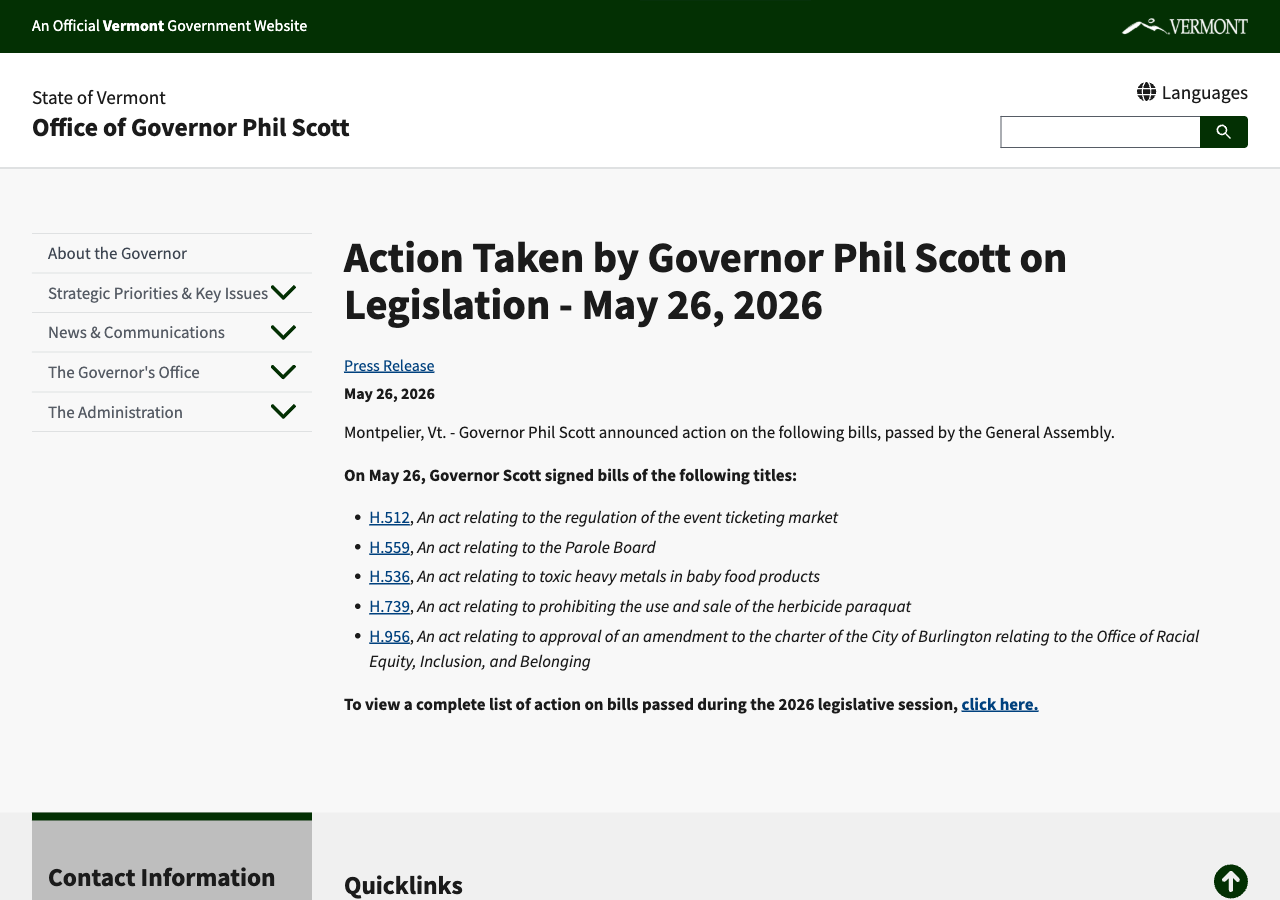
Source: Office of Governor Phil Scott (Vermont), “Action Taken by Governor Phil Scott on Legislation, May 26, 2026”, captured August 2026.
What Act 109 Actually Requires
Act 109 adds a new subchapter, 9 V.S.A. section 2479f, to Vermont’s consumer protection statute. It starts with disclosure: a ticket issuer must print the total price of the original ticket on the face of the ticket, and a secondary ticket exchange must tell a buyer up front whether they are purchasing from the original issuer or from a reseller, and that the resale price is legally capped. If the exchange shows how many tickets are left for an event, that number cannot be presented in a way that misleads a buyer about availability on that platform or anywhere else.
The price cap itself is the headline: a reseller cannot sell or offer a ticket above 110 percent of the original ticket price, and a secondary ticket exchange cannot authorize a resale listing above that same 110 percent line, according to the Act 109 summary published by the Vermont Office of Legislative Counsel. A $100 ticket can resell for no more than $110 at a covered venue.
Figure: A $100 ticket at a qualifying Vermont venue can legally resell for no more than $110 under Act 109’s price cap. Source: Vermont Act 109 (H.512), section 2479f(c).
The Cap Only Applies at “Independent Venues”
The 110 percent cap does not cover every ticketed event in Vermont. It applies only where the event is held at what the act calls an “independent venue,” and where at least one of three other conditions also holds: the venue seats 3,000 people or fewer, the venue is a nonprofit space that hosts agricultural fairs, exhibitions, or multiday community events alongside live performances, or the venue is used mainly for collegiate or amateur sports.
Act 109 defines an independent venue as one that draws most of its revenue, not counting charitable donations, from ticketed events, is not majority owned by a publicly traded company, and does not operate venues in more than 10 states. That definition draws a clear line around large arenas and amphitheaters run by publicly traded promoter and venue networks, which stay outside the price cap, and small, locally run venues, which do not. The cap also does not apply to resales handled under a written contract with the ticket issuer, and the law’s definition of “reseller” excludes an individual reselling a ticket they bought for personal use, so a fan who cannot make a show and resells one ticket to a friend is not the target here.
| Provision | What it requires |
|---|---|
| Resale price cap | Resellers and secondary ticket exchanges cannot sell or list a ticket above 110% of the original price |
| Applies to | Independent venues seating 3,000 or fewer, nonprofit fair and exhibition venues, and collegiate or amateur sports venues |
| Does not apply to | Venues majority owned by a publicly traded company or operating in more than 10 states, and resales under a written issuer contract |
| Deceptive URLs | Resellers cannot use a deceptive web address or imply a venue, team, or artist endorsement without written consent |
| Speculative tickets | Sellers cannot list or advertise a ticket they do not actually or constructively possess |
| Enforcement | A violation is an unfair and deceptive act under 9 V.S.A. section 2453 |
Two More Bans Riding Along With the Price Cap
Act 109 does two other things that apply regardless of venue size or ownership. First, it bars a secondary ticket exchange, reseller, or any ticket-selling website from using a deceptive web address, or from implying that it is affiliated with, endorsed by, or owns the intellectual property of a venue, team, or artist, including through words like “official” in ads, URLs, or search results, unless that venue, team, or artist gave written consent. Second, it bans speculative ticket sales outright: a person cannot list, advertise, or offer a ticket for sale unless they already have it, or already have a contract to get it. Both bans apply statewide, and both are enforced the same way as the price cap: a violation counts as an unfair and deceptive act under Vermont’s existing consumer protection law, section 2453.
What This Means for Your Refund Policy
If your business sells or resells tickets to events held in Vermont, or operates a platform that lets others do so, Act 109 is worth checking against your current pricing and refund language even if most of your inventory falls outside the 110 percent cap. The disclosure requirement in section (b) is the part most likely to apply broadly: if you run a secondary ticket exchange, you need to tell buyers plainly whether they are buying from the original issuer or a reseller, and that Vermont law limits how far resale prices can go, regardless of whether your specific listing sits above or below the cap.
A refund policy is a natural place to put that disclosure, along with plain language about what a buyer can expect if an event is postponed, moved, or canceled after a resale purchase. Our Refund Policy Generator can help you draft fee, resale, and cancellation language that states these terms clearly instead of leaving buyers to find out only after they have paid.
Vermont’s law also raises the stakes for anyone building a resale platform: a URL, a search ad, or a listing page that reads as “official” without a venue’s or artist’s written sign-off is now its own violation in Vermont, separate from the price question entirely. That is a policy and product decision, not just a legal-language fix, and it applies the moment a listing goes live for a Vermont event.
How This Fits the Broader Ticket-Resale Story
Act 109 is a state price cap, which puts it in different territory from the federal fee-disclosure enforcement covered in our post on StubHub’s $10 million FTC settlement: that case was about when a total price gets shown to a buyer, while Vermont’s law caps what the final resale price can be in the first place at qualifying venues. Ticket sellers weighing both stories at once should also look at our guide to refund policy for event and ticket sales, which covers the separate question of what happens to a buyer’s money when a show is postponed or canceled.
Vermont’s approach also sits alongside a wider run of 2026 state and city rules that regulate a specific number in a consumer transaction rather than leaving it to the market: California’s AB 483 caps early termination fees on installment contracts at 30 percent of the remaining balance, and refund timing itself varies by state under the rules in our guide to state cooling-off period laws. None of these laws share a legal mechanism, but they share a pattern: a state deciding that disclosure alone was not enough and setting a hard number instead.
Bottom Line
Vermont is currently the only state with an enforceable cap on ticket resale prices, and Act 109 pairs that cap with bans on deceptive reseller URLs and speculative listings that apply no matter how big the venue is. The price cap itself only reaches independent venues under the law’s specific ownership and size test, so most large-arena resale activity in Vermont stays outside it, but the disclosure duty, the URL ban, and the speculative-ticket ban do not carve out an exception for size. If you sell, resell, or operate a marketplace for tickets to Vermont events, this is the moment to check your resale pricing, your disclosure language, and your refund policy against the new law before its July 1, 2028 sunset date becomes the next thing to track.
The information in this article is for informational purposes only and should not be construed as legal advice on any matter, and does not create an attorney-client relationship.