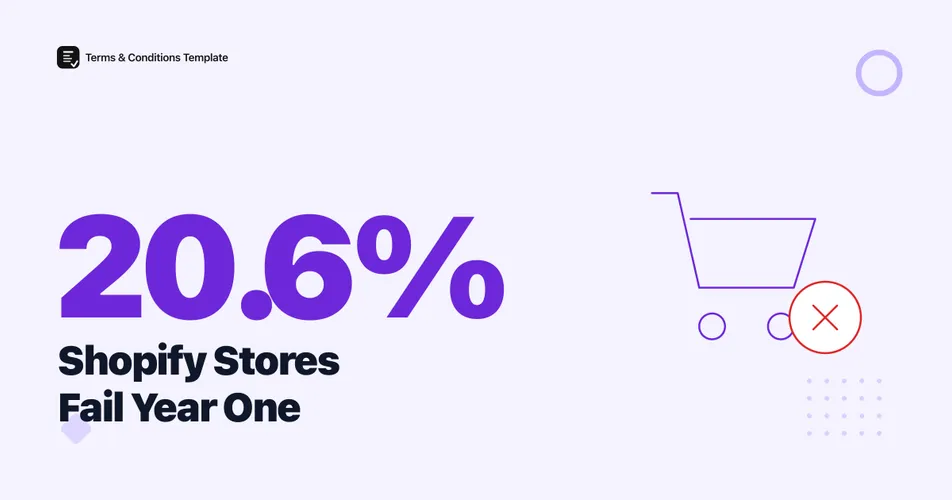
No credible study has ever measured a Shopify-specific store failure rate. The number closest to a defensible answer is 20.6%, the share of new US businesses across all industries that close within their first year, according to the US Bureau of Labor Statistics’ Business Employment Dynamics data for 2026. Shopify itself does not publish comparable churn or shutdown figures for its merchants.
That gap between what is widely claimed and what is actually documented is the entire subject of this article: which numbers trace back to a named source, which do not, and what the best available proxy data says about a new online store’s odds.
What percentage of Shopify stores actually fail?
Nobody outside Shopify has the data to answer this precisely, and Shopify has never published it. What exists instead is general small-business survival data from the US government, which is the best traceable proxy available. The Bureau of Labor Statistics’ Business Employment Dynamics program tracks new business establishments across all industries and finds that 20.6% close within their first year, meaning 79.4% survive to their first anniversary.
That figure is not Shopify-specific. It covers every new US business establishment with payroll, from restaurants to law firms to online retailers, which is a meaningfully different population than a Shopify store spun up in an afternoon with no employees. Still, it is the only failure-rate number in this space with a named source, a published methodology, and an annual update cycle, which is more than can be said for any of the round “90%” figures that circulate about Shopify specifically.
Figure 1: The documented federal figure against the most repeated undocumented claim. Source: US Bureau of Labor Statistics Business Employment Dynamics; widely circulated marketing claim with no traceable origin.
The takeaway is not that Shopify stores never fail. It is that anyone citing a specific Shopify failure percentage should be asked where the number came from, because in most cases nobody has ever traced it back to a real dataset.
Where does the “90% of Shopify stores fail” claim come from?
It does not come from anywhere identifiable. Searching for the original source of the commonly cited 80 to 90% Shopify failure figures turns up only other marketing blogs, listicles, and dropshipping course sales pages repeating the same round numbers, with no link back to a study, survey, or dataset that states a sample size or methodology. That pattern, a number that spreads without ever touching a primary source, is the definition of an untraceable statistic under any reasonable data-discipline standard.
Warning
Treat every “X% of Shopify stores fail” statistic you encounter as unverified unless the source names a specific study and sample size. This includes figures presented confidently in YouTube videos and course marketing, not just blog posts. If a number cannot be traced past a second blog citing a first blog, it should not be repeated as fact.
Figure 2: The verification test applied to every Shopify failure-rate claim in this article. Source: standard citation-tracing methodology.
Almost every viral Shopify failure statistic fails this test at the second step, which is why this article leans on general BLS business survival data instead of repeating a number nobody can source.
How reliable is general small-business data as a Shopify proxy?
It is the best available proxy, but it has real limits worth stating plainly. BLS survival data counts formal business establishments, typically ones with at least one payroll employee, while a large share of new Shopify stores are solo side projects, dropshipping tests, or print-on-demand experiments that a founder abandons without ever formally closing anything. That means the true Shopify-specific closure rate could plausibly run higher than the 20.6% first-year BLS figure, since low-commitment stores are easier to walk away from than a business with staff, a lease, or payroll obligations.
The cumulative BLS pattern also extends well past year one, and it is worth seeing the full curve rather than a single snapshot.
| Years since starting | Cumulative failure rate | Cumulative survival rate |
|---|---|---|
| 1 year | 20.6% | 79.4% |
| 2 years | 31.3% | 68.7% |
| 5 years | 48.0% | 52.0% |
| 10 years | ~65% (widely cited BLS estimate) | ~35% |
Source: US Bureau of Labor Statistics, Business Employment Dynamics, survival rates of establishments by year started, all industries.
Figure 3: How cumulative business failure compounds over a decade. Source: US Bureau of Labor Statistics Business Employment Dynamics.
Applied to Shopify, the honest reading is that the platform’s true closure rate for low-commitment stores likely sits above this baseline, while stores run as real, staffed businesses likely track closer to it. Neither version supports a flat “90%” headline.
How many Shopify stores are actually live right now?
Store counts are frequently mistaken for failure evidence, so it is worth separating the two. Store Leads, which verifies activity using historical DNS data, counted 2,898,351 live Shopify stores as of its mid-2026 report, up 11% year over year. BuiltWith’s broader technology-detection index, which flags any domain currently running Shopify’s code, reports a much higher figure of roughly 6.8 to 6.9 million, because it also counts abandoned test stores, duplicate subdomains, and stores that have not processed an order in years. How Many Shopify Stores Are There? breaks down that gap by country and by counting method in more depth.
Figure 4: What share of every Shopify installation BuiltWith detects is actually a verified, trading storefront. Source: Store Leads mid-2026 report (2,898,351); BuiltWith technology-detection index (approx. 6.9M), calculated as a ratio of the two published figures.
That 58% gap between “detected” and “verified live” is closer to a real signal about dormant and abandoned stores than any of the round failure percentages in circulation, and it comes from two named, cross-checkable trackers rather than an anonymous blog claim.
Do stores that scale on Shopify actually survive long term?
Among stores that gain real traction, the evidence points toward durability rather than churn. Shopify Plus, the platform’s enterprise tier built for larger merchants, grew from roughly 25,000 merchants in 2022 to more than 44,000 by 2025, per Shopify’s own investor disclosures, even though Plus stores remain under 1% of total store count. That growth trajectory would be difficult to sustain if a large share of successful stores were shutting down shortly after scaling up.
Figure 5: Growth of Shopify’s enterprise merchant tier over four years. Source: Shopify Inc. investor disclosures and FY2025 financial reporting.
This is not evidence about the broader base of small, low-commitment stores covered earlier. It is evidence that the subset of Shopify stores that reach meaningful scale tend to keep growing rather than closing, which is a different and narrower claim than any all-store failure percentage. For the full picture of GMV, revenue, and seller counts behind that growth, see Shopify Statistics 2026: Stores, Sales and Sellers.
What happens legally when a Shopify store shuts down?
A store closing mid-transaction is not just a statistics question, it is a contract question, and it is where a generic or missing Terms and Conditions document becomes a real liability. If a merchant closes without warning, customers with pending orders, active subscriptions, or unresolved disputes need a clear contractual answer for what happens next: who owns unfulfilled order obligations, what the refund process is, and what governing law and dispute-resolution process applies if a customer pursues a claim after the store is gone.
A properly drafted Terms and Conditions Generator sets these terms in advance, before a closure becomes a legal problem: limitation-of-liability language that caps a merchant’s exposure, a right-to-modify-or-discontinue-service clause that covers winding down the business, and a dispute-resolution clause that gives both sides a defined process instead of an open-ended dispute. Given that roughly one in five new businesses does not make it past year one per the BLS data above, treating these terms as optional paperwork rather than a standard part of launching a store is a real gap for a meaningful share of new Shopify sellers.
Figure 6: Illustrative positioning of when clear Terms and Conditions matter most across a store’s lifecycle. Source: author analysis based on the BLS and Shopify data cited throughout this article; illustrative positioning, not measured coordinates.
The takeaway holds regardless of a store’s size: the moment a business accepts its first order, it has taken on obligations that only a written terms document actually defines.
The Bottom Line
The honest answer to “what percentage of Shopify stores fail” is that nobody has published one, and the widely quoted “90% fail within 120 days” claim has no traceable source behind it. The best documented proxy is 20.6%, the US Bureau of Labor Statistics’ year-one failure rate for new businesses across all industries, climbing to 48% by year five. Shopify’s own numbers show a platform still growing, 2,898,351 live stores and a Shopify Plus tier that more than doubled between 2022 and 2025, which cuts against any narrative that most sellers who commit to the platform quickly disappear. For sellers, the practical implication is narrower than a headline statistic: given that roughly one in five new businesses does not survive its first year, having clear Terms and Conditions in place from day one, covering liability, refunds, and what happens if the business needs to wind down, is cheap insurance against a risk the data says is real.
Frequently Asked Questions
What percentage of Shopify stores actually fail? There is no verified, Shopify-specific failure rate. The closest credible proxy is the US Bureau of Labor Statistics’ finding that 20.6% of new US businesses across all industries close within their first year, and 48% close within five years, per BLS Business Employment Dynamics data. Shopify does not publish a comparable merchant closure or churn rate.
Is it true that 90% of Shopify stores fail within 120 days? No. That figure appears across dozens of marketing blogs but cannot be traced to any original study, dataset, or named source with a stated sample size. Following the citation trail leads only to other blog posts repeating the same number, which is the hallmark of an untraceable statistic.
How many Shopify stores are currently live? Store Leads counted 2,898,351 live, DNS-verified Shopify stores as of mid-2026. BuiltWith’s broader technology-detection index counts roughly 6.8 to 6.9 million domains with Shopify code installed, a figure that includes dormant, duplicate, and abandoned stores, which is part of why raw store-count figures get misread as failure data.
Do successful Shopify stores tend to keep growing? Yes. Shopify Plus, the platform’s enterprise tier for larger merchants, grew from about 25,000 merchants in 2022 to more than 44,000 by 2025, evidence that stores which gain real traction tend to scale rather than churn out, even though no reliable data exists on what share of all stores reach that point.
Sources and References
- US Bureau of Labor Statistics. Business Employment Dynamics, survival rates of establishments by year started, all industries.
- Store Leads. (2026). “The State of Shopify,” mid-2026 report. DNS-verified live store counts.
- BuiltWith. Shopify usage and technology-detection statistics.
- Shopify Inc.. (2026). Form 10-K, fiscal year ended December 31, 2025. Official SEC filing.
- Shopify Inc.. (2026). “Shopify’s Standout 2025” Q4 and full-year 2025 financial results announcement.
Note: All figures verified as of August 2026. BLS survival-rate data reflects the most recently published cohort tables; Shopify store-count and merchant figures are refreshed quarterly by their respective trackers and updated here at least twice a year.