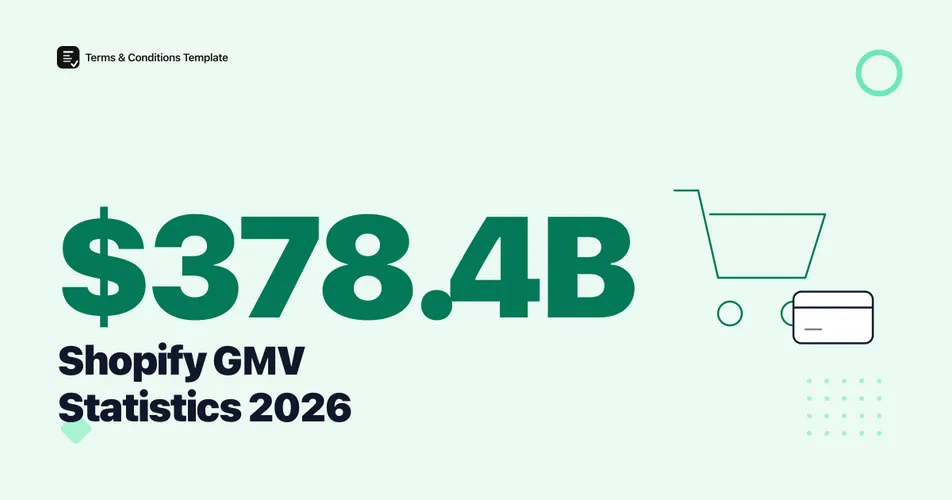
Shopify merchants sold $378.4 billion worth of goods through the platform in 2025, a 29% jump from 2024’s $292.3 billion, according to Shopify’s own FY2025 SEC filing. That single number is the clearest proxy for how large the Shopify economy has become, and it sits inside a platform now running somewhere between 2.9 million and 6.9 million live stores depending on how strictly “live” gets defined.
That range is not sloppiness. It is two different, both-legitimate counting methods producing very different answers, and untangling which number applies to which question is most of what this article does.
How many Shopify stores are there?
The honest answer depends on which tracker you trust and what counts as “live.” Store Leads, which verifies activity using historical DNS data, counted 2,898,351 live Shopify stores as of its mid-2026 report, up 11% year over year and 1.1% quarter over quarter. BuiltWith, which detects Shopify’s underlying technology signature across any indexed domain, reports a much higher figure, in the range of 6.8 to 6.9 million sites, because it counts every domain where Shopify code is present, including abandoned test stores, duplicate subdomains, and stores that have not processed an order in years.
Neither number is wrong. Store Leads answers “how many stores are actually running a business,” and BuiltWith answers “how many domains have Shopify installed.” When a source claims a single definitive Shopify store count without saying which methodology it used, treat that figure with caution.
Figure 1: Two legitimate but very different Shopify store counts. Source: Store Leads mid-2026 report; BuiltWith technology tracking.
The gap between these two figures is the single most common source of “how many Shopify stores exist” claims that contradict each other across the web.
How much revenue and GMV does Shopify process?
Shopify’s platform-wide gross merchandise volume (GMV), the total dollar value of everything merchants sell through it, reached $378.4 billion for full-year 2025, up 29% from 2024, per the company’s FY2025 SEC filing. Shopify’s own revenue (the cut it takes through subscriptions and merchant solutions, not merchant sales) hit $11.5 billion, up 30% year over year. Q4 2025 alone crossed $124 billion in GMV, the first quarter ever to clear $100 billion.
GMV has climbed every year since Shopify went public, but the growth rate itself has also been accelerating rather than flattening out.
Figure 2: Platform-wide gross merchandise volume by year. Source: Shopify FY2025 SEC filing (Form 10-K).
Revenue splits roughly into two buckets: subscription fees merchants pay to use Shopify, and merchant solutions revenue tied to transaction volume, mainly Shopify Payments.
Figure 3: Revenue mix for fiscal year 2025. Source: Shopify FY2025 SEC filing.
The GMV-to-revenue ratio matters for one reason: Shopify makes more money as merchants sell more, which is why every product decision the company makes, checkout, payments, B2B tooling, points back to GMV growth.
Which countries have the most Shopify stores?
The United States dominates by a wide margin. Store Leads’ mid-2026 data puts the US at 38% of all live Shopify stores (1,101,981 stores), more than the next several countries combined. The United Kingdom follows a distant second.
| Country | Live Shopify stores | Share of global total |
|---|---|---|
| United States | 1,101,981 | 38.0% |
| United Kingdom | 218,514 | 7.5% |
| Canada | 142,791 | 4.9% |
| Australia | 131,856 | 4.5% |
Source: Store Leads, mid-2026 report, DNS-verified store activity.
Figure 4: Store count by country. Source: Store Leads mid-2026 report.
If you sell internationally through Shopify, your refund terms need to account for this concentration: the bulk of your traffic and disputes will trace back to US consumer protection norms first, UK and EU withdrawal-right rules second.
What share of the ecommerce market does Shopify control?
Shopify’s own investor materials put its share at roughly 12% of United States retail ecommerce. Measured a different way, by counting which ecommerce platform technology is actually installed on live commerce sites, BuiltWith puts Shopify closer to 29% of the US ecommerce software market, making it the single largest platform by that narrower technical measure. Globally, Shopify’s share of all ecommerce platforms sits around 10%, per the same BuiltWith tracking.
Figure 5: Approximate positioning of major ecommerce platforms by US site count and GMV share. Source: synthesized from BuiltWith and Shopify investor disclosures; illustrative positioning, not precise coordinates.
These are two genuinely different metrics measuring two genuinely different things, retail dollars versus installed technology, and conflating them is how you end up with a headline that says Shopify has both “12%” and “29%” of the same market.
Do most Shopify stores actually succeed?
There is no reliable, sourced answer to this question, and that gap matters more than any single number in this article. The widely repeated claim that “90% of Shopify stores fail within 120 days” appears across dozens of blog posts, but none of them link back to an original study, a Shopify disclosure, or any dataset with a stated sample size. Shopify itself does not publish a merchant failure or churn rate.
Warning
Treat every “X% of Shopify stores fail” statistic you encounter as unverified unless the source names a specific study and sample size. We searched for the original source of the commonly cited 80 to 90% first-year failure figures and could not trace any of them past other marketing blogs repeating each other. The only traceable failure-rate data available is general US small-business data, not Shopify-specific: the Bureau of Labor Statistics reports 20.6% of all new businesses fail by year one, 31.3% by year two, and 48% by year five, across every industry, not just ecommerce.
What is separately documented is how sellers scale once a store gains traction. Shopify Plus, the platform’s enterprise tier for larger merchants, had grown to over 44,000 merchants by 2025, up from around 25,000 in 2022, even as Plus stores remain a small fraction, under 1%, of total store count.
The honest version of this question is: nobody has published a credible Shopify-specific failure rate, so any number you see attached to it should be treated as marketing copy, not data.
How does this connect to refund and return policies?
Return volume scales with GMV, and 2025 was a record year on both fronts. US consumers returned an estimated $849.9 billion in merchandise in 2025, per the National Retail Federation and Happy Returns, with the online-specific return rate running higher than in-store at 19.3% versus 15.8% across all retail. For a platform processing $378.4 billion in GMV, that return rate translates into real order volume that needs a clear, current refund policy attached to it.
EU and UK shoppers additionally have a legal 14-day withdrawal right on most online purchases regardless of what a merchant’s own policy says, which means a refund policy that only reflects US norms will misstate the law for a meaningful share of Shopify’s international sellers given the platform’s country mix above. Store owners covering both audiences need a document that states the shorter of the two windows correctly for each market rather than picking one default. A Refund Policy Generator built for multi-region stores handles that split automatically instead of leaving it to a single copy-pasted template.
Figure 6: Shopify GMV growth alongside 2025 US return-rate data. Sources: Shopify FY2025 SEC filing; National Retail Federation / Happy Returns 2025 Retail Returns Landscape.
If you sell through Shopify and have not touched your refund policy in over a year, GMV growth alone is a good reason to check whether your stated return window still matches your actual fulfillment and restocking process.
The Bottom Line
The number that matters most is $378.4 billion, the GMV Shopify merchants generated in 2025, because it explains why every other statistic on this page is trending upward: more stores, more countries, more B2B volume, and more returns to process. Store counts range from 2.9 million to 6.9 million depending on methodology, and the “most stores fail” claim circulating online has no traceable source, so treat both of those areas with more skepticism than the hard SEC-filed revenue and GMV figures above. For sellers, the practical takeaway is narrower: at this scale, a generic refund policy is a liability, not a formality, especially for stores selling into both the US and EU/UK markets at once.
Frequently Asked Questions
How many Shopify stores are there in 2026? Store Leads counted 2,898,351 live Shopify stores as of mid-2026, using historical DNS data to confirm each site is actually active. BuiltWith’s broader technology-detection index reports a higher figure, around 6.9 million, because it counts any domain where Shopify code is detected, including inactive and duplicate installs.
How much money moves through Shopify each year? Shopify processed $378.4 billion in gross merchandise volume (GMV) in 2025, up 29% year over year, according to the company’s FY2025 SEC filing. Full-year revenue reached $11.5 billion, a 30% increase from 2024.
What percentage of the ecommerce market does Shopify have? Shopify holds roughly 12% of United States retail ecommerce, per the company’s own investor materials, and closer to 29% of the US ecommerce software market specifically, per BuiltWith’s platform-detection data as of 2025.
Do most Shopify stores succeed or fail? There is no reliable, sourced failure rate for individual Shopify stores. The widely repeated “90% fail within 120 days” claim cannot be traced to a primary study. What is documented: the US Bureau of Labor Statistics puts general small-business failure at 20.6% by year one across all industries, not Shopify specifically.
Sources and References
- Shopify Inc.. (2026). Form 10-K, fiscal year ended December 31, 2025. Official SEC filing.
- Shopify Inc.. (2026). “Shopify’s Standout 2025” Q4 and full-year 2025 financial results announcement.
- Store Leads. (2026). “The State of Shopify,” mid-2026 report. DNS-verified live store counts by country.
- National Retail Federation / Happy Returns (UPS). (2025). “2025 Retail Returns Landscape.”
- US Bureau of Labor Statistics. Business Employment Dynamics, survival rates by year of establishments started, all industries.
Note: All figures verified as of July 2026. Shopify GMV, store count, and market share figures are updated quarterly by their respective sources and refreshed here at least twice a year. Store count methodology (Store Leads vs. BuiltWith) is flagged in-text because the two are not directly comparable.