A new California law capping early termination fees on installment contracts took effect August 1, 2026. AB 483, authored by Assemblymember Jacqui Irwin and signed into law by Governor Newsom, limits early termination fees on fixed-term installment contracts to 30 percent of the total sum a consumer is still obligated to pay under the contract, and requires businesses to spell out that fee, in writing, before the customer signs.
The law targets a specific and common consumer complaint: a customer signs up for a fixed-term deal, tries to cancel early, and finds out the termination fee is far larger than they expected, disclosed only in dense contract language or hidden behind a link they never opened. AB 483 does not touch subscriptions or automatic renewals directly. It applies to installment contracts, the kind of fixed-term agreement often used for internet service, cable or satellite television, and cell phone plans.
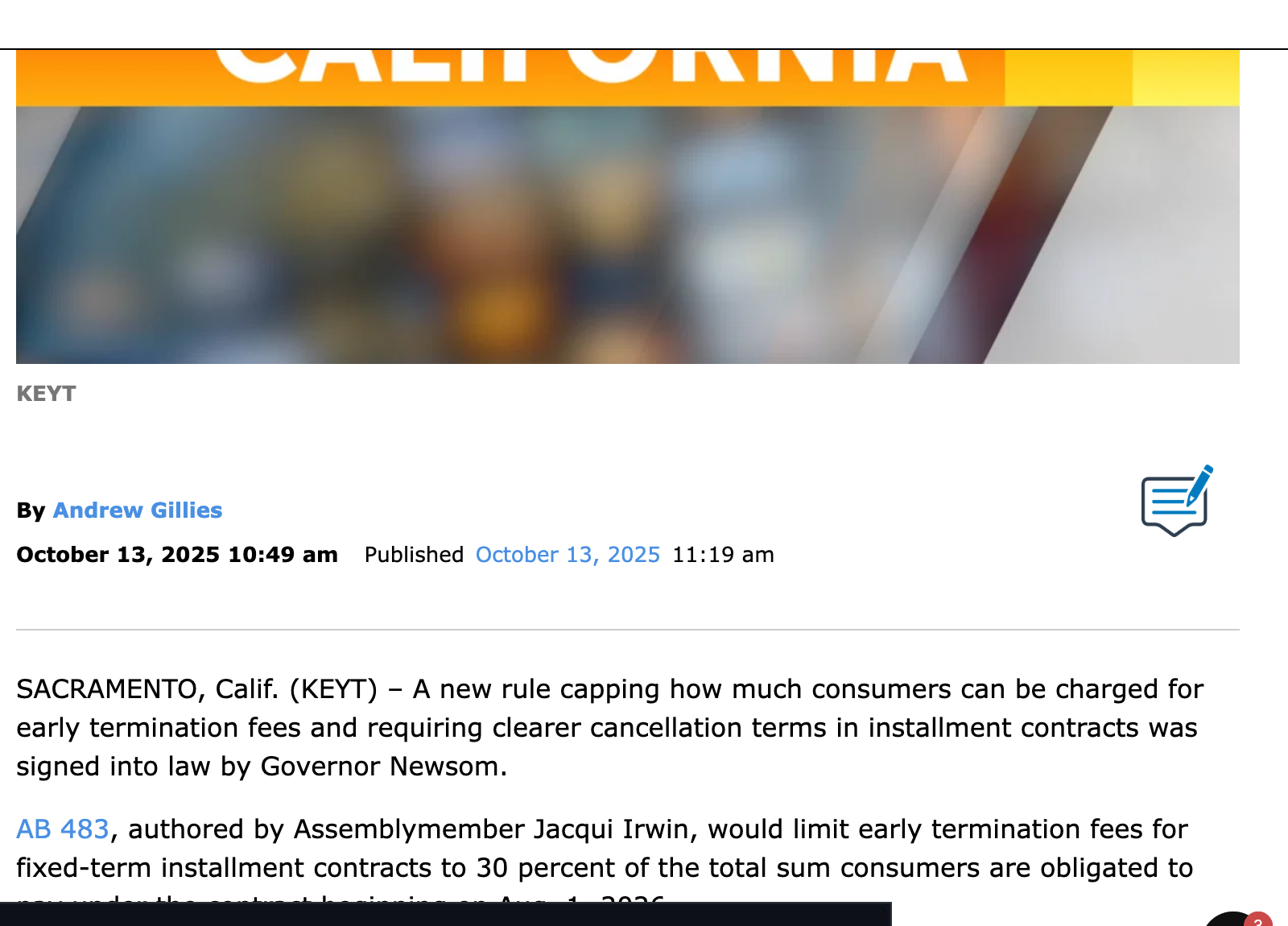
Source: News Channel 3-12 (KEYT), captured August 8, 2026.
What AB 483 actually requires
The core rule is a hard percentage cap. An early termination fee on a fixed-term installment contract entered into or modified on or after August 1, 2026 cannot exceed 30 percent of the total remaining balance the consumer owes under the contract. That is the ceiling, not a default; a business can charge less, or nothing at all, but it cannot contract around the 30 percent limit.
The disclosure piece is just as central to the law as the cap itself. A covered contract has to give the consumer clear and conspicuous written disclosure, inside the initial contract, of the termination fee itself or the formula used to calculate it, along with the highest possible termination fee the contract can ever charge. AB 483 specifically calls out the practice it is written to stop: fees “hidden in fine print or behind hyperlinks that require additional user interaction.” A termination fee clause that a customer has to click through to a separate page to find does not meet the standard. Any attempt by a business to get a customer to waive these disclosure requirements is void under the statute.
Figure: AB 483 sets a hard ceiling on early termination fees for fixed-term installment contracts starting August 1, 2026. Source: California AB 483, as reported by News Channel 3-12 (KEYT).
Assemblymember Irwin framed the law around exactly that surprise-fee problem. “Too many Californians have been shocked by outrageous early termination fees when they try to end an installment subscription early,” she said, adding that under AB 483, Californians will know exactly what type of termination fees they may have to pay, and that those fees will never exceed a fair limit.
Why a fee cap, not a cancellation rule
It is worth being precise about what kind of law this is, because California and several other states have passed a wave of subscription-cancellation rules recently, and AB 483 is not one of them. Our coverage of NYC’s new click-to-cancel rule and Virginia’s cancel-as-easy-as-signup law both deal with the mechanism a consumer uses to cancel an auto-renewing subscription: how many channels a business has to offer, and how easy the cancel button has to be to find. AB 483 does not touch that mechanism at all.
Instead, AB 483 caps and mandates disclosure of a termination fee on a fixed-term installment contract, a different kind of agreement with a different kind of consumer harm. A subscription auto-renews indefinitely until canceled; an installment contract runs for a set term the consumer agreed to up front, and the risk is a punitive fee for leaving that term early rather than a hard-to-find cancel button. The two problems get solved with two different legal levers, and a business offering both subscription and fixed-term installment products in California now has separate compliance obligations for each. Our guide to auto-renewal and negative-option disclosure requirements covers the subscription side of that split in more detail.
The fight over who the cap actually protects
AB 483 had real opposition, and the argument on both sides is worth understanding because it shapes how a business should think about structuring these contracts going forward. The Consumer Attorneys of California, which supported the bill, argued that businesses often justify early termination fees as a way to recoup a discount the consumer received for committing to a longer term, but added that it is not always clear when a fee goes beyond simple recoupment. The group’s position was that businesses who do not clearly disclose and explain how a cancellation fee is calculated are prioritizing their own profits over consumer understanding and basic fairness.
A coalition including the California Chamber of Commerce opposed the bill on a narrower technical point. In a variety of industries, the coalition argued, consumers benefit from arrangements that let them receive a significant share of the contract’s benefit up front, or a discount for committing to a longer term. Their concern was that a 30 percent cap on the recoverable fee implicitly caps how large that up-front discount can be, since a business cannot structure a discount that assumes it could recover more than 30 percent of the contract’s value if the consumer breaks the deal early. Telecommunications and retailer groups pushed for, and secured, the later August 2026 implementation date as the bill moved through the legislature, giving businesses time to review existing contract language before it took effect.
| Before AB 483 | Under AB 483 (effective Aug. 1, 2026) | |
|---|---|---|
| Fee amount | No statutory cap | Capped at 30% of the remaining contract balance |
| Fee disclosure | Often buried in fine print or behind a hyperlink | Must be clearly and conspicuously disclosed in writing, in the initial contract |
| Fee formula | Not required to be shown | The formula and the highest possible fee must both be disclosed |
| Waiver of these rules | Not addressed | Any attempt to waive the disclosure requirement is void |
What this means for your contract terms
If your business sells a fixed-term installment product to California consumers, whether that is a device payment plan, a service contract, or a term-based equipment lease, AB 483 changes two things about how that contract has to be written. First, the termination fee clause itself needs a hard number or a stated formula that a court could check against the 30 percent ceiling, not a vague reference to “applicable fees” defined somewhere else. Second, that clause has to sit in the contract itself, in language the consumer actually reads at signup, rather than behind a link to a separate terms page.
That second requirement is where a lot of existing contract language falls short, and it is exactly the gap a document generator is built to close. Our Terms & Conditions Generator builds a dedicated, clearly labeled fees and cancellation section rather than folding termination terms into a wall of boilerplate a customer has to click through to find, which is the specific pattern AB 483 was written to eliminate.
The Bottom Line
AB 483 does not ban early termination fees. It puts a hard 30 percent ceiling on them and requires the fee, or the formula behind it, to be stated in writing where a consumer actually sees it before they sign, not hidden in fine print or a hyperlink. If your business runs fixed-term installment contracts in California and your termination fee language has not been reviewed since before August 1, 2026, that is a reasonable trigger to check it now: confirm the fee cannot exceed 30 percent of the remaining balance, and confirm the disclosure sits in the contract itself rather than behind a link.
The information in this article is for informational purposes only and should not be construed as legal advice on any matter, and does not create an attorney-client relationship.