Cookies are used by 41.6% of all websites as of July 2026, according to W3Techs, which tracks technology adoption across the web daily using Chrome User Experience Report and Tranco list ranking data. That means fewer than half of all live websites set a cookie of any kind, well behind near-universal technologies like CSS and HTTPS. The number that matters more for compliance, though, is what happens on the sites that do use them.
If your site uses cookies at all, and most functional sites, from shopping carts to login forms, need at least a session cookie, the practical question is not whether to use cookies but whether your cookie policy and consent banner match what your code actually does. Here is what the current data says about cookie prevalence, cookie types, and how cookie use compares to actual consent compliance.
What percentage of websites use cookies?
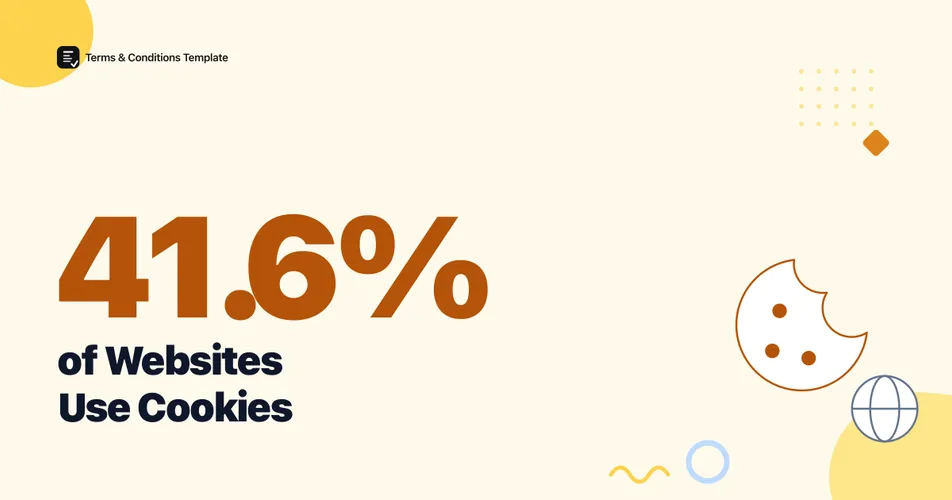
41.6% of all websites use cookies, according to W3Techs’ July 2026 technology survey. W3Techs recrawls a large, continuously ranked slice of the web daily rather than publishing a single fixed sample size, and it excludes non-content redirect and parking domains from the count, so the figure reflects websites with actual pages to serve. Cookies rank fourth among the “site elements” W3Techs tracks, behind CSS, compression, and default HTTPS, all of which run on 90% or more of sites.
Figure 1: Just under half of all crawled websites use cookies of any kind. Source: W3Techs, July 2026.
That 58.4% majority without cookies is not necessarily privacy-friendly by design. Many of those sites are simple, single-page, or static content with no login, cart, or analytics platform installed, so there was never a reason to set one. The sites that do use cookies tend to be the interactive, commercial, and content-driven properties most visitors actually spend time on.
How does cookie use compare to other web technologies?
Cookies sit in the middle of the pack. CSS is used by 98.9% of websites, compression by 92.8%, and default HTTPS by 90.1%, all well ahead of cookies at 41.6%. Cookies rank close to newer protocol technologies like HTTP/3 (40.0%) and just ahead of HTTP/2 (38.4%) and HTTP Strict Transport Security (34.9%).
| Technology | Share of all websites | Source |
|---|---|---|
| CSS | 98.9% | W3Techs, July 2026 |
| Compression | 92.8% | W3Techs, July 2026 |
| Default protocol HTTPS | 90.1% | W3Techs, July 2026 |
| Cookies | 41.6% | W3Techs, July 2026 |
| HTTP/3 | 40.0% | W3Techs, July 2026 |
| HTTP/2 | 38.4% | W3Techs, July 2026 |
Figure 2: Cookies rank behind foundational web technologies but ahead of newer transport protocols. Source: W3Techs, July 2026.
The gap makes sense once you separate “renders a page” from “runs an interactive experience.” CSS and HTTPS are close to mandatory for any modern site to display and load safely. A cookie is only necessary once a site needs to remember something about a specific visitor, a cart, a login session, a consent choice, which is a smaller subset of the web than “every page that exists.”
What types of cookies do websites actually set?
Among the 41.6% of sites that use cookies at all, most combine several cookie attributes rather than setting one plain cookie. W3Techs’ July 2026 breakdown found 68.8% of cookie-using sites set at least one secure cookie (sent only over HTTPS) and 58.3% set at least one HttpOnly cookie (hidden from client-side JavaScript, a defense against script-based theft). 62.1% set persistent cookies and an identical 62.1% also set session cookies, meaning most cookie-using sites run both types side by side rather than choosing one or the other.
| Cookie type | Share of cookie-using sites | Purpose |
|---|---|---|
| Secure cookies | 68.8% | Sent only over HTTPS connections |
| Non-HttpOnly cookies | 68.7% | Readable by client-side JavaScript |
| Persistent cookies | 62.1% | Remain until a set expiration date |
| Session cookies | 62.1% | Cleared when the browser closes |
| Non-secure cookies | 60.1% | Sent over HTTP or HTTPS alike |
| HttpOnly cookies | 58.3% | Hidden from client-side JavaScript |
Figure 3: A site may use more than one cookie subtype at once, so these shares overlap rather than sum to 100%. Source: W3Techs, July 2026.
A site that sets a persistent, non-secure, non-HttpOnly cookie carries meaningfully more risk than one using secure, HttpOnly, session-only cookies for the same feature. Your cookie policy should name which of these categories your site actually uses rather than a generic catch-all clause, since a document that says “we may use cookies” without specifying type, duration, or security attributes is exactly the kind of vague disclosure regulators flag first.
Do most websites that use cookies also ask for consent first?
Not necessarily, and this is where cookie prevalence and legal compliance pull apart. A CHI 2025 study by Nouwens et al. scraped 254,148 websites across 31 EU and ePrivacy-law countries and found that 67% display some kind of consent interface, but only 15% of the top 10,000 EU sites meet the minimal bar of showing an Accept and a Reject button with equal prominence. Using a cookie and lawfully asking permission to use it are two separate numbers, and the gap between them is where most compliance risk lives, covered in more depth in cookie consent statistics for 2026.
Figure 4: Most cookie-using sites show some consent interface, but few clear the compliance bar. Source: Nouwens et al., CHI 2025, 254,148 sites analyzed.
The gap gets worse before the click even happens. A 2025 preprint analysis of 14,000 sites found that 44% of EU sites and 83% of US sites set tracking cookies before a visitor clicks anything at all, and 92% of those cookies persist for more than 12 months. This paper has not yet completed peer review, so treat the figures as a strong signal rather than a settled number, but it lines up directionally with the compliance gaps the peer-reviewed CHI study found. A visitor who sees your consent banner may already have several cookies loaded before they touch it, and that mismatch is a large share of what turns a routine cookie policy review into a formal complaint. For the visitor side of this same equation, see what percentage of users accept all cookies once a banner actually appears.
How has the cookie compliance picture shifted?
Enforcement has caught up with cookie use faster than banner design has. France’s data protection authority, the CNIL, issued a 325 million euro fine to Google and a 150 million euro fine to Shein in 2025, both tied to cookies set without valid consent. On the browser side, Google confirmed in April 2025 that Chrome will keep third-party cookies on by default with a user opt-out rather than deprecating them, while Safari and Firefox have blocked third-party cookies by default since 2020 and 2022 respectively. None of this changes the base rate: cookies are used by 41.6% of all websites regardless of browser or regulator, only what happens after that cookie is set.
Figure 5: Cookie use has stayed roughly stable while consent compliance research and enforcement have intensified. Sources: WebKit, Mozilla, Nouwens et al. CHI 2025, CNIL, Google Privacy Sandbox.
The Bottom Line
Cookie use itself is not the story: 41.6% of all websites set one, a share that trails core web technologies like CSS and HTTPS and has stayed fairly stable because it tracks how many sites need to remember a visitor rather than how many sites exist. The real story is what happens on that 41.6%. Only 15% of the top EU sites clear the minimal compliance bar, and a large share set tracking cookies before a visitor has clicked anything. If your site is part of the 41.6% that uses cookies, whether for a cart, a login, analytics, or advertising, the fastest way to close the gap between what your code does and what you disclose is to generate a cookie policy that names the actual cookie types, durations, and security attributes your site sets, and pair it with a banner that gives Accept and Reject equal weight.
Frequently Asked Questions
What percentage of websites use cookies in 2026? 41.6% of all websites use cookies as of July 2026, according to W3Techs’ daily-updated survey of the web, which ranks sites using Chrome User Experience Report and Tranco list data. W3Techs does not publish a fixed sample size for this figure since it recrawls the ranked web continuously.
What is the difference between session cookies and persistent cookies? Session cookies clear when the browser closes and persistent cookies remain until their set expiration date. Among websites that use cookies, W3Techs found 62.1% set at least one persistent cookie and 62.1% set at least one session cookie as of July 2026, so most cookie-using sites combine both types on the same page.
Do most websites that use cookies also ask for consent first? Not always. A CHI 2025 study of 254,148 websites by Nouwens et al. found 67% display some kind of consent interface, but only 15% of the top 10,000 EU sites meet the minimal bar of showing Accept and Reject with equal prominence. Cookie use and lawful consent are two different numbers.
Are websites setting cookies before a visitor clicks anything? Frequently. A 2025 preprint analysis of 14,000 sites found that 44% of EU sites and 83% of US sites set tracking cookies before any click at all, meaning the cookie is often already active by the time a consent banner appears.
Sources and References
- W3Techs. (2026). “Usage Statistics of Cookies for Websites.” Daily-updated survey, data captured July 25, 2026.
- W3Techs. (2026). “Usage Statistics of Site Elements for Websites.” Ranking of cookies against CSS, compression, HTTPS, and protocol technologies, July 2026.
- Nouwens, Kristensen, et al.. (2025). “A Cross-Country Analysis of GDPR Cookie Banners and Flexible Methods for Scraping Them.” CHI 2025, ACM. Analysis of 254,148 websites across 31 countries.
- Singh, Jin, Kim. (2025 preprint). “Unveiling Evolving Dark Patterns in Cookie Consent Banners.” 14,000 sites, collected 2025. Not yet peer-reviewed.
- CNIL. (2025). Google cookie consent decision, 325 million euro total. Official regulator decision.
- Google Privacy Sandbox. (2025). “Next steps for Privacy Sandbox and tracking protections in Chrome.” Published April 22, 2025.
Note: All figures verified as of July 2026. W3Techs cookie usage figures update daily and are refreshed at least twice a year in this article. Preprint and rolling-source figures are flagged in-text and should be re-checked before each refresh.