On February 25, 2026, New York Attorney General Letitia James sued Valve Corporation in the New York Supreme Court, Index No. 450952/2026, alleging that the randomized loot box mechanics in Counter-Strike 2, Dota 2, and Team Fortress 2 amount to an unlicensed gambling operation under New York Penal Law §§ 225.05 and 225.10 and Article I, Section 9 of the state constitution. The complaint says players pay real money for a chance at a randomly generated virtual item, and that Valve’s own Steam Community Market lets those items be cashed out for real value, which is what turns a cosmetic drop into a wager in the state’s view.
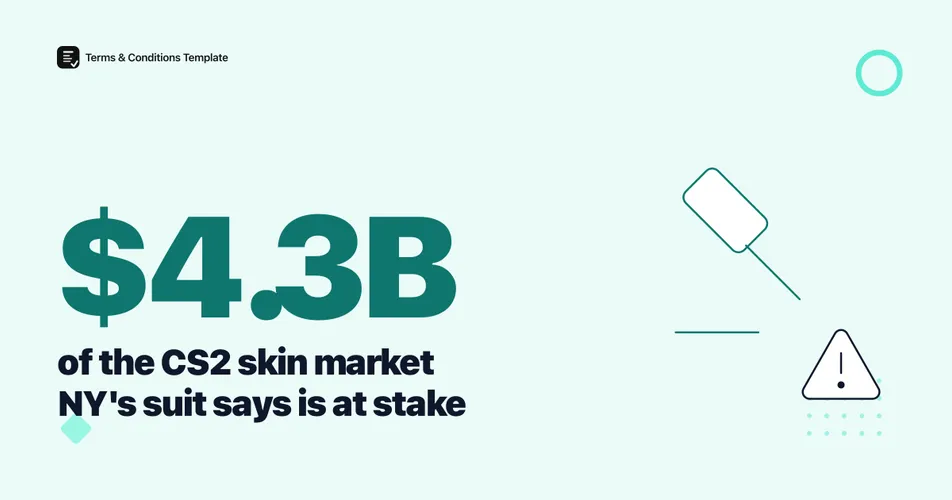
The suit doesn’t target a small feature. Loot boxes are an optional but central mechanic across Valve’s three biggest first-party titles, and the secondary market for the items they generate is large enough that the AG’s office cited an estimate putting the Counter-Strike skin market alone at over $4.3 billion. One individual skin has reportedly sold for more than $1 million. James is asking the court to stop Valve from running loot box mechanics going forward and to fine the company three times whatever it gained from the practice.

Source: GeekWire, “Valve Software sued by New York AG, accused of promoting illegal gambling via video game loot boxes”, captured August 8, 2026.
What the complaint actually alleges
New York’s theory isn’t that loot boxes exist. It’s that Valve built a closed loop where the randomized item and the cash value of that item are inseparable, and state gambling law doesn’t care whether the payout arrives as chips, tickets, or a tradeable virtual knife skin. The complaint walks through three pieces that, taken together, are what the AG’s office says makes this gambling rather than an ordinary blind-box purchase.
The first is the wager: a player pays real money for a loot box without knowing what it contains. The second is the chance element: the contents are randomly generated by Valve’s own systems, not chosen or influenced by the player. The third, and the one that separates this from a pack of trading cards, is the payout: the rarest drops can be resold on the Steam Community Market or on third-party marketplaces for amounts that dwarf the original purchase price, which is how a single skin can trade for over a million dollars.
James’s office frames the harm in blunt terms. In the office’s press release, she wrote that “illegal gambling can be harmful and lead to serious addiction problems… Valve has made billions of dollars by letting children and adults alike illegally gamble for the chance to win valuable virtual prizes.” The suit is part of a broader pattern for her office, which shut down 26 unlicensed online sweepstakes casinos in New York in 2025 before turning to Valve.
Figure: The scale of the secondary market New York’s complaint points to as evidence loot boxes carry real cash value. Source: GeekWire’s coverage of the AG’s complaint, citing an estimate for the Counter-Strike skin market as of 2025.
Valve’s defense: this is baseball cards, not blackjack
Valve responded publicly on March 11, 2026, through a statement posted to Steam Support, and it did not concede the core legal theory. The company said it doesn’t believe its loot box mechanics violate gambling law and was “disappointed to see the NYAG make that claim after working to educate them about our virtual items and mystery boxes since they first reached out to us in early 2023.” Valve compared its mystery boxes to Pokemon packs, Magic: The Gathering boosters, baseball cards, and Labubu toys, collectible categories where a buyer also doesn’t know exactly what’s inside until they open the pack.
Valve also pushed back on two specific remedies it believes the AG’s office wants: eliminating the ability to trade or transfer digital items, and requiring more invasive age-verification data collection. The company said it had already suspended more than one million Steam accounts for gambling-related activity involving its virtual items, positioning that enforcement record as evidence it already polices the behavior New York is suing over. Valve’s statement closed with an acknowledgment that “ultimately, a court will decide whose position, ours or the NYAG’s, is correct.”
New York's complaint vs. Valve's public defense
| NY AG's position | Valve's position | |
|---|---|---|
| What a loot box is | A wager with a random payout | A mystery box like trading cards |
| What gives it cash value | Steam Market resale of rare drops | A player-created secondary economy |
| Who is harmed | Minors and adults alike | Disputes any gambling harm exists |
| Requested/opposed fix | Stop the mechanic, treble damages | Opposes item transfer bans, data limits |
Neither side has proven anything yet. What matters for developers right now is that a state attorney general has put a specific, citable legal theory on the record: randomized purchase plus a functioning cash-out market equals gambling, regardless of what the drop looks like on screen.
What this means for your EULA
If your app or game sells any kind of randomized purchase, loot box, mystery pack, gacha pull, or card pack, this lawsuit is a reason to look at three clauses specifically, whether or not you ever expect to operate in New York.
The first is whether your EULA discloses odds at all. A EULA that describes a “mystery item” or “random reward” without stating the probability of each rarity tier reads, next to this complaint, like exactly the opacity New York is objecting to. Several jurisdictions already require odds disclosure for loot-box-style mechanics; stating them plainly in the EULA is cheap insurance even where it isn’t yet mandatory.
The second is whether your terms address resale value at all. Valve’s exposure here comes largely from the fact that its own marketplace lets players convert a random drop into cash. If your game has no secondary market and your EULA says items have no real-world value and cannot be redeemed for cash, that’s a meaningfully different legal position than Valve’s, and your EULA should say so in plain language rather than staying silent on it. If your game does support trading or resale, the EULA needs to be explicit that value is set by other players, not guaranteed or backed by you, since that’s the exact distinction Valve is now leaning on in court.
The third is age gating around randomized purchases specifically. A general “not intended for children under 13” line doesn’t address a gambling-style mechanic the way a dedicated clause requiring parental consent, or blocking randomized purchases for accounts flagged as minors, does. Given that James’s complaint leads with harm to “children and adults alike,” any EULA whose randomized-purchase language reads the same as its language for a flat-priced skin is a mismatch a plaintiff’s attorney would notice.
None of this requires shipping a different game. It requires the EULA to actually describe the odds, the resale mechanics (or lack of them), and the age controls around randomized purchases as their own clauses, rather than folding them into generic in-app-purchase language that predates this kind of scrutiny. Our EULA generator includes clauses for randomized digital items and virtual currency that can be adapted to state odds and resale terms explicitly, instead of leaving a loot box mechanic to hide inside a general purchases clause.
For the broader drafting picture on in-app purchases beyond loot boxes specifically, see our guide on terms and conditions for a mobile game with in-app purchases and the current in-app purchase spending data for 2026. This case also isn’t the only place app-store-level rules are reshaping what belongs in a EULA this year: see our coverage of the Texas Supreme Court order on app store age verification for a parallel, non-gambling example of the same trend.
Bottom line
New York hasn’t won this case, and Valve is fighting it. But the legal theory itself, that a randomized purchase becomes gambling once a functioning cash-out market exists for the prize, is now on the record in a state court complaint, not just in advocacy group reports. Any developer selling loot boxes, card packs, or gacha pulls with any kind of trade or resale path should treat this as the moment to check whether their EULA discloses odds, states plainly what happens to resale value, and gates randomized purchases for minors as its own clause rather than assuming general purchase terms already cover it.
The information in this article is for informational purposes only and should not be construed as legal advice on any matter, and does not create a lawyer-client relationship.