Global app downloads reached 149 billion in 2025, and consumers spent $167 billion inside apps, according to Sensor Tower’s State of Mobile 2026 report published in January 2026. Both figures confirm the app economy has stopped its pandemic-era sprint and settled into a slower, revenue-heavy phase: downloads barely moved while spending jumped 10%. That shift changes what a developer needs from a store listing, a licensing agreement, and a terms page.
If you publish an app, the numbers below explain where the money and the risk actually sit in 2026: which categories are growing, how much of a submission gets rejected before it ever reaches a user, and why a clear EULA matters more as review scrutiny rises.
How many times were apps downloaded in 2025?
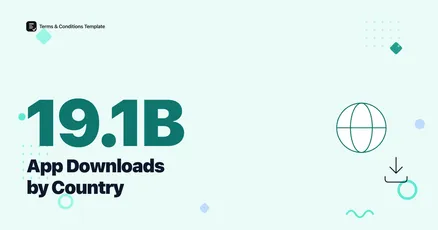
Apps were downloaded 149 billion times across the Apple App Store and Google Play combined in 2025, up just 0.8% from 2024’s 136 billion figure, per Sensor Tower’s State of Mobile 2026 report (released January 21, 2026). Growth in raw download volume has essentially plateaued after years of double-digit gains.
Figure 1: Combined annual app downloads, Apple App Store and Google Play. Source: Sensor Tower State of Mobile reports, 2024-2026 editions.
Download volume no longer tells the growth story on its own. The same report shows revenue climbing far faster than the number of installs, which means each download is worth more to a publisher than it was a year ago.
How much do consumers spend in apps?
Consumers spent $167 billion globally on in-app purchases in 2025, a 10% increase over 2024’s $150 billion, according to Sensor Tower. For the first time on record, spending on non-gaming apps outpaced games: non-gaming in-app purchase revenue rose 21% year over year to roughly $85 billion, nearly three times what the category earned five years earlier, while gaming revenue grew a comparatively flat 1%.
The 2025 App Economy in Four Numbers
Non-gaming’s rise is largely an AI story. ChatGPT’s in-app purchase revenue grew 254% year over year, its downloads grew 148%, and it finished 2025 as the third highest-grossing app worldwide behind TikTok and Google One, per Sensor Tower’s category data. If your app touches AI features at all, generate a EULA that names the AI functionality and the licensing terms around it, since a EULA written before the feature existed will not cover it.
Spending growth outrunning download growth by this much means the average paying user is worth more than in past years, not that more people are paying.
Figure 2: Global in-app purchase spend, trending upward each year. Source: Sensor Tower State of Mobile reports, 2023-2026 editions.
How many apps are on the Apple App Store and Google Play?
The Apple App Store carried roughly 2.2 to 2.5 million apps as of late 2025 depending on whether the count comes from Apple’s own reporting or a third-party crawl, and about 95.4% of those apps are free to download, according to Statista and Business of Apps tracking. Google Play carried approximately 2,137,219 apps as of December 2025, with 800 to 1,200 new apps added daily, and roughly 97% listed as free.
| Metric | Apple App Store | Google Play |
|---|---|---|
| Total apps (late 2025) | ~2.2M to 2.5M | ~2.14M |
| Share free to download | ~95.4% | ~97% |
| Weekly active users | 850M+ | Not disclosed |
| 2025 ecosystem revenue | $1.4T (billings and sales) | $63.4B (est. store revenue) |
Sources: Statista App Store tracking (2025); Business of Apps App Store and Google Play data (2025); Apple Newsroom (June 2026).
Store size keeps growing even as review gets stricter, which means discoverability, not app count, is now the harder problem for a new publisher to solve.
How much of the App Store economy actually reaches developers?
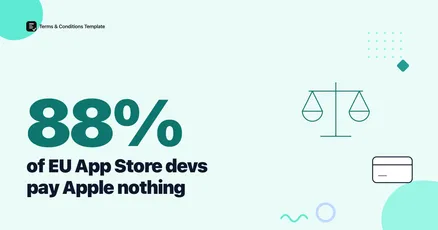
The App Store ecosystem generated $1.4 trillion in developer billings and sales in 2025, according to Apple’s own report published in June 2026, and on more than 90% of that revenue developers paid Apple no commission at all. Apple frames this as proof the store mostly functions as free distribution infrastructure rather than a toll road, since commission only applies to digital goods and services sold inside an app, not to physical goods, services booked through an app, or in-app advertising.
Figure 3: Share of 2025 App Store ecosystem billings on which developers paid Apple no commission. Source: Apple, “Apple’s Global App Store Ecosystem and Its Growth,” June 2026.
The ecosystem has nearly tripled since 2019, per the same Apple report, driven largely by categories Apple does not take a cut from at all, like ride-hailing bookings and retail app purchases that route payment outside the app. Apple also reports that apps with consumer-facing AI features saw roughly 4 times more billings growth than apps without them, which lines up with Sensor Tower’s separate finding that AI Assistants was the fastest-growing app category of 2025 by both revenue and time spent.
None of this changes what counts as taxable commission for Apple. The 90% figure covers digital goods and services sold through in-app purchase, physical goods and services booked through an app such as ride-hailing or food delivery, and in-app advertising revenue, none of which Apple takes a cut of under its current App Store rules. Only digital content and subscriptions sold directly inside an app remain subject to the standard 30% or reduced 15% small-business commission.
How many apps get rejected or removed for policy violations?
Google rejected more than 1.75 million app submissions for policy violations in 2025 and separately removed roughly 2 million previously published apps, according to Google’s own security blog post published in February 2026. Google also blocked over 255,000 apps from obtaining excessive access to sensitive user data and banned more than 80,000 developer accounts, all figures the company frames as evidence that its review pipeline is catching more before publication rather than only after user complaints.
Figure 4: The two-stage filter apps pass through on Google Play. Source: Google Online Security Blog, “Keeping Google Play & Android app ecosystems safe in 2025,” February 2026.
Google ran more than 10,000 automated safety checks per published app in 2025 and used generative AI models to help reviewers catch more complex violations, a scale of enforcement that did not exist five years ago. Google Play Protect, the scanning layer that runs even after publication, screened over 350 billion apps daily across the wider Android ecosystem in 2025 and flagged more than 27 million malicious apps sideloaded from outside Google Play entirely, according to the same security blog post.
Apple runs a comparable, though less publicly quantified, pre-publication review for the App Store, combining automated checks with human reviewers for every submitted build. Neither company breaks out how many rejections trace specifically to missing or inadequate legal disclosures such as a EULA or privacy policy, but both list incomplete or inaccurate app metadata and policy information among their published rejection reasons, and both stores’ own guidelines require that in-app purchase terms, subscription terms, and licensing language match what the app actually does.
Why does review scrutiny keep rising?
Enforcement intensity has climbed every year the two major stores have disclosed removal data, tracking the same period that in-app spending has climbed. Plotting the two trends side by side shows they move together, not in opposite directions.
Figure 5: Store scale and enforcement volume rising together. Sources: Apple Newsroom, Sensor Tower State of Mobile reports, Google Online Security Blog.
A store processing this much revenue and this many submissions cannot review every line of every listing by hand, which is exactly why automated policy checks increasingly flag missing or mismatched legal terms, not just malware.
How has app review changed since 2019?
- Manual review dominated the approval process
- Generic or templated EULAs rarely triggered rejection
- Policy violations caught mostly after user reports
- AI-assisted review flags mismatched or missing legal terms
- Over 1.75M submissions rejected before publication in 2025
- 10,000+ automated safety checks run per published app
The shift from manual, report-driven moderation to AI-assisted, pre-publication screening is the single biggest change in how a listing gets approved, and it puts license terms and data disclosures under earlier, harder scrutiny than they faced even two years ago.
The Bottom Line
The app economy in 2026 rewards depth over volume: downloads grew less than 1% in 2025 while consumer spending grew 10%, and AI-driven non-gaming apps now out-earn games for the first time. At the same time, both major stores tightened review, with Google alone rejecting 1.75 million submissions and removing 2 million more. A generic or outdated EULA is one of the easier things a review pipeline can flag, and one of the cheapest things to fix. If your app’s licensing terms, data use, or AI-feature disclosures have not been updated recently, that is the first place to check before your next submission.
Frequently Asked Questions
How many times were apps downloaded in 2025? 149 billion times across the Apple App Store and Google Play combined, according to Sensor Tower’s State of Mobile 2026 report, up 0.8% from 2024.
How much did consumers spend in apps in 2025? $167 billion globally in in-app purchases, a 10% year-over-year increase, per Sensor Tower. For the first time, non-gaming apps out-earned games, at roughly $85 billion versus games’ remaining share.
How many apps are on the Apple App Store and Google Play? The Apple App Store carried roughly 2.2 to 2.5 million apps and Google Play carried about 2.14 million apps as of late 2025, per Statista and Business of Apps tracking.
How many apps get rejected from Google Play? Google rejected more than 1.75 million app submissions for policy violations in 2025 and removed a further 2 million published apps, according to Google’s own security blog.
Sources and References
- Sensor Tower. (2026). “State of Mobile 2026.” Global download and consumer spend data, published January 21, 2026.
- Apple Newsroom. (2026). “Apple’s Global App Store Ecosystem and Its Growth 2025.” Published June 4, 2026.
- Google Online Security Blog. (2026). “Keeping Google Play & Android app ecosystems safe in 2025.” Published February 2026.
- Statista. (2025). “Number of apps available in leading app stores.” App count tracking, 2025 data.
- Statista. (2025). “Number of apps from the Apple App Store.” Quarterly app count since 2008.
- Business of Apps. (2025). “Apple App Store Statistics.” Free/paid split and category tracking.
Note: All figures verified as of July 2026. App store download, revenue, and enforcement figures update on each store’s own annual reporting cycle, so headline figures here are refreshed at least twice a year.