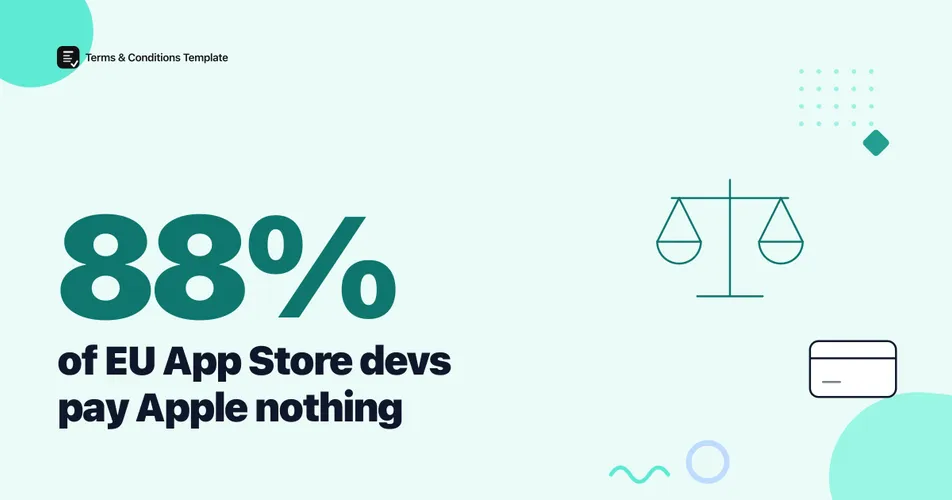
88% of developers on the App Store in the European Union now pay Apple no commission at all, according to Apple’s own 2026 developer terms published to comply with the EU’s Digital Markets Act. Outside the EU, Apple still charges its standard 30% cut on paid apps and in-app purchases, reduced to 15% for smaller developers, while Google Play runs a nearly identical 15%/30% split. Here is how each platform’s commission actually works in 2026, including the fee Apple briefly charged on external payment links before a federal court shut it down.
What commission does Apple charge on the App Store?
Apple’s standard commission is 30% on paid apps and in-app purchases, the same headline rate it has charged since the App Store opened in 2008. Developers who earned up to $1 million in App Store proceeds in the prior calendar year can apply for the App Store Small Business Program instead, which cuts the commission to 15%. Apple announced the program on November 18, 2020, and it took effect January 1, 2021, with Apple stating at launch that it would “benefit the vast majority of developers who sell digital goods and services on the store.”
Figure 1: Share of App Store developers in the EU paying Apple a commission at all. Source: Apple, “Update on apps distributed in the European Union,” 2026.
That 88% figure is specific to the EU’s alternative business terms, covered in detail below, but it underlines a point that holds everywhere Apple operates: the 30% headline rate is what a large publisher pays, not what most individual developers actually pay. If a developer’s proceeds rise above $1 million during the year, the standard rate applies to future sales; if proceeds later fall back under the threshold, they can requalify for 15% the following year.
Apple’s 30% rate is unchanged in 2026, but which developers actually pay it keeps shrinking as the Small Business Program, EU alternative terms, and external-link rulings carve out exceptions around it. For the download and revenue numbers behind these commission tiers, see our App Store statistics for 2026.
What commission does Google Play charge developers?
Google Play’s baseline is 15% on a developer’s first $1 million in annual revenue and 30% on everything earned above that, according to Google’s current Play Console service fee schedule. Subscriptions are billed at a flat 15% regardless of a developer’s total revenue. Google also states that 97% of developers distribute their apps at no charge at all, and that of the smaller group who do pay a service fee, 99% are eligible for 15% or less through programs like the Play Media Experience Program.
Figure 2: Standard and reduced commission tiers, Apple vs. Google Play, 2026. Source: Apple Small Business Program page and Google Play Console service fees page.
Developers who offer an alternative billing system alongside Google Play’s own billing, currently available to users in South Korea and India, pay a service fee equal to the standard rate minus 4 percentage points. Google Play’s structure has tracked Apple’s small-developer tier closely since 2021, and the chart above shows how tightly the two platforms’ published rates now mirror each other outside of Apple’s EU-specific terms.
How has the EU’s Digital Markets Act changed Apple’s fees?
Apple’s EU alternative business terms, adopted to comply with the Digital Markets Act, let developers distribute apps outside the App Store and use non-Apple payment systems. Developers who adopt these terms pay a reduced commission of 10% for the vast majority of apps (and for subscriptions after their first year) or 17% for apps that exceed Apple’s revenue thresholds, instead of the standard 30%. Developers who stay on the App Store’s own payment processing under the alternative terms pay an additional 3% fee on top of that commission.
Figure 3: How an EU app’s commission is determined under Apple’s 2026 terms. Source: Apple, “Update on apps distributed in the European Union.”
Apple separately charges a Core Technology Commission of 5% on sales of digital goods that a developer promotes through an actionable external purchase link inside their app, effective June 26, 2025, renewing every 12 months per install. Apple has said it plans to fold its older per-install Core Technology Fee into this single Core Technology Commission model for all EU developers, a transition Apple’s developer terms describe as targeted for January 1, 2026. Combined, these EU-specific carve-outs are why 88% of developers on the App Store in the EU pay Apple no commission at all: most simply distribute free apps or sell nothing that counts as a digital good.
What did the Epic v. Apple ruling change about App Store fees?
Apple’s anti-steering rules were the last unresolved piece of Epic Games v. Apple after the US Supreme Court declined to hear either side’s appeal on the case’s other claims. To comply with the surviving injunction, Apple let developers add external links to purchasing pages, but required developers to pay Apple 27% of any sale made within seven days of a customer clicking through one of those links, a rate Apple described as accounting for “the substantial value Apple provides developers.” Epic asked the court to enforce a stricter reading of the injunction, and in April 2025, US District Judge Yvonne Gonzalez Rogers ruled that Apple had “willfully” failed to comply with her prior order, barring Apple from collecting any revenue share on external link purchases or restricting how those links appear in an app.
Figure 4: Key commission-related events across both platforms. Sources: Apple Newsroom, Apple DMA terms, Epic Games v. Apple court record.
This part of the case is still moving. The Ninth Circuit denied Apple’s request for an emergency stay of that order on June 4, 2025, and the dispute returned to the district court to determine what, if any, revenue share Apple can eventually charge on external purchases. As of August 2026, Apple has asked the Supreme Court to review the contempt finding, and the Court has agreed to hear that narrow question in its 2026 term, so treat the current zero-commission state on US external links as provisional rather than settled.
How do Google Play’s 2026 fee cuts compare to Apple’s EU changes?
Google Play’s core 15%/30% structure is not changing globally, but starting June 30, 2026, Google is rolling out a new fee structure for transactions with users in the EEA, UK, and US that separates a service fee from a new billing fee. Under the new structure, a developer’s first $1 million in annual earnings and all subscriptions are billed at 10% plus a 5% billing fee, an effective 15% that matches the prior single-rate tier. The bigger change is on standard transactions from new app installs after the rollout date: those drop from a combined 30% to 25% (20% service fee plus 5% billing fee), or as low as a flat 20% if the developer routes the sale through an external web link instead of Google Play’s own billing.
Figure 5: Google Play’s total fee by transaction type, before and after the June 30, 2026 EEA/UK/US rollout. Source: Google Play Console Help, service fees page.
Existing installs from before the rollout date keep paying the prior combined 30% rate until they update, so the practical cut only applies going forward. Between Google’s phased-in discount for new installs and external links, and Apple’s EU alternative terms cutting the standard rate to 10% or 17%, both platforms are converging on the same regulatory pressure point: full-price 30% commission increasingly applies only to developers who stay on the default, closed-billing path.
App Store and Google Play commission at a glance
| Program | Commission | Who it applies to | Extra fees |
|---|---|---|---|
| Apple Standard | 30% | All App Store sales by default | None |
| Apple Small Business Program | 15% | Developers with up to $1M in prior-year proceeds | None |
| Apple EU Alternative Terms | 10% or 17% | Developers who adopt alternative EU distribution/payment terms | +3% for Apple’s payment processing, +5% Core Technology Commission on external links |
| EU App Store developers overall | 88% pay $0 | Developers distributing free apps or no in-app digital goods | None |
| Google Play Standard | 15% / 30% | First $1M in annual revenue / earnings above that | None |
| Google Play EEA/UK/US, from June 30, 2026 | 15% to 25% (or 20% via external link) | New installs, tiered by revenue and transaction type | 5% billing fee component |
Source: Apple App Store Small Business Program page; Apple “Update on apps distributed in the European Union”; Google Play Console Help, service fees.
If you distribute an app under any of these commission tiers, the terms and conditions you publish for it should match what you actually charge users and how refunds, subscriptions, and in-app purchases are handled under that agreement. A generic EULA copied from another app can misstate purchase terms that a store’s own review process, or a regulator, will flag. You can generate an EULA that matches your actual in-app purchase and subscription terms in a few minutes.
The Bottom Line
Apple’s headline 30% commission has not moved since 2008, but fewer developers pay it every year. The Small Business Program already cut it to 15% for smaller developers back in 2021, and the EU’s Digital Markets Act pushed that further: 88% of developers on the App Store in the EU now pay Apple nothing at all, while the rest pay 10% or 17% instead of 30%. Google Play’s numbers tell a similar story, with 97% of developers paying no fee and a mid-2026 cut trimming new-install fees further in the EEA, UK, and US. The one number still genuinely unsettled is what Apple can eventually charge on external payment links in the US, a question the Supreme Court has now agreed to hear.
Frequently Asked Questions
What percentage of App Store developers pay no commission to Apple? 88% of developers on the App Store in the EU pay Apple no commission at all, according to Apple’s own developer terms page for the Digital Markets Act (2026). Globally, Apple’s Small Business Program separately cuts the rate to 15% for anyone earning up to $1 million a year, which Apple has said covers the vast majority of developers.
What is Apple’s standard App Store commission rate? 30% on paid apps and in-app purchases is Apple’s standard commission, the same rate it has charged since the App Store launched in 2008, though developers earning up to $1 million a year in proceeds pay 15% under the Small Business Program.
What commission does Google Play charge developers? Google Play charges 15% on a developer’s first $1 million in annual revenue and 30% above that, per Google’s current Play Console service fee schedule. Google states 97% of developers pay no service fee at all because they distribute free apps, and 99% of the developers who do pay a fee are eligible for 15% or less.
Did the Epic v. Apple ruling remove Apple’s commission on external payments? In April 2025, a US federal judge ruled Apple willfully violated her injunction and barred Apple from taking any cut of purchases made through external payment links, ending the 27% fee Apple had briefly charged. Apple is appealing, and the US Supreme Court has agreed to hear the case in its 2026 term, so the final commission on external links is not yet settled.
Sources and References
- Apple. “App Store Small Business Program.” Apple Developer.
- Apple Newsroom. (2020). “Apple announces App Store Small Business Program.” Press release, November 18, 2020.
- Apple. “Update on apps distributed in the European Union.” Apple Developer Support.
- Google Play Console Help. “Service fees.”
- European Commission. “The Digital Markets Act.”
- Epic Games v. Apple, US District Court for the Northern District of California. Summary of the April 2025 contempt ruling and subsequent appeals, including the Ninth Circuit’s June 2025 stay denial and the Supreme Court’s grant of certiorari for the 2026 term.
Note: All figures verified as of August 2026. Apple’s EU terms, Google Play’s EEA/UK/US fee rollout, and the Epic v. Apple appeal are all active and subject to change; the external-link commission in particular is unresolved pending the Supreme Court’s 2026 term review, so headline figures here are refreshed at least twice a year.