On July 6, 2026, the Supreme Court declined to block Texas’s App Store Accountability Act, letting the law’s age verification and parental consent requirements stay in effect while a First Amendment challenge continues in the lower courts. The justices issued a pair of brief, unsigned orders on the emergency docket, in Students Engaged in Advancing Texas v. Paxton (No. 25A1389) and Computer and Communications Industry Association v. Paxton (No. 25A1390), with no public dissents noted.
Neither order ruled on whether SB 2420 is constitutional. The Court only decided that the law can keep operating while the underlying appeal plays out, which means Apple, Google, and every developer whose app appears in their Texas app stores has been living under the law’s age verification and consent rules since a Fifth Circuit panel first paused a district court injunction against it on June 4, 2026, and now knows that status will hold for the foreseeable future.
For developers who publish an app into the Texas market, the practical question isn’t about the constitutional fight. It’s whether the EULA sitting in front of users today reflects what the app store, not just the developer, is now required to check before a minor can download the app or buy anything inside it.
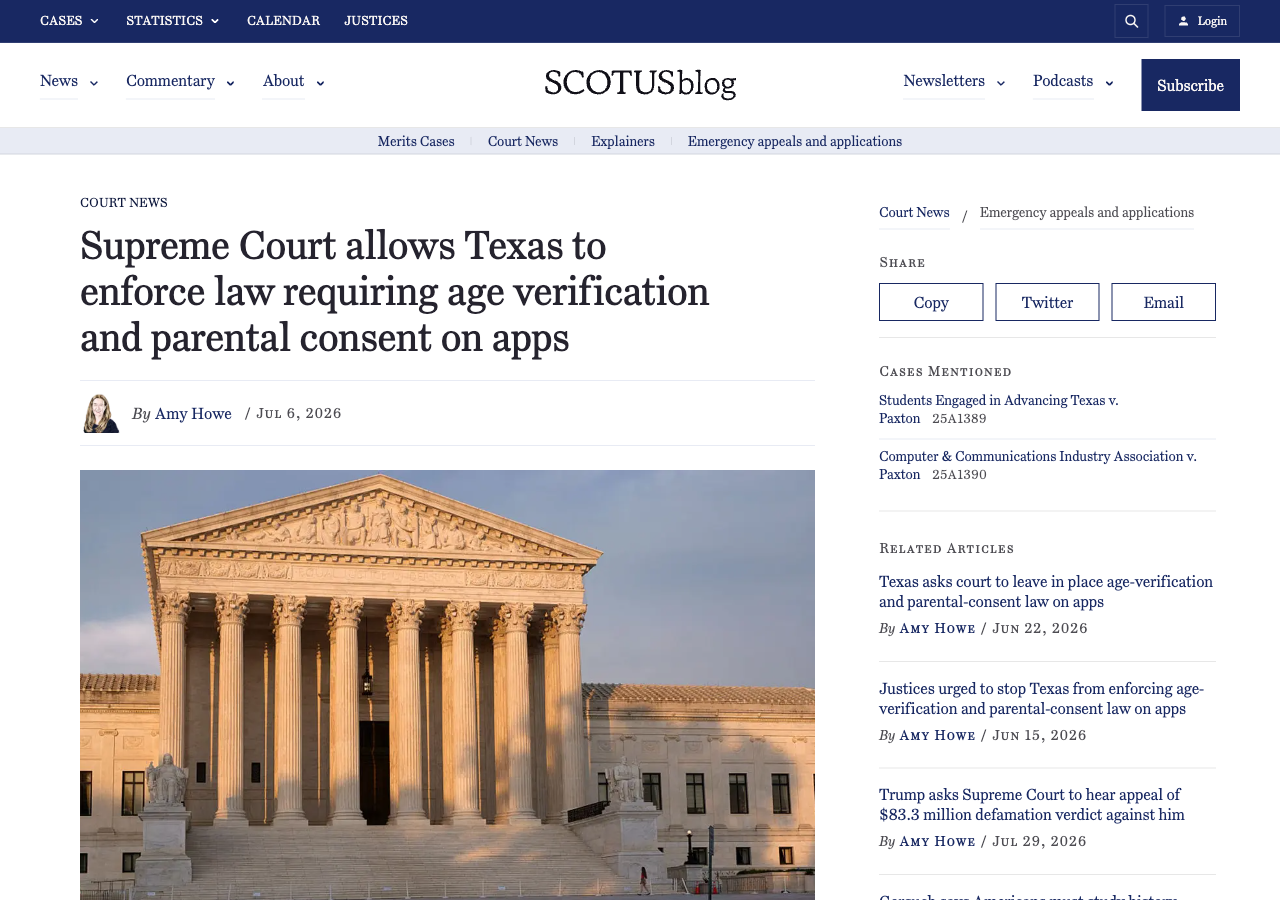
Source: SCOTUSblog, “Supreme Court allows Texas to enforce law requiring age verification and parental consent on apps”, captured August 4, 2026.
How the case got here
The Texas App Store Accountability Act, SB 2420, was scheduled to take effect January 1, 2026. Before it could, two separate sets of challengers sued: Students Engaged in Advancing Texas, a youth policy group, and the Computer and Communications Industry Association, a trade group representing app stores and developers. Both argued the law’s age verification and content-rating requirements amount to unconstitutional regulation of speech.
U.S. District Judge Robert Pitman in Austin agreed, at least preliminarily, and issued orders in December 2025 temporarily blocking the state from enforcing the law. Texas appealed, and on June 4, 2026, the Fifth Circuit stayed Pitman’s orders, letting enforcement resume while the appeal proceeded. The challengers then asked the Supreme Court to reinstate the district court’s block. The justices said no on July 6, 2026, so the law stays in force for now, and the constitutional merits move back to the Fifth Circuit, which has an expedited hearing scheduled for early August 2026.
Texas told the Court in its filing that SB 2420 regulates a commercial transaction, not speech, comparing it to age restrictions on a driver’s license rather than a restriction on what any app is allowed to say. That argument is what persuaded the Fifth Circuit to let the law resume, and it’s the argument the full appeal will now test on the merits.
What SB 2420 actually requires
The law puts obligations on two different parties: the app store operating the marketplace (Apple’s App Store, Google Play) and the developer whose app is listed there. It sorts every user into one of four age tiers, under 13, 13 to 15, 16 to 17, and 18 or older, and ties different consent requirements to each.
What changes under SB 2420
| Before enforcement | Now (in effect) | |
|---|---|---|
| Age check | Self-reported birthdate | App store verifies age at signup |
| Minor downloads | Set by the developer's own terms | Blocked without linked parental consent |
| In-app purchases by minors | Set by refund and billing terms | Fresh parental consent per purchase |
| Non-compliance exposure | Ordinary contract dispute | Deceptive trade practice under Texas law |
Two details matter more than the general “age verification” headline suggests. First, consent under SB 2420 isn’t a blanket, set-it-once approval: a parent has to sign off on each download and each in-app purchase a minor makes, and developers have to notify the app store when a material change (new data collection, a new monetization mechanic, a revised age rating) should trigger a fresh consent request. Second, the verification and consent data flowing between app store and developer carries its own restrictions: developers are limited to using it for age enforcement, legal compliance, and safety features, and are required to delete it once verification is complete rather than retain it for other purposes.
That data-handling boundary is exactly the kind of clause that belongs in a EULA, not just in an internal compliance policy, because it’s the developer’s contractual promise to users about what happens to the age and consent signals the app receives from the store.
Figure: The scale of support the law drew at the Supreme Court. Source: Texas Policy Research, reporting on the amicus brief filed ahead of the July 6, 2026 order.
Twenty-seven state attorneys general, led by Florida’s, filed an amicus brief urging the Court to leave SB 2420 in place, arguing the law “merely recognizes that parents have a right to supervise the sources and materials that are imposed on their children” and that it regulates business conduct rather than protected expression. That’s a wide coalition for a law that’s still working through a First Amendment challenge, and it’s one signal among several that similar app-store age verification mandates are likely to spread to other states regardless of how the Fifth Circuit ultimately rules on Texas’s law specifically. Utah and Louisiana have already passed comparable legislation that has not yet taken effect.
What this means if you publish an app in Texas
If your EULA was drafted before this law existed, or drafted for a national audience without a state-specific carve-out, there are three gaps worth checking now rather than after a complaint arrives.
The first is whether your EULA still describes age eligibility the way most software EULAs have for years: a single line stating the app “is not intended for users under 13” or requiring users to self-certify their age, with no reference to a parental consent mechanism at all. Under SB 2420, that self-certification model doesn’t reflect what’s actually happening at the point of download for a Texas user. The app store, not your app, is now doing the verification and consent collection, and your EULA should say so rather than imply your own age gate is the operative control.
The second is what your EULA promises about data the app store hands you once a user is verified. If your EULA’s data-use clause is written broadly (“we may use account data to improve our services and for any other lawful business purpose”), that’s now in tension with a state law that limits how you’re allowed to use age-verification data specifically. A EULA clause that scopes data use narrowly for anything flagged as age or consent data, separate from your general data-use language, closes that gap.
The third is what happens contractually if a Texas user circumvents age verification, whether by using a different account or a workaround the app store didn’t catch. Most EULAs already disclaim liability for user misrepresentation of age; it’s worth confirming that clause references the app-store-level verification process now in place rather than only the app’s own signup flow, since a plaintiff’s attorney reading a generic “user represents they are of legal age” clause against a law that shifts verification duty onto the platform is exactly the kind of mismatch this litigation wave has been probing.
None of this requires rewriting the whole document. It requires the age-eligibility, data-use, and misrepresentation clauses to actually describe the verification and consent flow SB 2420 puts in place, rather than the self-certification model most EULA templates still assume.
Bottom line
The Supreme Court didn’t decide whether SB 2420 is constitutional, and the Fifth Circuit’s expedited hearing this month means the law’s final fate is still genuinely open. What isn’t open, for now, is whether the law applies: it does, to any app listed in the Texas app stores, while the appeal runs its course. If your EULA hasn’t been updated to reflect the age-tier verification and per-transaction parental consent model this law imposes, that’s a real gap between what your document says and what’s actually happening at the point of download for your Texas users. Our EULA generator includes age-eligibility and data-use clauses you can adapt to reflect app-store-level age verification rather than a generic self-certification line, so the document matches how minors actually reach your app now, not how they did before this law took effect.
The information in this article is for informational purposes only and should not be construed as legal advice on any matter, and does not create a lawyer-client relationship.