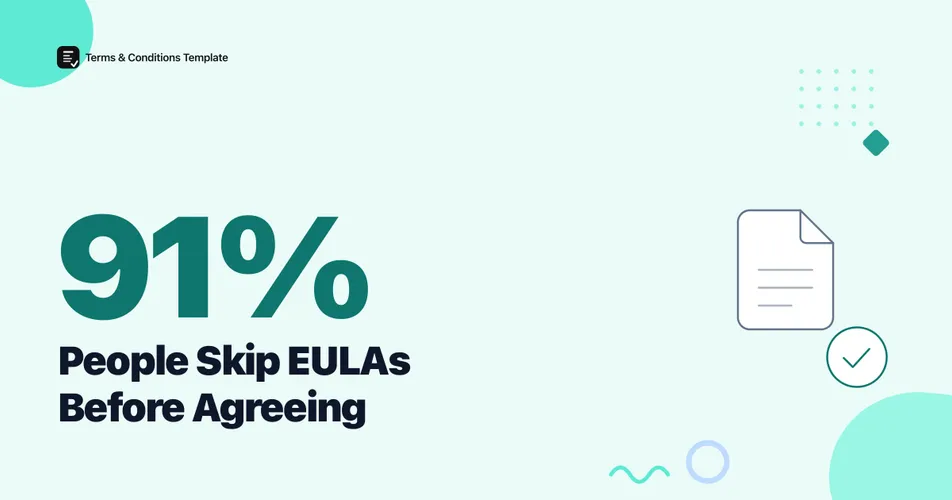
Only about 9% of people read the terms before agreeing to them. According to Deloitte’s Global Mobile Consumer Survey of 2,000 US consumers, 91% consent to legal terms and software license agreements without reading them, and that rate climbs to 97% for people ages 18-34. Every study that has actually measured the behavior, rather than asking people to self-report it, lands in the same range.
The gap between what a EULA legally requires and what a user actually sees before clicking Agree is the real story here. Below is what the timing data, the missed-clause experiments, and one memorable real-world test say about how little of a software license agreement anyone reads.
How many people read a EULA before agreeing?
Roughly 9% of people read the terms in front of them, and that number holds up across two different measurement methods. Deloitte’s 2017 survey found 91% of the 2,000 US consumers it questioned said they consent to legal terms and conditions without reading them. Separately, MeasuringU’s Jeff Sauro analyzed timing logs from about 2,500 real software installation sessions and found that, at 95% statistical confidence, no more than 8% of users spent enough time on the license screen to have read it in full.
One study asked people, the other measured what they actually did, and they agree almost exactly. That convergence is unusual in behavioral research and is a large part of why this figure keeps getting cited nearly a decade after Deloitte first published it.
Figure 1: Share of US consumers who read legal terms before consenting. Source: Deloitte Global Mobile Consumer Survey, n=2,000, 2017.
Warning
Deloitte’s 2017 survey is still the most-cited named figure for this exact question, and it keeps showing up in 2023 and 2024 coverage because no equivalently sized, methodologically disclosed replacement survey has been published since. Treat the 91%/97% split as the standing reference point rather than a fresh 2026 measurement, and treat any blog post citing a different round number for this stat with suspicion unless it names its own primary source.
How long does it take to actually read a EULA?
A typical EULA or terms of service document takes far longer to read than anyone spends on it. Using standard adult reading speed of 250 to 280 words per minute, researchers Jonathan Obar and Anne Oeldorf-Hirsch calculated that a privacy policy and terms of service pair should take roughly 45 minutes combined to read properly. In their study, participants who opened the documents at all spent an average of just 51 seconds on them.
MeasuringU’s install-log data tells the same story at the software level: the median time on a EULA screen was 6 seconds, and at least 70% of sessions lasted under 12 seconds, against an assumed 2-minute floor for reading even a short agreement in full.
The visual above is the same 91%/9% split from Deloitte’s survey, mapped onto reading behavior rather than a survey question. Both framings point at the same underlying habit: clicking Agree is treated as a formality, not a decision point.
Is this consistent across different studies?
Yes. Every named, sample-sized study on this behavior, regardless of exact methodology or document type, finds that most people do not read what they are agreeing to.
| Study | Year | Sample | Share who did not read in full |
|---|---|---|---|
| MeasuringU (Jeff Sauro) | 2011 | ~2,500 install sessions | 92% |
| Deloitte Global Mobile Consumer Survey | 2017 | 2,000 US consumers | 91% |
| Obar & Oeldorf-Hirsch, “The Biggest Lie on the Internet” | 2020 | 543 participants | 74% skipped the privacy policy entirely |
Figure 2: Non-reading rates across three independently conducted studies. Sources: MeasuringU 2011, Deloitte 2017, Obar & Oeldorf-Hirsch 2020.
Obar and Oeldorf-Hirsch’s figure is lower because it measures only who skipped the document entirely, a stricter and narrower behavior than “did not read in full.” Even on that stricter bar, roughly three in four participants never opened the page at all. If you generate a EULA for your own software, assume the overwhelming majority of installers will never open it, and put anything you actually need users to notice, such as data collection or refund limits, somewhere more visible than the license text.
What do people miss by not reading?
Skipping the terms has consequences that go beyond an abstract compliance risk. Obar and Oeldorf-Hirsch built a fictitious social network called NameDrop and buried two absurd clauses in its terms of service: one requiring users to share their data with the NSA, and one requiring them to surrender their firstborn child as a condition of service. Among the 543 participants, 98% missed both clauses entirely. 74% never opened the privacy policy at all, instead clicking a “quick join” shortcut past it.
A real-world experiment reached a similar conclusion through a very different method. In 2005, PC Pitstop buried a clause in its own EULA offering a $1,000 cash reward to the first person who emailed the company about it. It took 5 months and more than 3,000 software sales before Doug Heckman became the first buyer to notice and claim the reward.
Figure 3: How PC Pitstop’s buried-clause EULA experiment played out. Source: PC Pitstop, 2005.
These are not the same population or method, but they point the same direction: a clause can sit in plain text inside a document that thousands of people formally accept, and go unnoticed for months.
Does age or platform change EULA reading rates?
Age is the one reliable predictor the data actually supports. Deloitte’s survey found 97% of respondents ages 18-34 accept legal terms without reading them, compared to 91% across all ages, meaning younger consumers skip reading at a noticeably higher rate than the overall population, not a lower one. This runs against the common assumption that older users are the ones skipping the fine print out of unfamiliarity with technology.
We could not find a reliably sourced, sample-sized breakdown by platform (mobile app versus desktop software versus browser extension) or by device. Multiple blogs cite specific country and device splits for terms-reading behavior, but none of the ones we checked traced back to a named study with a disclosed sample. Treat any such breakdown as unverified until a primary source publishes one.
Figure 4: Seconds spent viewing license and terms documents, by study. Sources: MeasuringU 2011, Obar & Oeldorf-Hirsch 2020.
Figure 5: Chronology of the research behind these numbers. Sources: as cited throughout this article.
The pattern has held for roughly two decades across five separate research efforts using five different methods: a planted cash reward, an economic cost model, install-log timing, a fabricated social network, and a repeated consumer survey. None of them found a reading rate anywhere close to a majority.
The Bottom Line
The honest answer to “how many people read a EULA” is somewhere between 6% and 9%, depending on which named study you use, and the number has not moved in any meaningful way across nearly 20 years of measurement. Deloitte’s 91%/97% split, MeasuringU’s 6-second median, and Obar and Oeldorf-Hirsch’s 98% missed-clause rate were produced by three different research teams using three different methods, and they all describe the same behavior: clicking Agree is a reflex, not a review. If you publish software, treat the EULA as a legal record that almost nobody will read rather than a communication channel, and put anything users genuinely need to see, refund terms, data use, liability limits, in your product interface itself, not buried on page four of a document with a 6-second average dwell time. A clear, current EULA still matters for enforceability even when almost nobody opens it.
Frequently Asked Questions
What percentage of people read a EULA before agreeing? About 9% read it at all. Deloitte’s Global Mobile Consumer Survey of 2,000 US consumers found 91% consent to legal terms and software conditions without reading them, and MeasuringU’s log-data study of roughly 2,500 install sessions found no more than 8% read the license agreement in full.
How long do people actually spend on a EULA screen? A median of 6 seconds, according to MeasuringU’s analysis of about 2,500 software installation sessions. The same study found at least 70% of users spent less than 12 seconds on the license screen, well short of the roughly 2 minutes needed to read a short agreement.
Do younger people read EULAs less than older people? Yes. Deloitte found 97% of consumers ages 18-34 accept legal terms without reading them, compared to 91% across all age groups, based on a 2017 survey of 2,000 US respondents.
What do people miss by not reading the terms? Obar and Oeldorf-Hirsch’s 2020 study embedded a clause requiring users to give up their firstborn child and share data with the NSA in a fictitious terms of service document. 98% of the 543 participants missed both clauses entirely, and 74% skipped the privacy policy altogether by clicking a quick-join option.
Sources and References
- Business Insider, reporting Deloitte’s Global Mobile Consumer Survey. (2017). “91% of People Agree to Legal Terms Without Reading Them.” Survey of 2,000 US consumers.
- Jeff Sauro, MeasuringU. (2011). “Are Users More Likely to Read a EULA With This One Weird Trick?” Log-data analysis of roughly 2,500 software installation sessions.
- Obar, J. A., & Oeldorf-Hirsch, A.. (2020). “The Biggest Lie on the Internet: Ignoring the Privacy Policies and Terms of Service Policies of Social Networking Services.” Information, Communication & Society, 23(1). Fictitious “NameDrop” network study, 543 participants, fielded 2016.
- PC Pitstop. (2005, revisited 2009). “4 Years Later: The PC Pitstop EULA Experiment Still the Buzz.” Real-world buried-clause experiment, over 3,000 sales before the clause was noticed.
- CGAP. (2020). “Data Protection and Financial Inclusion: Why Consent Is Not Enough.” Secondary citation corroborating the Deloitte 91%/97% figures.
Note: All figures verified as of August 2026. The Deloitte and MeasuringU figures are the most recent named, sample-sized studies we could trace on this specific question; both are flagged in-text as older sources with no fresher equivalent published since. Figures are re-checked at least twice a year for a fresher primary source.