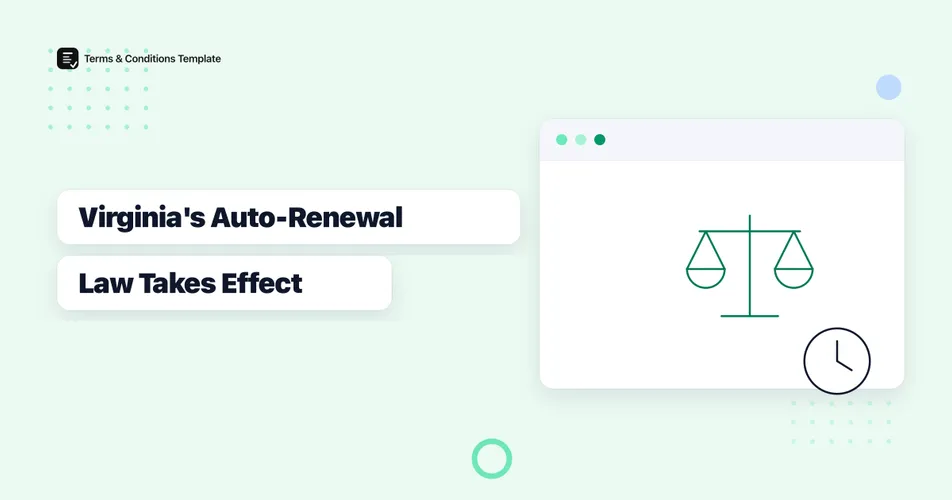
On July 1, 2026, amendments to Virginia’s automatic-renewal law took effect, adding a specific rule to the Virginia Consumer Protection Act: a business that offers a subscription or continuous-service plan to a Virginia consumer must provide a cancellation mechanism through every channel it offers enrollment through, and each of those cancellation mechanisms must be at least as easy to use as the one the consumer used to sign up. The amendments arrive via two companion bills, HB1022 and SB493, and they update Chapter 17.8 of the Code of Virginia, sections 59.1-207.45 through 59.1-207.49.
The new language is narrow but specific. A seller can no longer bury cancellation behind a live-agent call if signup happened with a single click online, and a seller that signs a customer up in person still has to offer an online or phone cancellation path. The amendments also remove the “good faith effort” defense that previously gave a business some cover if it made a reasonable attempt to comply, meaning a cancellation process that falls short of the as-easy-as-signup standard is now a prohibited practice on its own, regardless of intent.
Connecticut adopted a related but different change on the same day. Public Act No. 25-44 (Substitute Senate Bill No. 3), signed in June 2025 with its automatic-renewal provisions effective July 1, 2026, strikes a sentence from Connecticut’s consumer protection statute that previously read, “Nothing in this section shall be construed to create a private right of action.” Removing it means a Connecticut consumer can now sue directly over an automatic-renewal violation as an unfair trade practice, instead of relying solely on the state Attorney General to bring an enforcement action.
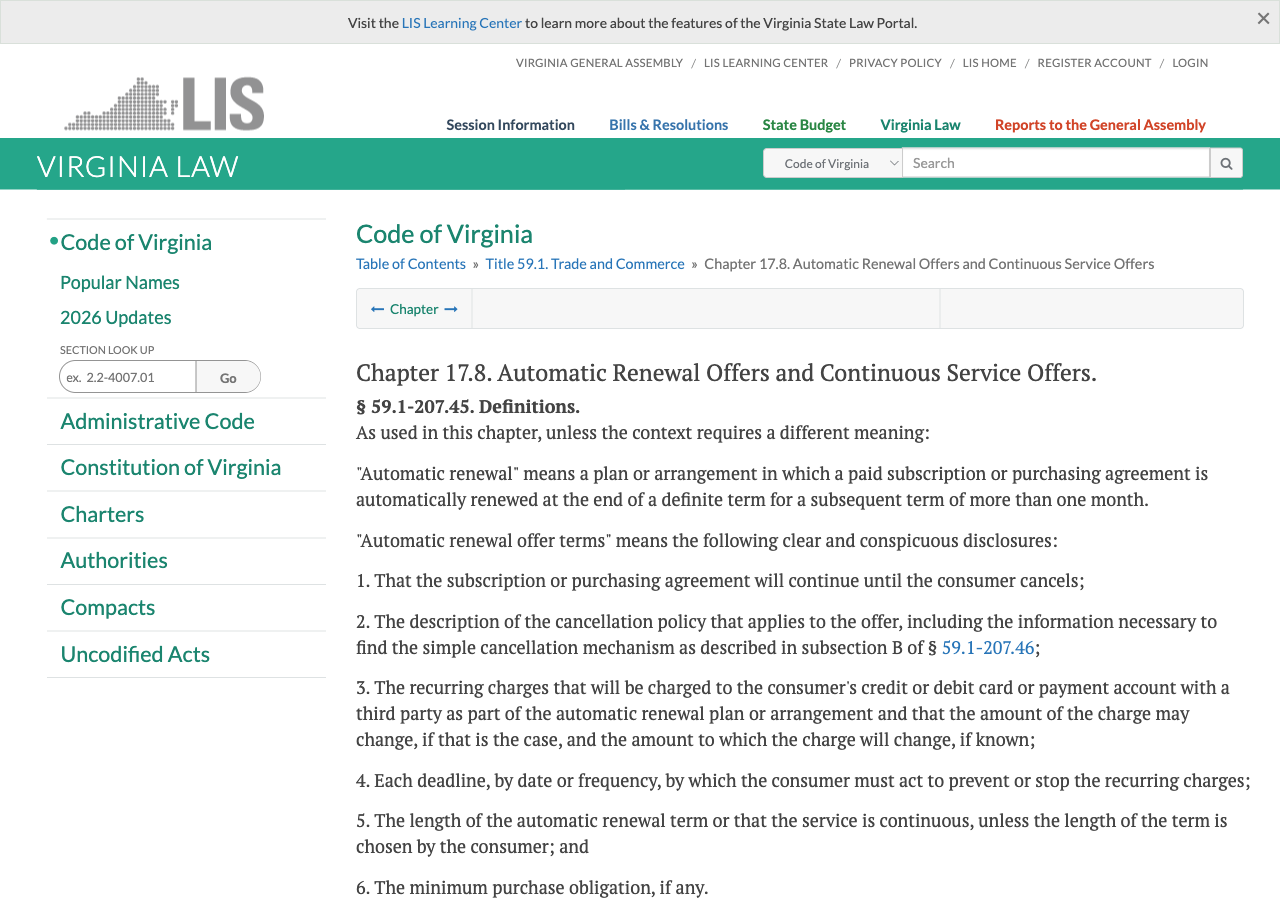
Source: Code of Virginia, Chapter 17.8, captured August 4, 2026.
What the amended statute actually requires
The core rule sits in section 59.1-207.46(B) of the Code of Virginia: “The cancellation mechanism shall be at least as easy to use as the mechanism the consumer used to initiate the automatic renewal or continuous service offer.” A handful of subsections spell out what that means in practice.
A seller has to offer a cancellation option through, at minimum, every method it uses to sign customers up, with one exception carved out for in-person enrollment. For an offer that started in person, the seller only has to add an electronic (website or app) or phone cancellation option, not an in-person one. No customer can be required to talk to a live or virtual agent to cancel unless a live or virtual agent was also required to sign up in the first place. If a seller does offer phone cancellation, that call has to be free, answered or voicemail-monitored during normal business hours, and processed at least as promptly as the signup call would have been. Print, mail, and pamphlet-initiated subscriptions get their own rule: those have to offer either an electronic or phone cancellation path, since neither of the original signup channels can realistically double as a cancellation channel.
None of this replaces Virginia’s existing disclosure requirements. The law still requires clear and conspicuous disclosure of the automatic-renewal terms before a consumer is charged, a retainable acknowledgment of those terms after signup, and advance notice before a material change or a renewal longer than 12 months takes effect. The new piece is entirely about the mechanics of canceling once someone wants out.
Figure: Since 2023, five states have adopted a cancellation-must-be-as-easy-as-signup standard for automatic renewals.
Virginia joins a growing multi-state standard
Virginia is not writing a new legal theory here. It is adopting language that closely tracks amendments already in force in four other states, each on its own timeline. New York’s General Business Law Section 527-a picked up its as-easy-as-signup requirement effective December 13, 2023. California’s AB 2863 added the same standard to the Business and Professions Code effective July 1, 2025. Massachusetts followed with an Attorney General regulation, 940 CMR 38.00, effective September 2, 2025, enforced as an unfair or deceptive practice under Chapter 93A. Colorado strengthened its existing automatic-renewal statute (Colorado Revised Statutes Section 6-1-732) with SB25-145, which added a specific online-cancellation requirement effective August 6, 2025. Virginia’s July 1, 2026 amendments make it the fifth state with a materially similar rule on the books.
| State | Statute | Effective date | Enforcement |
|---|---|---|---|
| New York | GBL Section 527-a | December 13, 2023 | State Attorney General |
| California | Bus. & Prof. Code Sections 17601-17602 (AB 2863) | July 1, 2025 | State Attorney General |
| Massachusetts | 940 CMR 38.00 (Chapter 93A) | September 2, 2025 | Attorney General and private suit |
| Colorado | Rev. Stat. Section 6-1-732 (SB25-145) | August 6, 2025 | State Attorney General |
| Virginia | Code of Va. Sections 59.1-207.45 to .49 (HB1022/SB493) | July 1, 2026 | State Attorney General |
Connecticut does not appear in that table because its July 1, 2026 change works differently. Connecticut already had a general as-easy-as-signup cancellation expectation on the books; what Public Act 25-44 adds is a private right of action, so a Connecticut consumer no longer has to wait on the Attorney General to bring a claim. Combined with a new annual-reminder requirement (businesses must notify Connecticut consumers once a year about an active automatic-renewal or continuous-service agreement, naming the goods or services covered, how to cancel, and the frequency and amount of charges), Connecticut’s change raises the practical enforcement risk of the same underlying conduct rather than rewriting the underlying standard.
What this means if you run a subscription business
If your business already updated its cancellation flow for California’s or Massachusetts’s 2025 deadlines, the Virginia changes should not require rebuilding anything, since the “cancellation must match signup” standard is now consistent across all five states. The channel-matching detail is worth checking specifically, though: Virginia’s rule (like the others) is not satisfied by adding one generic “cancel your subscription” contact form if your business signs customers up through multiple channels, such as a website, a mobile app, and a phone sales line. Each of those channels needs its own working cancellation path, and none of them can require a live agent unless that same channel required one to sign up.
The removal of Virginia’s “good faith effort” defense also raises the stakes of a policy that is vague or aspirational rather than accurate. A refund and cancellation policy that says “you may cancel online or by phone” without those options actually working the way the policy describes is no longer a matter of proving intent; the gap between what the policy promises and what a Virginia customer can actually do is now enough on its own to constitute a prohibited practice under the Virginia Consumer Protection Act.
Businesses serving Connecticut consumers have a narrower but sharper concern: a private right of action means a single dissatisfied customer, not just the state Attorney General, can now bring a claim over a cancellation process that does not match what was promised at signup, or over a missed annual reminder.
Bottom Line
Virginia’s July 1, 2026 amendments do not introduce a new legal test, but they do close off the “we made a reasonable effort” defense and extend the as-easy-as-signup standard to a fifth state, while Connecticut’s same-day change adds a private right of action that raises the cost of getting cancellation wrong. If your refund and cancellation policy still describes cancellation in general terms, doesn’t name every enrollment channel your business actually uses, or was last updated before these 2025 and 2026 state changes, this is a reasonable trigger to revisit it. Our Refund Policy Generator builds a cancellation and refund policy that documents the actual channels your business offers for signup and cancellation, so what the policy says matches what a customer can really do.
The information in this article is for informational purposes only and should not be construed as legal advice on any matter, and does not create a lawyer-client relationship.