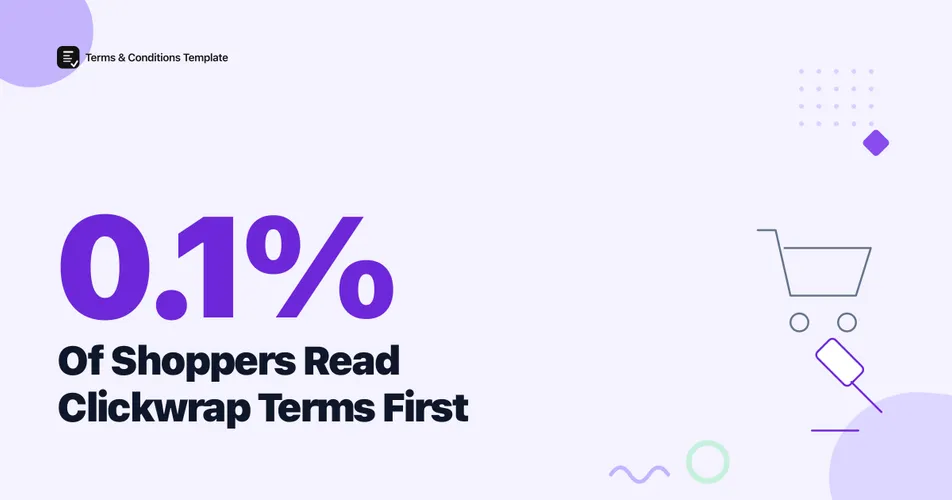
Almost nobody reads a clickwrap agreement, and courts enforce it anyway. Only 0.1% to 0.2% of online shoppers, about 1 or 2 in every 1,000, ever open the license agreement before clicking Agree, according to a 2014 Journal of Legal Studies analysis of 45,091 households shopping across 66 software retailers. That gap between what people accept and what they read is the real story behind clickwrap enforceability in 2026: courts stopped asking whether anyone read the terms and started asking whether the notice was clear enough to demand a reasonable person’s attention.
If you publish clickwrap terms for a website, app, or SaaS product, the practical lesson is not that disclosure is pointless. It is that the specific words your visitor sees at the exact moment they click Agree now carry more legal weight than the text of the contract itself.
How many people actually read clickwrap terms before agreeing?
Almost none. Bakos, Marotta-Wurgler, and Trossen tracked the browsing behavior of 45,091 households across 66 online software companies and found that only one or two out of every thousand retail software shoppers chose to access the license agreement at all. Among the small fraction who did open it, the average time spent was too short to have read more than a small portion of the text.
The study, published in the Journal of Legal Studies in 2014, was designed to test the “informed minority” theory that a small group of careful readers keeps sellers honest on behalf of everyone else. The data did not support it.
Figure 1: Share of retail software shoppers who access the end user license agreement before purchase. Source: Bakos, Marotta-Wurgler & Trossen, 45,091 households, 66 software companies, 2014.
The read rate has not needed updating because the incentive structure has not changed. Sellers write the terms, buyers do not read them, and the informed-minority backstop the theory relies on simply is not there in practice.
What legal test decides whether a clickwrap agreement holds up in court?
A two-part test decides it, not whether the user read the text. In Berman v. Freedom Financial Network, the Ninth Circuit held in 2022 that an online agreement is enforceable only if the terms are presented with reasonably conspicuous notice and the user takes an unambiguous action, such as checking a box or clicking a clearly labeled button, that manifests assent.
Figure 2: The two-part enforceability test from Berman v. Freedom Financial Network, 30 F.4th 849 (9th Cir. 2022).
Publishing a plain-language terms and conditions agreement that pairs a visible checkbox with a direct link to the full text is exactly what this test asks for. The safest designs put the acceptance language directly under the action button rather than in a footer link the user never has to see.
Courts do not police whether a user actually scrolled through every clause. They police whether an ordinary person had a fair chance to notice that clicking a button meant agreeing to something.
How often do companies bury mandatory arbitration inside clickwrap terms?
Often, and at scale. Eisenberg, Miller, and Sherwin’s 2008 study found that 75% of major telecommunications, banking, and financial services companies included mandatory arbitration provisions in their standard consumer contracts, most of them presented as clickwrap or account-opening terms rather than negotiated one at a time.
Once a dispute lands in arbitration instead of court, the outcome data looks different from a jury trial. An earlier Searle Civil Justice Institute review of American Arbitration Association records found consumers won some relief in 53.3% of filed cases, recovering an average of $19,255. A later, larger analysis by Horton and Chandrasekher examined 4,839 consumer complaints filed with the AAA between July 2009 and December 2013 and found a lower win rate.
Figure 3: Share of AAA consumer arbitration cases where the consumer recovered $1 or more. Source: Searle Civil Justice Institute (2009); Horton & Chandrasekher, 104 Georgetown Law Journal (2015), n=4,839 complaints, 1,407 arbitral awards.
The newer study also found that 39% of consumers who prosecuted a claim all the way to a final award still lost money once arbitrator fees were subtracted from any recovery, mainly because those fees are far higher than a court filing fee. That is the cost side of the same clickwrap clause that decided where, not just whether, the dispute would be heard.
Which type of online agreement holds up best in court?
Not all “wrap” agreements are treated the same. Courts have consistently drawn a line between agreements a user must actively click through and agreements that merely sit behind a link the user never has to open.
Figure 4: Relative notice clarity and enforcement outcomes by online agreement type, based on Specht v. Netscape (2002), Nguyen v. Barnes & Noble (2014), Meyer v. Uber (2017), and Keebaugh v. Warner Bros. (2024).
| Agreement type | Typical notice | How courts treat it | Leading case |
|---|---|---|---|
| Browsewrap | Terms linked in a footer, no click required | Usually not enforced absent proof of actual notice | Specht v. Netscape (2002) |
| Sign-in-wrap | ”By continuing you agree…” text near a button | Enforced only when notice is reasonably conspicuous | Meyer v. Uber (2017) |
| Clickwrap / scrollwrap | Checkbox or scroll-to-bottom before an Agree click | Enforced in the large majority of disputes | Keebaugh v. Warner Bros. (2024) |
The pattern across two decades of case law is consistent: the more a design forces a user to notice and act on the terms, the more likely a court is to hold the user to them.
How has the law caught up with click-to-agree contracts?
Federal and state law caught up before most of the case law existed. The federal E-SIGN Act, signed in 2000, gave electronic signatures and records the same legal standing as their paper equivalents. Since then, 49 states plus DC and the US Virgin Islands have adopted the Uniform Electronic Transactions Act, with New York relying on its own separate electronic signatures law instead.
Figure 5: Federal statute and appellate milestones shaping clickwrap enforceability. Sources: 15 U.S.C. Section 7001; Uniform Law Commission; case citations in Sources below.
The statutory groundwork has not needed a rewrite since 2000. What keeps changing is how specific courts apply it to new interface designs, from a hyperlink in a footer to a checkbox under a mobile game’s play button.
Do clickwrap terms change after you agree to them?
Often, yes. Marotta-Wurgler and Taylor tracked 264 mass-market software license agreements from 2003 to 2010 and found that 39% materially changed at least one term over that period, with some agreements revising as many as 14 separate terms. On average, the contracts that changed grew several hundred words longer and shifted toward terms more favorable to the seller.
That finding matters for anyone relying on a clickwrap agreement to stay fixed once a user accepts it. A term you did not include at signup can often be added later through a unilateral modification clause, which is itself usually presented as another clickwrap update.
Clickwrap by the numbers
| Metric | Figure | Source |
|---|---|---|
| Shoppers who open a clickwrap license before buying | 0.1% to 0.2% (1 to 2 in 1,000) | Bakos, Marotta-Wurgler & Trossen, 2014 |
| Major telecom, banking, and financial firms with mandatory arbitration in their terms | 75% | Eisenberg, Miller & Sherwin, 2008 |
| Consumer win rate once an AAA arbitration reaches an award | 34.9% | Horton & Chandrasekher, 2015 |
| Software license agreements that changed a material term within 7 years | 39% | Marotta-Wurgler & Taylor, 2013 |
The Bottom Line
The defining fact about clickwrap agreements in 2026 is not that people fail to read them. It is that reading was never the legal requirement. Only 0.1% to 0.2% of shoppers open the license agreement, yet courts enforce these contracts routinely once the interface itself gives reasonably conspicuous notice and captures an unambiguous click. That shifts the real compliance work from writing dense legal text to designing the moment of assent: where the notice sits, how it is worded, and what action the user has to take to move forward. Businesses that get that interface right pass the Berman test; businesses that bury the notice behind a hyperlink are the ones losing motions to compel arbitration.
Frequently Asked Questions
What percentage of people read clickwrap terms before agreeing? About 0.1% to 0.2% of shoppers, or 1 to 2 out of every 1,000, ever open the license agreement before buying, according to Bakos, Marotta-Wurgler and Trossen’s tracking of 45,091 households across 66 online software companies (Journal of Legal Studies, 2014).
Is a clickwrap agreement legally binding if nobody reads it? Yes. Under the two-part test from Berman v. Freedom Financial Network (9th Cir., 2022), a clickwrap agreement is enforceable if the notice is reasonably conspicuous and the user takes an unambiguous action, like a checkbox or button click, that manifests assent. Courts do not require proof anyone actually read the text.
What percentage of clickwrap agreements include mandatory arbitration? 75% of major telecommunications, banking, and financial services companies embed mandatory arbitration clauses in their standard consumer contracts, according to Eisenberg, Miller and Sherwin’s 2008 study of 41 U. Mich. J.L. Reform 871.
How often do consumers win when a clickwrap dispute goes to arbitration? Consumers won some relief in 34.9% of 1,407 arbitral awards from a sample of 4,839 AAA complaints filed between 2009 and 2013 (Horton and Chandrasekher, 2015). 39% of consumers who arbitrated all the way to an award still lost money once arbitrator fees were counted.
Sources and References
- Bakos, Yannis, Florencia Marotta-Wurgler, and David R. Trossen. (2014). “Does Anyone Read the Fine Print? Consumer Attention to Standard-Form Contracts.” Journal of Legal Studies, 43(1). Tracking of 45,091 households across 66 online software companies.
- Berman v. Freedom Financial Network, LLC, 30 F.4th 849 (9th Cir. 2022). Established the reasonably-conspicuous-notice and unambiguous-assent test.
- Horton, David, and Andrea Cann Chandrasekher. (2015). “After the Revolution: An Empirical Study of Consumer Arbitration.” 104 Georgetown Law Journal. Analysis of 4,839 AAA consumer complaints, July 2009 to December 2013; also reports the Searle Civil Justice Institute’s earlier 53.3% win-rate finding and Eisenberg, Miller and Sherwin’s finding that 75% of major telecom, banking, and financial firms use mandatory arbitration clauses (41 U. Mich. J.L. Reform 871, 880-83 (2008)).
- Marotta-Wurgler, Florencia, and Robert Taylor. (2013). “Set in Stone? Change and Innovation in Consumer Standard-Form Contracts.” 88 New York University Law Review 240. Sample of 264 software license agreements, 2003 to 2010.
- Uniform Law Commission. Uniform Electronic Transactions Act, enactment status by state.
- Specht v. Netscape Communications Corp., 306 F.3d 17 (2d Cir. 2002).
- Nguyen v. Barnes & Noble, Inc., 763 F.3d 1171 (9th Cir. 2014).
- Meyer v. Uber Technologies, Inc., 868 F.3d 66 (2d Cir. 2017).
- Keebaugh v. Warner Bros. Entertainment Inc., 100 F.4th 1005 (9th Cir. 2024).
Note: All figures verified as of August 2026. Case law on notice design continues to develop; headline figures are refreshed at least twice a year.