On October 28, 2026, New York Attorney General Letitia James announced a settlement with Frank W. Cawood & Associates, Inc. (FC&A), a Georgia-based publisher of self-help books aimed at seniors. The signed agreement, Assurance of Discontinuance No. 26-055, resolves an investigation by the Office of the Attorney General (OAG) into FC&A’s “free no-risk preview” book program. FC&A will pay $23,500 in penalties, end the program in New York, and refund eligible customers.
The case is about books and mailers, but the pattern, a “free” offer whose real terms sit in small print, applies to any trial a business offers.
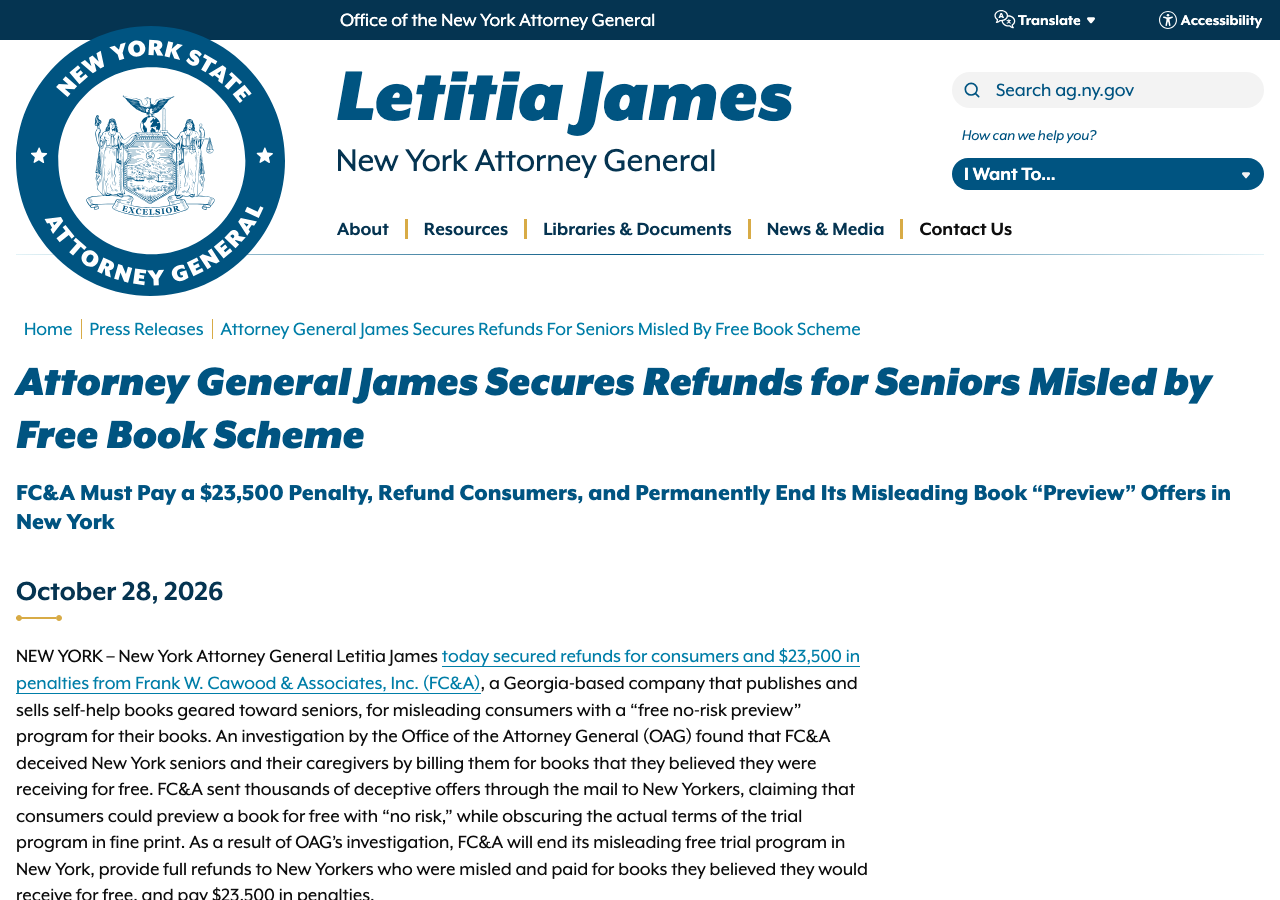
Source: New York Attorney General, captured October 31, 2026.
What the settlement says
According to the OAG’s press release, FC&A mailed thousands of offers to New Yorkers advertising a “free, no-strings-attached” chance to try its books for a trial period. “Free trial” and “no risk” appeared in large, bold print, while the payment terms were printed in significantly smaller font on the card a customer had to return to accept the trial. The program also included a free booklet, which, the OAG says, often led people to believe the trial book was free too.
Customers who accepted a trial book received an invoice with charges for shipping and taxes, bringing the total for a $36 book to $49.68. The assurance document itemizes it: $36.00 for the book, payable in four monthly installments or one lump sum, $10.00 for shipping and handling, and $3.68 in state taxes for New York residents. Customers who chose to return the book had to pay the cost of shipping it back. If FC&A received neither payment nor the book, it sent a series of escalating invoices marked “Overdue Account” and “PAST DUE!” with late fees added. The OAG also says the order form came with a box pre-checked for a “no-risk” free trial “without any obligation.”
Figure: The $36 book price against the $49.68 invoice total, split into book, shipping and handling, and state tax, as itemized in the assurance document.
The OAG found that the program caused significant confusion. It reports that FC&A received over 650 calls between 2018 and 2024 from caregivers of customers who did not understand the terms and received bills for products they did not remember ordering.
What FC&A has to do
Under the settlement, FC&A will end its free trial program in New York and pay $23,500 in penalties. It must also give full refunds to eligible consumers who paid for a book sent to a New York address on a trial basis within the last six years. The assurance defines the restitution amount as 100% of what was paid for the product, including the shipping cost and any late fees charged, and says refunds are paid by paper check. FC&A is also required to review its internal records to find customers who asked for a refund and never got a full one, and customers who had told the company they did not understand the bill or remember ordering a book. Consumers who believe they qualify should contact FC&A before April 23, 2027.
Two details matter. First, the agreement says FC&A “neither admits nor denies” the OAG’s findings, so what we know about the conduct is the OAG’s account, not a court ruling. Second, the OAG’s stated legal basis, per the document, is New York Executive Law section 63(12) and General Business Law section 349, the latter being the state’s general ban on deceptive acts or practices in business.
What the mailer said versus what the terms said
| What a customer saw | What the OAG says the terms were |
|---|---|
| ”Free, no-strings-attached” trial, “no risk” in large bold print | Payment terms in much smaller font on the reply card |
| A $36 book | An invoice of $49.68 after shipping and tax |
| A free booklet “gifted” with the trial | The booklet often led people to think the book was free too |
| A pre-checked “no-risk” trial box on the order form | A trial order that generated an invoice |
| A trial book the customer could send back | Customer pays the return shipping |
| No payment, no return | Invoices marked “PAST DUE!” with late fees added |
The release also states that none of the materials sent to people who signed up mentioned the free trial program or explained how to exit it without paying. That last point is the one most likely to catch an ordinary online business: in the OAG’s account, the offer was prominent on the way in and silent on the way out.
How to word a free trial in your refund policy and terms
The lesson is not to avoid trials. It is to make sure the words “free” and “no risk” are true at every point in the customer’s path. Our guide to refund policy for a subscription box covers the broader structure, and our piece on auto-renewal and negative option disclosure requirements covers recurring-charge disclosure.
Put the full cost next to the word “free.” If a customer can end up owing money, say so in the same size type as the offer: the price, the shipping, the tax if you know it, and the date charges begin. A refund policy that says “free trial” in a heading and explains the charge three screens later repeats the gap the OAG describes.
State who pays for return shipping, and say it where the customer accepts the trial, not only in the policy. If returns cost the customer money, “no risk” is a hard claim to defend. Either cover return shipping, or drop the phrase and describe the actual terms plainly.
Do not pre-check the box. The OAG called out a pre-checked “no-risk” trial box on the order form. A customer should take an affirmative action to start a trial, and your terms should describe that action in the same words the checkout uses.
Say what happens if the customer does nothing. Your terms should state the exact consequence of not returning the product or not canceling: whether an invoice is issued, when, and for how much. Then say how to exit without paying, and name the channel, whether that is a link, an email address or a phone number. The OAG’s press release says FC&A’s materials gave no such instructions.
Treat late fees and collection language as part of the offer. If a late fee can apply, state the rate and the trigger date, and link it to the trial terms. Our free trial statistics page collects the wider numbers on trial offers, and the wording of each one matters.
For cancellation channels, see also our write-up of the NYC click-to-cancel rule.
Bottom line
New York’s FC&A settlement is a small penalty and a large wording lesson: “free” and “no risk” are claims a regulator will test against the fine print, the return-shipping cost, the pre-checked box and the late-fee notices that follow. If your terms say a trial is free, make sure the price, who pays to send items back, the default outcome and the way out are all stated up front in plain type. Our Refund Policy Generator builds a policy that names those terms, so the document matches how your trial actually works.
Sources
New York Attorney General, Attorney General James Secures Refunds for Seniors Misled by Free Book Scheme (October 28, 2026) New York Attorney General, Assurance of Discontinuance No. 26-055, Frank W. Cawood & Associates, Inc.The information in this article is for informational purposes only and should not be construed as legal advice on any matter, and does not create a lawyer-client relationship.