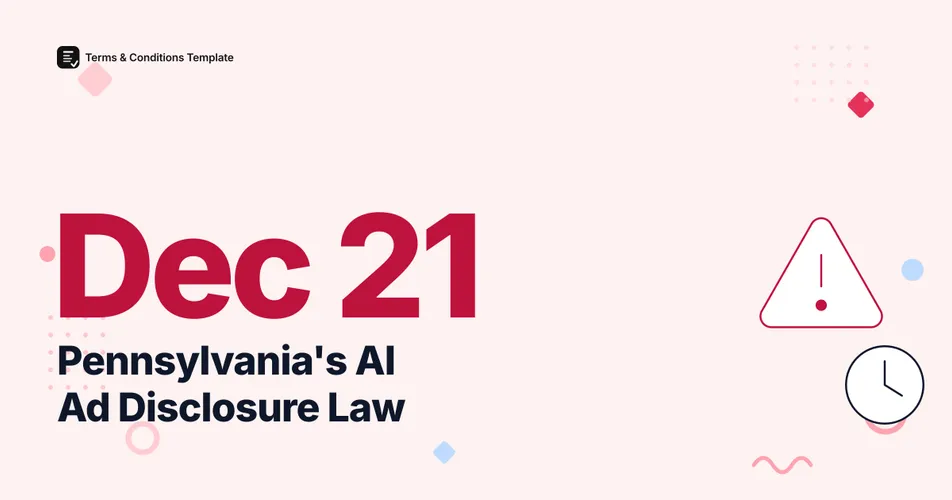
On October 22, 2026, Pennsylvania Gov. Josh Shapiro approved Senate Bill 806, the Artificial Intelligence Deceptive Advertising Act, which the General Assembly’s bill page lists as Act No. 99 of 2026. The law is signed but not yet in force. The bill says it takes effect “in 60 days,” which lands on December 21, 2026, according to Loeb & Loeb, A New AI Disclosure Law from Pennsylvania.
According to the General Assembly’s bill page, the bill passed the Senate 48 to 2 on June 10 and the House 163 to 40 on October 7, and its prime sponsor is Sen. Nick Pisciottano. It was signed as part of a batch of 58 bills, as reported by City & State Pennsylvania, 7 bills signed into law by Gov. Josh Shapiro in October.
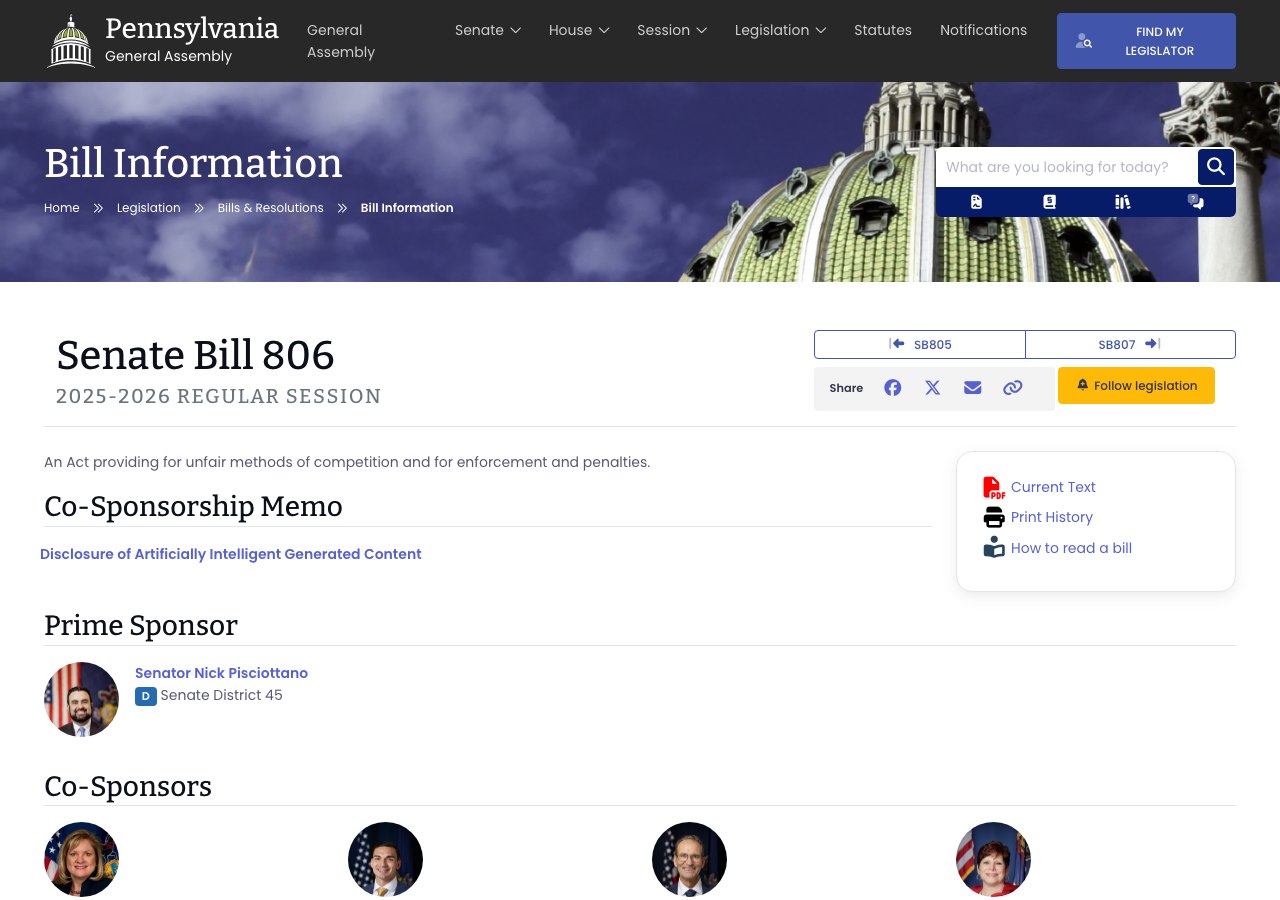
Source: Pennsylvania General Assembly, Senate Bill 806 bill information, captured October 31, 2026.
What the law actually says
The law applies to any advertiser, not just AI companies. It targets advertisements that use “synthetic content,” which the bill defines as an image, video, audio clip or text that has been significantly modified or generated by artificial intelligence. An advertiser may not knowingly, recklessly or willfully create and disseminate such an ad “in a manner that creates a false consumer perception about the nature, origin or authenticity of the goods or services being advertised” unless it carries a clear and conspicuous disclosure. That wording comes straight from Section 4 of the Pennsylvania General Assembly, SB 806 Printer’s No. 1808 bill text.
The required statement is specific. It must say that the advertisement contains content that was modified or generated using artificial intelligence. It must appear the first time the synthetic content is presented, sit in the same medium as the content, and, where technically feasible, be permanent or extraordinarily difficult to remove. “Clear and conspicuous” is defined in the bill by size, color, contrast, location, duration and audibility, and a disclosure cannot contradict the surrounding message or be obscured.
This is a different animal from California’s rule. Our California AI Transparency Act breakdown covers a law aimed at large generative AI providers who must label what their systems produce. Pennsylvania instead regulates the business that publishes the advertisement, whatever tool made the image.
The trigger is narrower than “we used AI”
The disclosure duty depends on a false consumer perception, not on AI use alone. Loeb & Loeb points out that the term “false” is undefined, and that one reading would require a disclosure whenever AI depicts the product, while another would require one only when the ad otherwise misrepresents it. Until the Attorney General or a court says which reading wins, a cautious advertiser treats AI-generated product imagery as a likely trigger.
Section 4(a) also limits the duty to an advertiser who acts “knowingly, recklessly or willfully.” Loeb & Loeb reports that this wording was removed on the Senate floor, but the Printer’s No. 1808 text, the version the Senate passed on June 10, 2026 and the House passed without amendment on October 7, 2026, still contains it in Section 4(a). We found no later printing, so we treat the wording as part of the law and expect a violation to require that state of mind. Check the official Act 99 text before relying on it.
Does your ad need the disclosure?
Figure 1: Decision path for an advertisement under SB 806, drawn from Section 4 of the bill text and the Loeb & Loeb analysis.
Covered versus exempt content
| Content | Covered by the disclosure duty? | Why |
|---|---|---|
| AI-generated product photo that implies a real item | Likely yes | Creates a perception about the nature or authenticity of the goods |
| AI-cloned voiceover presented as a real customer | Likely yes | Audio is covered and the origin is misleading |
| AI-retouched image that still shows the real product accurately | Unclear | Depends on how “false” is read |
| Obviously fictional animated mascot ad | No | Evidently fictional exception |
| Parody or satirical ad | No | Parody, satire, commentary or criticism exception |
| Text-only ad copy written with AI | No, per the bill text | Exception for content limited to text |
The text-only row deserves a note. The bill’s definition of synthetic content mentions text, which is why secondary sources disagree. Section 4(b) of the bill, though, excludes content “limited to text” from the duty, and Loeb & Loeb lists the same exemption. An ad with an AI-written headline over an AI-generated photo is not text-only, so the photo still counts.
Penalties and who enforces
Only the Attorney General or a district attorney can bring an action under the bill. They can seek an injunction or a civil action, and a court may award a civil fine that does not exceed $3,000 plus actual attorney fees and court costs. The bill creates no private lawsuit for consumers, a point Loeb & Loeb also makes. Section 4(c) adds that making a disclosure does not limit any other legal recourse, so a disclosure is not a shield against a separate false advertising claim.
A disclosure line you can adapt
For a banner, video or landing page hero that uses AI imagery, a short line near the visual does the job. Something like: “This advertisement contains content that was modified or generated using artificial intelligence.” Using the statute’s own sentence removes any guesswork about the required wording. Place it where the image first appears, in the same format as the image. A video needs on-screen text or a spoken line, an audio spot needs a spoken line, and a static image needs readable text in the frame, not a footnote on another page.
For the rest of your site, add a short clause to your website terms or an AI disclaimer page covering how you use AI in marketing materials, what a reader should not assume about AI-generated images, and where to ask questions. Our guide to a disclaimer for AI-generated content walks through that wording. Keep the on-ad label and the site-wide disclaimer consistent, because a policy page that says one thing while the ad says another invites the contradiction the definition of “clear and conspicuous” warns about.
What to do before December 21
Start with an inventory of every live ad, email header, landing page and social post that uses AI-modified imagery, video or audio. For each item, decide whether it could mislead a shopper about what the product is or whether it is real, and label anything in the gray zone. Update templates so new creative inherits the disclosure by default. Then bring your site-wide wording in line, since our Disclaimer Generator can draft the AI-use section of your terms and keep it consistent with what your ads say.
Bottom line
Pennsylvania’s law is signed, numbered Act 99 of 2026, and on a 60-day clock that ends December 21, 2026. It reaches any advertiser, with no AI-company limit, whose ads use AI-modified images, video or audio that could mislead about the product, and it carries a fine of up to $3,000 enforced by prosecutors. The trigger is vague enough that the safe habit is a short, consistent AI label on every ad that uses synthetic visuals.
Sources
Pennsylvania General Assembly, Senate Bill 806 bill information Pennsylvania General Assembly, SB 806 Printer’s No. 1808 bill text Loeb & Loeb, A New AI Disclosure Law from Pennsylvania City & State Pennsylvania, 7 bills signed into law by Gov. Josh Shapiro in OctoberThe information in this article is for informational purposes only and should not be construed as legal advice on any matter, and does not create a lawyer-client relationship.