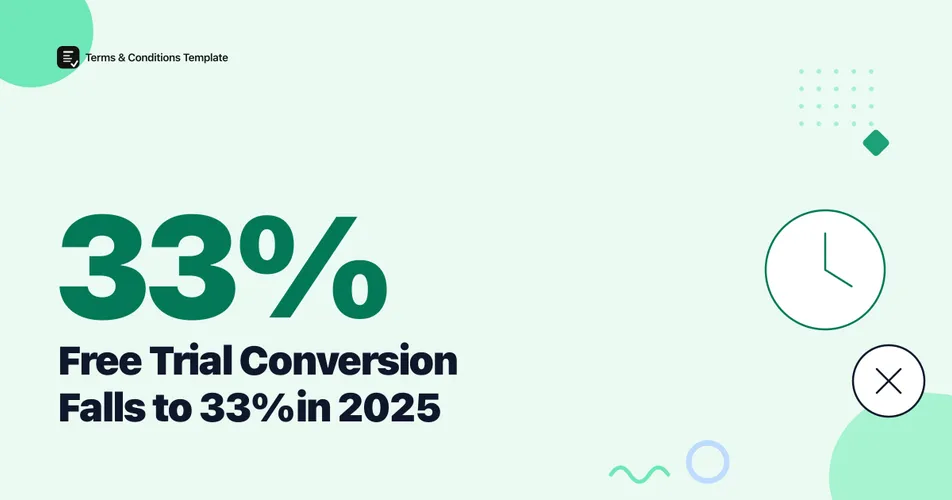
Free trial to paid conversion dropped from 46% in 2021 to 33% in 2025, according to Recurly’s subscriber acquisition benchmarks, which track 67 million unique subscribers across its billing platform. Fewer trial users are converting than four years ago, but the picture underneath that single number is more complicated: conversion still depends heavily on category, trial length, and how easy the cancellation window actually is to find.
How many free trials actually convert to a paying customer?
Recurly’s benchmark data shows the industry-wide free trial to paid conversion rate fell from 46% in 2021 to 33% in 2025, even as overall subscriber acquisition rates held roughly steady at 2.8% to 3%. That means fewer of the people who start a trial are finishing it as a paying customer, not that fewer people are starting trials in the first place.
Figure 1: Free trial to paid conversion rate, four years apart. Source: Recurly, subscriber acquisition benchmarks, 2021-2025, 67 million unique subscribers.
A business converting trials at the old 46% baseline today would be a clear outlier. Recurly’s own read is that businesses are trading volume for retention, converting fewer trial sign-ups but keeping the ones who do convert for longer, which is a very different problem than a straightforward decline in interest.
Does free trial conversion differ by app category?
It varies more than the headline 33% figure suggests. RevenueCat’s State of Subscription Apps 2025 report, drawn from 75,000 subscription apps and more than $10 billion in tracked revenue, found travel apps converting trials at a 48.7% median rate, the highest of any category it tracks, with media and entertainment apps close behind at 43.8% and health and fitness apps trailing at 39.9%.
Figure 2: Median trial-to-paid conversion rate by app category. Source: RevenueCat, State of Subscription Apps 2025, 75,000 apps tracked.
RevenueCat is a subscription infrastructure vendor that processes billing for the apps in its dataset, so its 75,000-app, $10 billion figure is a real, disclosed sample, but it is also a company with a commercial interest in subscription apps looking healthy. Its category numbers line up directionally with Recurly’s broader decline, though the two report on different populations (RevenueCat covers mobile apps specifically; Recurly’s benchmark spans subscription billing generally), so the exact percentages should not be read as measuring the same thing.
Health and fitness apps sit at the bottom of RevenueCat’s tracked categories for a reason familiar to anyone who has ever paid for a gym membership: intent to use the product regularly is highest at signup and fades fastest, exactly the period a free trial covers.
Does trial length change how likely someone is to convert?
Yes, and the relationship is not subtle. RevenueCat’s 2025 data shows trials running 17 to 32 days convert at a 45.7% median rate, well above the conversion seen in shorter formats, supporting what RevenueCat describes as more time to experience a product’s value translating into stronger purchase intent by the time the trial ends.
That has started to show up in how trials are actually structured. 52% of app trials ran 5 to 9 days in 2024, up from 48.5% in 2023, while very short trials of 4 days or less lost ground over the same period. The shift is not universal: gaming apps still favor short trials heavily, with 96.3% of gaming trials running 4 days or less, while education and health and fitness apps are far more likely to offer 5 or more days.
For a business deciding on trial length, a Refund Policy Generator that states the exact trial window and what happens at the end of it removes one of the most common disputes: a subscriber charged the day after a trial they thought was still running.
Longer trials convert better on average, but only if the cancellation terms tied to them are just as clear as the trial length itself.
When do free trial users actually cancel?
Most of the decision window is compressed into the very start of the trial. RevenueCat’s 2025 data found 82% of trial starts happen the same day a user installs the app, meaning the clock on a trial is usually already running before someone has spent any real time with the product.
Cancellation timing then splits by trial length. Short 3-day trials see the sharpest cancellation activity on Day 0 and Day 1, before most users have meaningfully evaluated the product. Longer 30-day trials spread cancellations across the period, with a notable spike toward the end as users who set a reminder act on it just before the charge hits.
Figure 3: How cancellation timing differs by trial length. Source: RevenueCat, State of Subscription Apps 2025.
The same reminder behavior that drives that end-of-trial spike is exactly what a clear, upfront cancellation policy is supposed to support instead of fight against.
Is it actually hard to cancel a free trial before it charges you?
For a meaningful share of subscription businesses, yes, and the free trial moment is where the friction matters most, since it is the point where a trial silently becomes a paid subscription. A 2024 international sweep led by the FTC, in coordination with the International Consumer Protection and Enforcement Network and the Global Privacy Enforcement Network, reviewed 642 subscription websites and apps across 26 countries and found 81% required auto-renewal into a paid plan with no clear opt-out offered at signup, while 76% used at least one dark pattern somewhere in the cancellation flow.
Figure 4: Share of reviewed subscription sites and apps that required auto-renewal without offering a clear opt-out at signup. Source: FTC, International Consumer Protection and Enforcement Network, and Global Privacy Enforcement Network, 2024 sweep of 642 sites and apps.
That 81% figure is the mechanism behind a lot of trial-to-paid friction: a free trial that converts automatically into a paid plan is only fair to a subscriber if the terms said so clearly before they signed up, and the sweep found most reviewed services fell short of that bar.
Free trial data at a glance
| Metric | Figure | Source |
|---|---|---|
| Trial-to-paid conversion, 2021 | 46% | Recurly, 2021 |
| Trial-to-paid conversion, 2025 | 33% | Recurly, 2025 |
| Highest-converting category (travel apps) | 48.7% median | RevenueCat, 2025 |
| Conversion for 17-32 day trials | 45.7% median | RevenueCat, 2025 |
| Trial starts same day as install | 82% | RevenueCat, 2025 |
| Sites/apps with no clear auto-renewal opt-out | 81% | FTC-led sweep, 2024 |
Where a business’s federal legal footing stands on all this is not settled either. The FTC’s amended Negative Option Rule, the Click-to-Cancel rule that would have forced cancellation to be as easy as sign-up, was vacated by the Eighth Circuit Court of Appeals on July 8, 2025 for procedural defects, and the FTC did not file a draft Advance Notice of Proposed Rulemaking to restart the process until January 30, 2026. For the full timeline and what it means for cancellation obligations right now, see our subscription cancellation data for 2026. For the broader market context these conversion numbers sit inside, including total subscription economy size and why people cancel in general, see our subscription economy statistics for 2026. A dedicated look at streaming-specific trial and cancellation behavior is planned for a future post in this cluster and is not yet available to link.
The Bottom Line
Free trial conversion fell from 46% to 33% in four years, but that decline is not a flat story: travel and media apps still convert close to half of their trials, trials of 17 to 32 days convert nearly twice as well as very short ones, and 82% of the entire decision window opens on install day. None of that happens against a backdrop of clear legal cancellation standards, since a 2024 sweep found 81% of reviewed services offered no clear opt-out from auto-renewal at signup, and the federal rule meant to fix that is still working through a restarted rulemaking process. A trial that states its exact length and cancellation window in plain language, backed by a Refund Policy Generator that keeps those terms current, is the more reliable way to move a business’s own conversion number without relying on a rule that is not currently in force.
Frequently Asked Questions
What percentage of free trials convert to a paid subscription? Free trial to paid conversion fell from 46% in 2021 to 33% in 2025, according to Recurly’s subscriber acquisition benchmarks, which covered 67 million unique subscribers.
Does free trial conversion vary by category? Yes. Travel apps convert at a 48.7% median rate, media and entertainment apps at 43.8%, and health and fitness apps at 39.9%, according to RevenueCat’s State of Subscription Apps 2025 report, which tracked 75,000 apps and more than $10 billion in tracked revenue.
Does trial length affect conversion? Trials running 17 to 32 days convert at a 45.7% median rate in RevenueCat’s 2025 data, well above shorter formats. 52% of app trials ran 5 to 9 days in 2024, up from 48.5% in 2023, as very short trials lost share.
When do people cancel a free trial? 82% of trial starts happen the same day a user installs the app, per RevenueCat’s 2025 report. Three-day trials see the sharpest cancellation spikes on Day 0 and Day 1, while longer trials see cancellations cluster near the end of the period.
Is it hard to cancel a free trial before it charges you? For many services, yes. A 2024 FTC-led international sweep of 642 subscription websites and apps found 81% required auto-renewal with no clear opt-out at signup, and 76% used at least one dark pattern in their cancellation flow.
Sources and References
- Recurly. (2025). “Subscriber Acquisition Benchmarks.” Free trial conversion and acquisition rate trends, 2021-2025, 67 million unique subscribers.
- RevenueCat. (2025). “State of Subscription Apps 2025.” Data drawn from 75,000 subscription apps tracking more than $10 billion in revenue on RevenueCat’s platform.
- TechCrunch, reporting on the FTC, International Consumer Protection and Enforcement Network, and Global Privacy Enforcement Network’s 2024 international sweep. (2024). Sweep of 642 websites and apps across 26 countries; published July 10, 2024.
- Crowell and Moring. (2026). “Clicking All the Right Boxes: FTC Moves to Revive Click-to-Cancel Rule Following Eighth Circuit Vacatur.” Client alert covering the July 8, 2025 Eighth Circuit ruling and the January 30, 2026 draft ANPRM filing.
Note: All figures verified as of September 2026. Free trial conversion and length data are refreshed by their source vendors on a rolling basis and the Click-to-Cancel rulemaking is an active legal process, so headline figures in this article are refreshed at least twice a year.