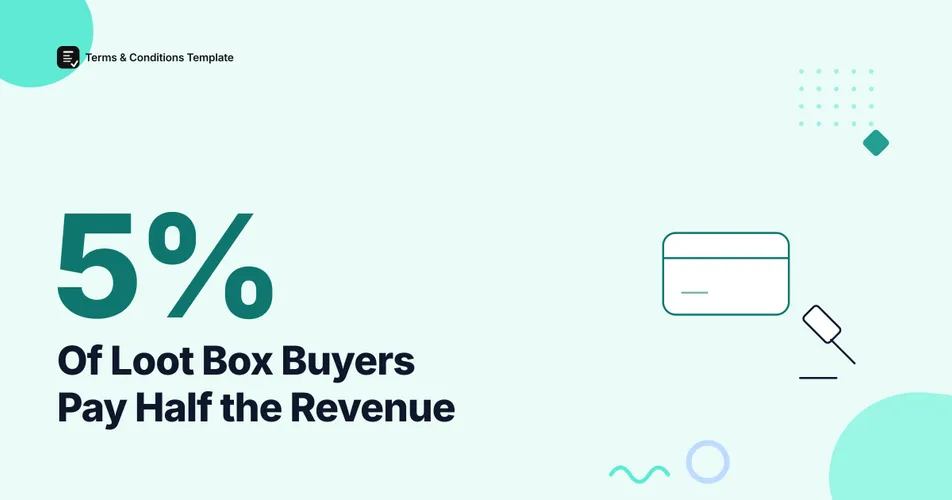
Loot boxes make money from a small crowd. In a pooled analysis of 7,767 loot box buyers, the top 5% of spenders, those paying more than $100 a month, generated half of all loot box revenue. Most buyers spend under $20 a month. The data below is current as of November 2026, and where a source is old or self-reported, we say so.
If you build or publish a game, this matters twice. Regulators now write rules around exactly this spending pattern, and your EULA is the first place a regulator or a plaintiff looks. Here is what the numbers say.
How many games sell loot boxes?
About six in ten of the biggest mobile games sell them. A peer-reviewed survey in the journal Addiction found loot boxes in 59.0% of the top 100 grossing iPhone games and 58.0% of the top 100 grossing Google Play games. On Steam, 36.0% of the 50 most-played games had them. The authors published the work in 2020, so treat the percentages as a snapshot of that market, not today’s.
Figure 1: Share of top games with loot boxes. iPhone and Google Play samples are the top 100 grossing games each; the Steam sample is the 50 most-played. Source: Zendle et al., “The prevalence of loot boxes in mobile and desktop games,” Addiction, 2020.
Kids can reach most of them. The same study found 94.9% of iPhone games with loot boxes and 93.1% of Android games with them were rated suitable for children aged 12 and up. Desktop ratings ran stricter: only 38.8% of desktop games with loot boxes were open to that age group.
The UK government reached a similar read from its own review. Its July 2022 response said over half of the top 100 grossing games in both UK mobile app stores contained loot boxes in 2020.
Loot boxes are the norm in big mobile games, and the age ratings do little to keep them away from children.
How much do people spend on loot boxes?
Most players spend little, and a few spend a lot. A pooled analysis of 7,767 loot box buyers, published in Addictive Behaviors in 2021, found monthly spending is typically under $20. It also found the top 5% of spenders, paying over $100 a month, represent half of loot box revenue. The data is self-reported survey data from several earlier studies, so it shows a pattern, not an audited revenue split.
Figure 2: The spending skew in pooled loot box survey data. Source: Close et al., Addictive Behaviors, 2021 (7,767 buyers, self-reported spend).
Buying is common among gamers who answer these surveys. In a 2018 PLOS ONE study, 5,793 of 7,422 surveyed gamers (78%) had bought a loot box. The sample came from an online survey, not a random draw of all players, so do not read 78% as a market-wide rate.
The money story has one more number. A projection cited in the UK government’s 2022 response put the UK loot box market at 700 million pounds at the end of 2019, per Juniper Research. That is a forecast from a vendor, not a measured total.
A small group of heavy spenders carries the revenue, and that is exactly the group regulators worry about.
Do loot boxes link to problem gambling?
Yes, in the sense that the two move together. A meta-analysis of 15 studies found a correlation of r = 0.26 between loot box spending and problem gambling symptoms. Across 7 studies, the link with excessive gaming was r = 0.25. The pooled whale analysis above found an aggregate correlation of 0.34 between loot box spend and problem gambling.
Figure 3: Reported correlations between loot box spending and two outcomes. Adjusted is the gambling meta-analysis after a trim-and-fill adjustment, Pooled is the 7,767-buyer analysis, Meta is the unadjusted gambling meta-analysis, and Gaming is the link to excessive gaming. Sources: Garea et al., International Gambling Studies, 2021; Close et al., Addictive Behaviors, 2021.
These are correlations. The 2018 PLOS ONE authors said plainly that the data cannot show whether loot boxes push people toward problem gambling or whether people with gambling problems buy more loot boxes. The UK government’s 2022 response drew the same line: it found an association with harm but could not confirm a cause.
The link is real and repeatable. Cause is still open, and that open question is why laws differ so much by country.
Did Belgium’s loot box ban work?
Mostly no. Belgium’s Gaming Commission opined in 2018 that paid loot boxes are gambling under existing law and threatened prosecution of unlicensed ones. Years later, Leon Xiao’s study of the 100 highest-grossing iPhone games in Belgium found 82.0% still made money through a randomized method. Among games rated suitable for ages 12 and up, the figure was 80.2%.
Figure 4: Share of Belgium’s top 100 grossing iPhone games with randomized monetization. The 18.0% slice is the remainder of the 100-game sample. Source: Xiao, “Breaking Ban,” Collabra: Psychology, 2023.
Xiao concluded the ban was not effectively enforced. A rule on paper is not a rule in practice, and publishers noticed.
A ban nobody enforces changes little, so expect the next wave of rules to come with named enforcement dates.
What have regulators done about loot boxes?
The actions so far span courts, agencies, and statutes. Brazil’s Digital ECA added loot box requirements for minors, and its grace period ended on March 17, 2026. According to Mayer Brown’s April 2026 analysis, administrative sanctions are scheduled to begin in November 2026 and formal compliance checks in January 2027. Fines can reach 10% of the economic group’s revenue in Brazil in the prior fiscal year.
In the US, the Federal Trade Commission announced a proposed settlement with Cognosphere, the Genshin Impact publisher, on January 17, 2025. It carries a $20 million civil penalty and bars loot box sales to children under 16 without a parent’s affirmative express consent. It also covers children’s data under COPPA, which applies below age 13. The FTC page for the case lists the stipulated order as filed; we could not confirm the court’s entry of it, so check the docket.
Figure 5: The civil penalty in the FTC’s Genshin Impact case. Source: FTC press release, January 17, 2025.
State action followed. On February 25, 2026, New York Attorney General Letitia James sued Valve over loot boxes in Counter-Strike 2, Team Fortress 2, and Dota 2, citing a March 2025 report that the Counter-Strike skin market passed $4.3 billion. We covered the allegations in our write-up of the New York v. Valve loot box lawsuit.
| Regulator or case | Date | What it did | Key number |
|---|---|---|---|
| Top 5% of buyers (research finding) | 2021 | Pooled survey data on who pays | Half of loot box revenue |
| Belgium Gaming Commission | 2018 | Treated paid loot boxes as gambling | 82.0% still used them in 2023 sample |
| UK government response | July 18, 2022 | Chose industry measures first, no law change | Over half of top 100 games had loot boxes |
| FTC v. Cognosphere | Jan 17, 2025 | Proposed settlement, parental consent under 16 | $20 million penalty |
| Brazil Digital ECA | Mar 17, 2026 | Grace period ended, loot box rules for minors | Fines up to 10% of Brazil revenue |
Source: Close et al. (2021); Xiao (2023); UK DCMS (2022); FTC (2025); Mayer Brown (2026).
Figure 6: Loot box regulation milestones. Sources: Xiao (2023); UK DCMS (2022); FTC (2025); New York Attorney General (2026); Mayer Brown (2026).
The UK took the softest line. Its July 2022 response said it would not amend the Gambling Act 2005 for loot boxes, pursue industry-led measures first, and said children should not buy loot boxes without parental approval.
Rules differ by country, but the direction is the same: odds, minors, and money get named in law.
What does a loot box mean for your EULA?
Your EULA should say what a randomized purchase is, what the odds are, and what happens to the items. The FTC’s Genshin order points at the same gaps: odds and exchange rates for loot boxes, a real-money purchase option, and parental consent under 16. A EULA that treats a loot box like a flat-priced skin does not cover any of that. You can start from a EULA generator and add the clauses your game needs.
Figure 7: A drafting checklist for loot box terms. Synthesized from the FTC (2025) and New York (2026) allegations above, not legal advice.
For the wider drafting picture, see our guide to terms and conditions for a mobile game with in-app purchases. The spending context is in our in-app purchase spending data for 2026, and the platform view is in mobile gaming 2026: players and revenue.
Write the odds down. It costs one paragraph and answers the first question any regulator asks.
The Bottom Line
5% of loot box buyers pay for half of loot box revenue, per pooled survey data on 7,767 buyers. That is the number regulators keep coming back to, because spending tracks problem gambling symptoms (r = 0.26 in a 15-study meta-analysis). Belgium’s 2018 ban did little by itself, with 82.0% of top iPhone games still selling randomized items. The newer rules come with dates and penalties: $20 million at the FTC, fines up to 10% of Brazilian revenue, and a New York lawsuit filed in February 2026. If your game sells randomized items, put the odds, the cash-out position, and the age rules in your terms now.
Frequently Asked Questions
How many games contain loot boxes? A peer-reviewed survey published in Addiction in 2020 found loot boxes in 58.0% of the 100 top-grossing Google Play games, 59.0% of the 100 top-grossing iPhone games, and 36.0% of the 50 most-played Steam games.
How much do people spend on loot boxes? Monthly spend is usually under $20, but it is lopsided. In a pooled analysis of 7,767 loot box buyers, the top 5% of spenders (over $100 a month) accounted for half of loot box revenue.
Are loot boxes banned anywhere? Belgium’s Gaming Commission treated paid loot boxes as gambling in 2018, but a 2023 study found 82.0% of the top 100 grossing iPhone games in Belgium still used randomized monetization. Brazil’s Digital ECA, whose grace period ended on March 17, 2026, adds loot box rules for minors.
Has the US regulated loot boxes? Mostly through enforcement. The FTC’s January 2025 settlement with the Genshin Impact publisher carried a $20 million civil penalty and bars loot box sales to children under 16 without a parent’s affirmative consent.
Sources and References
- Zendle et al.. (2020). “The prevalence of loot boxes in mobile and desktop games.” Addiction. Top 100 grossing Google Play and iPhone games, top 50 most-played Steam games.
- Close et al.. (2021). “Secondary analysis of loot box data: Are high-spending whales wealthy gamers or problem gamblers?” Addictive Behaviors. 7,767 loot box purchasers, self-reported spend (figures confirmed against the authors’ preprint abstract).
- Zendle and Cairns. (2018). “Video game loot boxes are linked to problem gambling: Results of a large-scale survey.” PLOS ONE. n=7,422.
- Garea et al.. (2021). “Meta-analysis of the relationship between problem gambling, excessive gaming and loot box spending.” International Gambling Studies. 15 and 7 studies (figures confirmed against the authors’ preprint abstract).
- Xiao, L. Y.. (2023). “Breaking Ban: Belgium’s Ineffective Gambling Law Regulation of Video Game Loot Boxes.” Collabra: Psychology. Top 100 grossing iPhone games in Belgium.
- UK Department for Digital, Culture, Media and Sport. (July 18, 2022). “Government response to the call for evidence on loot boxes in video games.”
- US Federal Trade Commission. (January 17, 2025). Press release on the Cognosphere (Genshin Impact) proposed settlement, case 222-3152.
- Mayer Brown. (April 2026). “Enforcement of Brazil’s ECA Digital introduces new obligations for companies.”
- New York Attorney General. (February 25, 2026). “Attorney General James Sues Game Developer for Promoting Illegal Gambling Through Video Games.”
Note: All figures verified as of November 2026. The FTC settlement status, Brazil’s enforcement schedule, and the New York case are still moving, so check the primary sources before you rely on them.