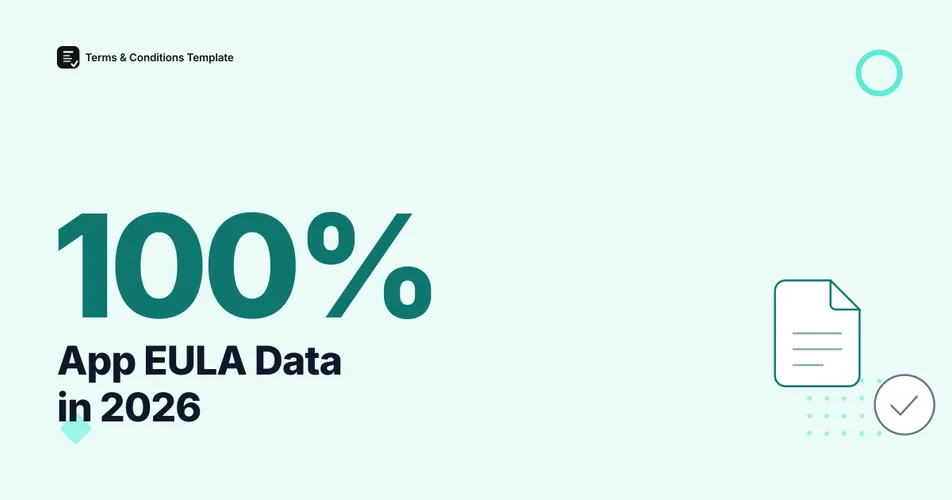
100% of apps on Apple’s App Store operate under a EULA, whether the developer wrote one or not. Apple’s own licensing terms state that a developer’s right to distribute an app is subject to either Apple’s Standard EULA, which applies automatically by default, or a Custom EULA the developer supplies instead. That single policy detail means the question “how many App Store apps have a EULA” has a flat answer: all of the roughly 2.49 million of them.
Android tells a different story. Below is the full breakdown of what each platform actually requires, and how little that requirement seems to matter to the people clicking Agree.
Does every App Store app actually have a EULA?
Yes, by design. Apple’s Licensed Application End User License Agreement states plainly that a user’s license to each app is subject to prior acceptance of either the Standard EULA or a Custom EULA the developer provides “if one is provided.” In practice, this makes the Standard EULA a legal fallback: a developer who submits an app without writing custom license terms does not end up with no EULA, they end up with Apple’s own.
Figure 1: How every App Store app ends up covered by a EULA, whether custom or Apple’s default. Source: Apple Legal, Licensed Application EULA and Minimum Terms.
This is why a EULA generator is still worth using even for a Standard-EULA app: Apple’s fallback terms are deliberately generic, and a Custom EULA lets you add app-specific terms, such as data handling, subscription cancellation, or liability limits tailored to what your app actually does, that the generic default was never written to cover.
How does Android compare?
Google Play takes the opposite policy position. Its Developer Policy requires every app to publish a privacy policy but treats a EULA as entirely optional. As of August 2026, Google Play hosts an estimated 1.96 million apps, compared with roughly 2.49 million on Apple’s App Store, and no publicly disclosed audit tells us what share of those Android apps actually include license terms of their own.
Figure 2: App counts across the two largest stores and each store’s EULA policy. Sources: existing App Store count data; AppBrain Google Play count, August 2026.
Warning
We could not find a reliable, sample-sized audit of what share of Google Play apps actually publish their own EULA. Google’s own policy only mandates a privacy policy, not a EULA, so the honest answer for Android is “unknown, and optional by design,” not a percentage. Treat any blog claiming a specific Android EULA-adoption rate with suspicion unless it names a primary, disclosed-methodology source.
Does having a EULA actually change user behavior?
Barely. Whether an app has Apple’s Standard EULA, a Custom EULA, or none at all on Android, the overwhelming majority of users never read it. Deloitte’s Global Mobile Consumer Survey of 2,000 US consumers found 91% accept software terms and EULAs without reading them, a figure that climbs to 97% among consumers ages 18-34.
Figure 3: Non-reading rate for software terms and EULAs by age group. Source: Deloitte Global Mobile Consumer Survey, n=2,000, 2017.
For the full picture on reading behavior across studies and methods, see how many people actually read EULAs. The existence of a EULA protects the developer legally regardless of whether anyone opens it, which is exactly why Apple makes one mandatory by policy rather than leaving it to chance.
What has to be in an App Store EULA?
Apple’s Minimum Terms of Developer’s End-User License Agreement specify roughly 10 required provisions that apply even to a Custom EULA, including a warranty disclaimer, a limitation of liability, an acknowledgment that Apple has no maintenance or support obligation for the app, and a statement that the developer, not Apple, is responsible for claims relating to the app. A Custom EULA can add terms on top of this baseline, such as subscription billing or data-collection specifics, but it cannot remove or contradict any of Apple’s required clauses.
Figure 4: Timeline of app store legal requirement milestones. Sources: Apple, Google, Deloitte, EU Digital Markets Act documentation.
Where do app stores sit on EULA strictness versus review strictness?
Figure 5: Illustrative positioning of major distribution channels by EULA and review strictness, based on the policy details cited throughout this article. Not a single unified dataset. Sources: Apple Legal; Google Play Developer Policy; EU DMA documentation. See the alternative app store market data and EU DMA sideloading effects for the channels referenced here.
Even an alternative iOS marketplace operating under the EU’s Digital Markets Act still routes through Apple’s notarization review, which is why it sits closer to the App Store on review strictness than Google Play does, even though it does not carry Apple’s own EULA mandate.
App EULA requirements by platform
| Platform | Apps (2026) | EULA required? | What’s mandatory instead |
|---|---|---|---|
| Apple App Store | ~2.49 million | Yes, 100% (Standard or Custom) | N/A, EULA is the requirement |
| Google Play | ~1.96 million | No | Privacy policy only |
| EU alternative iOS marketplace | Varies by store | Inherits Apple’s App Store EULA policy | Apple notarization review |
The Bottom Line
The honest answer to “how many apps have a EULA” splits cleanly by platform. On Apple’s App Store, the answer is 100% of roughly 2.49 million apps, because Apple’s Standard EULA applies automatically to any app that does not supply its own. On Google Play’s roughly 1.96 million apps, a EULA is optional, and no reliable audit tells us how many developers actually bother. Either way, the practical impact on users is close to zero: 91% to 97% of people accept whatever terms are in front of them without reading. If you publish on iOS, a Custom EULA generator lets you replace Apple’s generic default with terms that actually match your app’s data use, subscription model, and liability needs, while still meeting Apple’s minimum required clauses.
Frequently Asked Questions
Do all apps on the Apple App Store have a EULA? Yes, effectively 100% of them. Apple’s own Licensed Application EULA terms state that a developer’s license to distribute an app is subject to either Apple’s Standard EULA or a Custom EULA, meaning every one of the roughly 2.49 million apps on the App Store operates under some form of EULA whether the developer wrote one or not.
Does Google Play require apps to have a EULA? No. Google Play’s Developer Policy requires a privacy policy for every app but treats a EULA as optional; developers may add one to govern license terms, but it is not mandatory for the roughly 1.96 million apps on Google Play as of August 2026.
What does Apple require a EULA to contain? Apple’s Minimum Terms of Developer’s End-User License Agreement require specific clauses even in a custom EULA, including a warranty disclaimer, a limitation of liability, and an acknowledgment that Apple has no maintenance obligation for the app.
Do people actually read app EULAs even when one exists? Rarely. 91% of consumers accept software terms and EULAs without reading them, rising to 97% for people ages 18-34, according to Deloitte’s Global Mobile Consumer Survey of 2,000 US consumers.
Sources and References
- Apple Legal. “Licensed Application End User License Agreement.” Standard EULA terms and default-applies-automatically policy.
- Apple Legal. “Minimum Terms of Developer’s End-User License Agreement.” Required Custom EULA clauses.
- Google Play. “Developer Policy Center.” Privacy policy requirement; EULA treated as optional.
- AppBrain. (2026). “Number of Android Apps on Google Play.” App count, August 2026.
- Business Insider, reporting Deloitte’s Global Mobile Consumer Survey. (2017). “91% of People Agree to Legal Terms Without Reading Them.” Survey of 2,000 US consumers.
Note: All figures verified as of August 2026. App store counts change daily; policy details are re-checked at least twice a year for updates to Apple’s or Google’s developer terms.