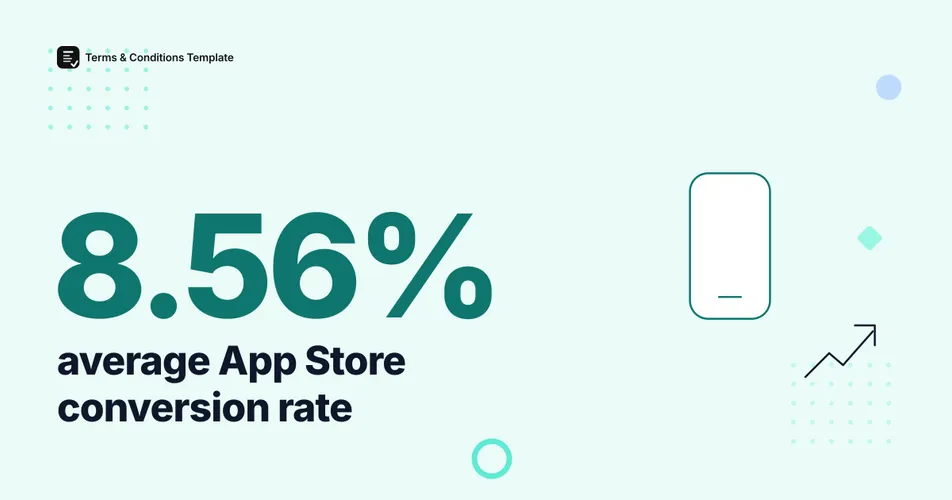
The average US App Store product page converted just 8.56% of visitors into installs in 2025, according to AppTweak’s conversion rate benchmark data, versus 16.15% on Google Play over the same period. That blended figure hides a wide spread: Food & Drink apps convert above 50%, while some game categories barely clear 5%. App Store Optimization exists to move one app’s conversion rate toward the top of its own category, not toward an industry average that few apps actually hit.
If you publish or maintain an app, the numbers below show where ASO effort still pays off in 2026: search dominance, the category-specific conversion bar, the outsized effect of star ratings, and the shrinking amount of text Apple’s algorithm actually reads.
What is a good app store conversion rate in 2026?
A good conversion rate depends entirely on category, not a single benchmark number. AppTweak’s 2025 US App Store data puts the overall average at 8.56% of product page visitors converting to installs, with Food & Drink apps topping the chart at 52.8% and Trivia games sitting at the bottom at 5.2%. Google Play runs hotter across the board, averaging 16.15%, with Auto & Vehicles apps reaching 62.3% and Strategy games as low as 6.6%.
Figure 1: Average product page conversion rate by platform, 2025. Source: AppTweak US benchmark data.
Figure 2: Category conversion rate spread on the App Store. Source: AppTweak, US App Store, 2025 benchmark data.
AppTweak does not publish the underlying sample size for its category benchmark feature, so treat these as directional category rankings rather than a precise universal rate. The gap between top and bottom categories, roughly a 10x difference, is the more durable finding: comparing your app against the wrong category benchmark will send you chasing either false comfort or an impossible target.
How much of app discovery still comes from search?
Search remains the dominant discovery channel on the App Store, accounting for about 65% of all downloads, according to Sensor Tower’s analysis of App Store download sources. Browse contributes roughly 15% of downloads, up from about 10% before Apple’s 2017 App Store redesign, and the remainder splits between app and web referrals.
Figure 3: Share of App Store downloads by discovery channel. Source: Sensor Tower, App Store download-source analysis.
Search share is not uniform across app types. Sensor Tower’s category breakdown found search drives 69% of non-game app downloads but only 56% of game downloads, since games see proportionally more browse and referral traffic through charts and cross-promotion. This dataset is dated to the year following the 2017 redesign and Sensor Tower has not published a full refreshed breakdown as of 2026, but it remains the baseline every current ASO guide still cites, and Apple’s continued investment in search placements, including new ad slots added in March 2026, suggests search’s share has held or grown rather than shrunk. If your app is a non-game utility or tool, keyword and metadata work carries even more weight than it does for a typical game.
For the full picture of download and revenue trends across both major app stores, see our App Store statistics roundup for 2026.
How much does a star rating actually affect conversion?
A jump from a 3-star to a 4-star average rating can lift conversion by as much as 89%, according to Apptentive’s (now Alchemer) Mobile Customer Engagement Benchmark Report. That figure dates to 2017, and no fresher primary study with comparable rigor has replaced it, so treat it as a directional order-of-magnitude effect rather than a precise 2026 number. It has nonetheless been repeated in nearly every ASO guide published since, which is itself a signal that nothing has displaced it as the industry’s reference point on rating impact.
Figure 4: Conversion index, 3-star rating versus 4-star rating (3-star indexed to 100). Source: Apptentive (now Alchemer), 2017 benchmark study.
Warning
Treat the 89% figure as an order-of-magnitude signal, not a precise 2026 conversion multiplier. It comes from a single 2017 study, predates several major App Store redesigns, and has never been independently replicated at that scale. Use it to argue that ratings matter enormously, not to forecast an exact revenue lift from a specific ratings campaign.
The practical takeaway holds regardless of the exact multiplier: apps sitting below a 4.0 average rating are competing with one hand tied behind their back, since both users and the ranking algorithm treat 4.0 as a meaningful threshold rather than a smooth gradient.
What actually moves App Store rankings versus conversion rate?
Ranking and conversion are two different problems, and mixing them up wastes ASO effort. Apple’s algorithm ranks apps mainly on keyword relevance, download velocity, and ratings and reviews, while conversion rate is driven by the visual assets a visitor sees after they already found your listing: the icon, screenshots, preview video, and description.
Figure 5: Where common ASO levers sit on developer control versus ranking or conversion impact. Framework based on Apple’s public ranking guidance and AppTweak/SplitMetrics practitioner benchmarks, not a single numeric study.
The one lever both ranking and conversion share is text, and Apple gives developers very little of it to work with: a 30-character app name, a 30-character subtitle, and a 100-character keyword field, for 160 characters of indexed text total. Google Play has no equivalent dedicated keyword field and instead indexes the full app title, short description, and long description, which rewards a different kind of keyword placement strategy entirely.
| Metadata field | Character limit | Indexed for search? |
|---|---|---|
| App name (iOS) | 30 characters | Yes, strongest ranking weight |
| Subtitle (iOS) | 30 characters | Yes, second-strongest weight |
| Keyword field (iOS, hidden) | 100 characters | Yes, not shown to users |
| Title, short and long description (Android) | No dedicated keyword field | Yes, full text is indexed |
How has the App Store discovery landscape changed since 2017?
The current 65% search share sits on top of several structural changes to how Apple surfaces apps. Apple’s 2017 App Store redesign shifted meaningful discovery volume from search into browse for the first time. Apple rebranded Apple Search Ads to Apple Ads in April 2025 to reflect a broader advertising surface beyond search results alone, and in March 2026 Apple added more ad slots throughout App Store search results, pushing organic listings further down the page even as the top organic position became more valuable per click.
Figure 6: App Store discovery and advertising milestones, 2017 to 2026. Sources: Sensor Tower, Apple Ads product announcements.
The direction is consistent: paid placements are claiming more of the screen, which makes the remaining organic real estate, and the metadata that wins it, more valuable rather than less. A weak keyword field in 2026 costs more visibility than the same weak keyword field cost in 2020.
For a related benchmark on what happens after the install, see our freemium app conversion data for 2026, which covers how many of these installs actually convert to paying users.
The Bottom Line
The single most useful number in this data is not the 8.56% average, it is the category spread underneath it. A Food & Drink app converting at 30% is underperforming its category, while a Trivia game converting at 6% might be near the top of its own. Benchmark against your category, fix your rating before you fix your keywords if it sits below 4.0, and remember that Apple only reads 160 characters of your metadata, so every one of them should carry a real search term. Every app on either store also needs current legal terms before it ships: use our EULA generator to publish an end-user license agreement that matches what your app actually does, since app store review teams check for one and users increasingly do too.
Frequently Asked Questions
What is a good conversion rate for an app store product page? 8.56% is the US App Store average across all categories in 2025, per AppTweak. A good rate depends heavily on category: Food & Drink apps average 52.8% while Trivia games average just 5.2%, so compare against your own category, not the blended figure.
Does search still drive most App Store downloads? Yes. Search accounts for about 65% of all App Store downloads, per Sensor Tower’s download-source analysis, with browse contributing roughly 15% and referrals making up the remainder. Search share is even higher for non-game apps, at 69%, versus 56% for games.
How much does an app’s star rating affect its conversion rate? Moving from a 3-star to a 4-star average rating can lift conversion by as much as 89%, per Apptentive’s (now Alchemer) mobile engagement benchmark research. That figure dates to 2017 and no fresher primary study has replicated it, but it remains the most-cited number in the ASO industry.
How many characters can I use for App Store keywords? Apple indexes just 160 characters of text for App Store search ranking: a 30-character app name, a 30-character subtitle, and a 100-character keyword field. Google Play has no equivalent hard keyword field and instead reads the full title, short description, and long description.
Sources and References
- AppTweak. (2025). “Average App Conversion Rate per Category.” US App Store and Google Play benchmark data.
- Sensor Tower. “App Store Browsing Has Grown to Drive 15% of Downloads Since iOS 11’s Launch.” Download-source analysis, May 2017 to April 2018.
- Apptentive (now Alchemer). (2017). “Mobile Customer Engagement Benchmark Report.” Rating-to-conversion impact study.
- Search Engine Land. (2025). “Apple Ads: What you need to know in 2026.” Coverage of the Apple Search Ads to Apple Ads rebrand, April 2025.
- PPC Land. (2026). “Apple will squeeze more ads into App Store search, here’s what changes.” Coverage of March 2026 ad slot expansion.
- Apple Developer. App Store Connect metadata guidelines, app name, subtitle, and keyword field character limits.
Note: All figures verified as of August 2026. ASO benchmarks and Apple’s own algorithm behavior change frequently, so headline figures here are refreshed at least twice a year. The 2017-dated rating and discovery-channel figures are flagged in-text and should be re-checked against fresher primary research before each refresh.