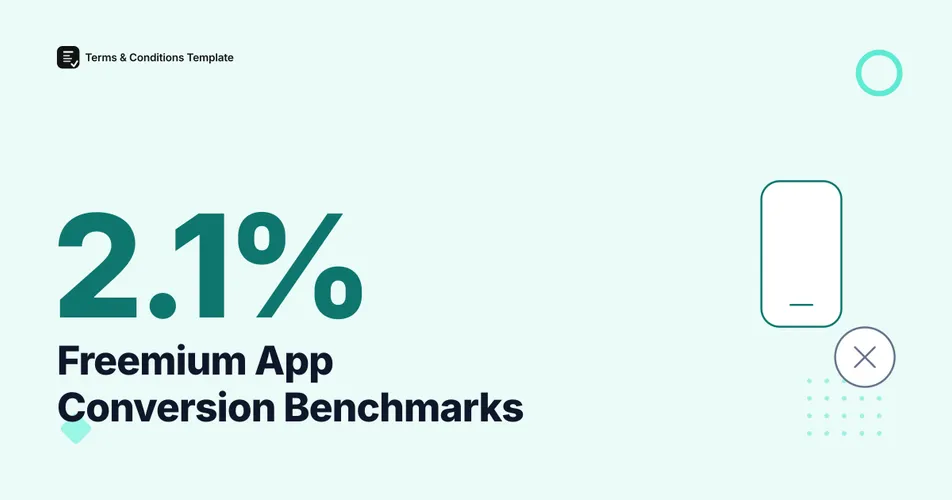
Freemium apps, meaning apps where a free tier stays usable indefinitely rather than expiring into a required payment, convert just 2.1% of downloads to a paid subscription by day 35, according to RevenueCat’s 2026 State of Subscription Apps report. Hard-paywall apps, which require payment or a trial signup before full access, convert more than five times better, at 10.7%. That single comparison is the starting point for nearly every freemium monetization decision a mobile app makes in 2026.
What is the freemium free-to-paid conversion rate?
RevenueCat’s 2026 report, drawn from a dataset of 115,000-plus apps with active subscription revenue, $16 billion in tracked revenue, and over 1 billion transactions, puts freemium’s median day-35 download-to-paid conversion rate at 2.1%. Hard-paywall apps convert at 10.7% over the same window, a gap RevenueCat itself describes as hard paywalls converting “5x better than freemium.”
The comparison is not simply “freemium underperforms.” A freemium app deliberately trades conversion rate for reach: because the free tier never expires, it can be installed and used by an enormously larger audience than a hard-paywall app that filters out anyone unwilling to commit upfront, which is exactly why the category still dominates app store listings even at a fraction of the conversion rate.
How does freemium compare to a hard paywall on revenue?
The monetization gap between the two models is even larger than the conversion gap. By day 14, hard-paywall apps generate a median $2.32 in revenue per install, versus just $0.27 for freemium apps, a 9x difference. By day 60, hard-paywall apps still lead at $3.09 per install against freemium’s $0.38, an 8x gap that has narrowed only slightly as freemium users have more time to eventually convert.
| Metric | Hard paywall | Freemium | Gap |
|---|---|---|---|
| Day-35 download-to-paid | 10.7% | 2.1% | 5x |
| Day-14 revenue per install | $2.32 | $0.27 | 9x |
| Day-60 revenue per install | $3.09 | $0.38 | 8x |
Source: RevenueCat, State of Subscription Apps 2026.
Figure 1: Hard-paywall apps monetize roughly nine times faster per install than freemium apps in their first two weeks. Source: RevenueCat, State of Subscription Apps 2026.
If a freemium app’s paid tier unlocks any AI features, cloud storage, or expanded license rights beyond the free version, keeping that distinction documented in an EULA generator protects the app from disputes over what a free-tier user was and was not entitled to use.
Has freemium conversion changed over time?
Freemium’s day-35 conversion rate has held essentially flat at 2.1% since 2025, per RevenueCat, showing no meaningful movement year over year. Hard-paywall conversion has actually declined, from 12.1% in 2025 to 10.7% in 2026, a drop RevenueCat attributes to broader market reluctance to convert rather than any change specific to the paywall model itself.
Figure 2: Hard-paywall conversion is trending down toward freemium’s flat baseline, not the reverse. Source: RevenueCat, State of Subscription Apps 2025 and 2026 editions.
That direction matters for anyone benchmarking against last year’s numbers: a hard-paywall app converting at 10.7% today is not underperforming relative to its own historical baseline, it is tracking the same market-wide softening every paywall model is currently seeing. Our broader mobile app conversion benchmarks for 2026 cover the full funnel this conversion rate sits at the end of, from store listing through trial start.
Does freemium monetization vary by app category?
Substantially. RevenueCat’s day-14 revenue-per-install figures show Health & Fitness apps leading at $0.48, more than six times Gaming’s $0.08, with the global median across all categories at $0.23. By day 60, Health & Fitness rises to $0.66 per install and Gaming to $0.14, while the global median reaches $0.34.
Figure 3: Health & Fitness apps extract roughly six times more early revenue per install than Gaming apps. Source: RevenueCat, State of Subscription Apps 2026.
The gap tracks willingness to pay for outcomes rather than entertainment: a Health & Fitness free tier typically demonstrates enough value, a workout plan, a tracked habit streak, to justify a subscription quickly, while gaming’s enormous free-to-play population is accustomed to spending nothing at all, or spending unpredictably on in-app purchases rather than a recurring subscription.
Why do most apps still choose freemium despite lower conversion?
Retention is the answer RevenueCat’s data points to most directly: freemium and hard-paywall apps see nearly identical year-one retention, despite freemium converting at a fifth of the rate. In practice, that means a freemium app is not losing meaningfully more of its paying subscribers over time than a hard-paywall app is, it is simply starting from a much larger free-tier base that most of those users never convert out of.
Figure 4: Freemium and hard-paywall apps arrive at similar long-term retention through very different funnel shapes. Source: authors’ synthesis of RevenueCat’s 2026 conversion and retention data.
For a free tier to be worth maintaining at a 2.1% conversion rate, it typically needs to serve a second purpose beyond direct monetization: driving app store ratings and review volume, generating word-of-mouth referrals, or building a large enough installed base that even a small paid percentage produces meaningful revenue at scale. Our App Store statistics for 2026 and app subscription revenue and churn data both cover the wider installed-base and revenue context freemium’s low conversion rate operates inside. For apps considering a hybrid approach, our SaaS free trial statistics for 2026 cover how a time-limited trial changes these same conversion dynamics, and our data on what percentage of apps are free shows just how dominant the freemium and fully-free model remains across app stores overall.
The Bottom Line
Freemium converts at a fifth of the rate a hard paywall does, 2.1% versus 10.7% by day 35, and monetizes at roughly a ninth of the speed in early revenue per install. Neither gap has closed in the past year; if anything, hard-paywall conversion is drifting down toward freemium’s flat baseline rather than freemium catching up. The model still dominates app stores because conversion rate and retention are not the same measurement: a freemium app trades a lower percentage for a larger base, and RevenueCat’s retention data shows that trade does not cost it meaningfully on how long the subscribers it does convert actually stick around.
Frequently Asked Questions
What percentage of freemium app downloads convert to paid? 2.1% of freemium app downloads convert to a paid subscription by day 35, per RevenueCat’s 2026 benchmark dataset of 115,000-plus apps, a rate that has stayed flat since 2025.
Is a hard paywall more profitable than freemium? Yes. By day 14, hard-paywall apps generate $2.32 in revenue per install versus $0.27 for freemium apps, a 9x gap. By day 60 the gap narrows slightly to 8x, at $3.09 versus $0.38, per RevenueCat.
Which app categories monetize freemium best? Health & Fitness leads at $0.48 in revenue per install by day 14, more than 6x Gaming’s $0.08. The global median across all categories is $0.23, per RevenueCat’s 2025 dataset.
Why do so many apps still use freemium if hard paywalls convert better? Freemium and hard-paywall apps see nearly identical year-one retention despite the conversion gap, per RevenueCat, so freemium’s main appeal is maximizing top-of-funnel reach and word-of-mouth rather than early monetization.
Sources and References
- RevenueCat. (2026). “State of Subscription Apps 2026: Business.” Dataset of 115,000-plus apps, $16 billion in tracked revenue, over 1 billion transactions, primarily 2025 metrics.
- RevenueCat. (2025). “State of Subscription Apps 2025.” Prior-year hard-paywall conversion baseline (12.1%) used for the year-over-year comparison.
- RevenueCat. State of Subscription Apps report hub.
Note: All figures verified as of August 2026. RevenueCat’s dataset primarily reflects 2025 transaction data published in its 2026 report edition; figures are refreshed at least twice a year as newer report editions publish.