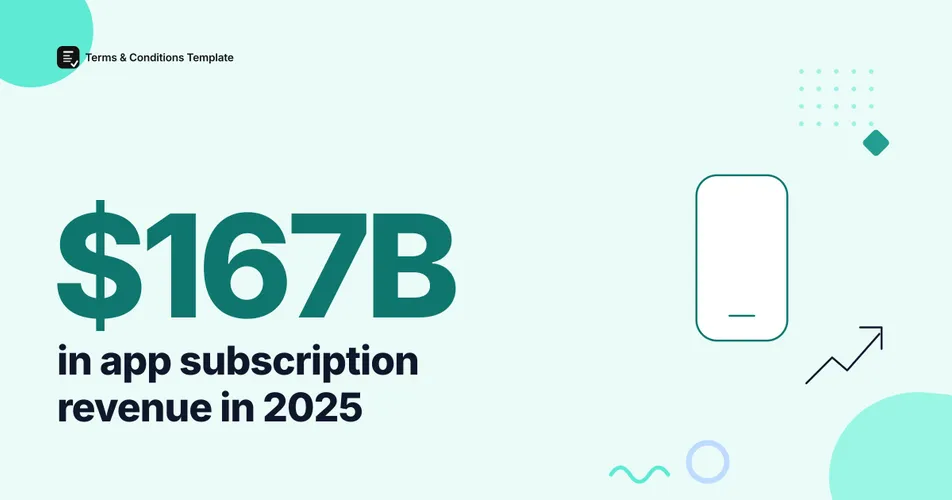
Global spending on mobile app subscriptions and in-app purchases reached $167 billion in 2025, up 10.6% year over year, according to Sensor Tower’s State of Mobile 2026 report. At the same time, RevenueCat’s analysis of 75,000 subscription apps found that nearly 30% of annual subscriptions cancel within the first 30 days. Revenue keeps climbing and so does the pace at which subscribers leave, and the gap between the two numbers is where most of the money in app subscriptions gets made or lost.
If you run a subscription app, both halves of that story matter. A bigger market means more competition for the same wallet share, and a high early-cancellation rate means the terms you set at signup, including price, trial length, and how a subscriber cancels, decide whether a download turns into a year of revenue or a single billing cycle.
How much do people spend on app subscriptions in 2025?
Consumers spent $167 billion on mobile apps in 2025, up from $150 billion in 2024, a 10.6% increase, according to Sensor Tower’s State of Mobile 2026 report. For the first time in Sensor Tower’s tracking history, spending on non-gaming apps, the category that includes most subscription products, overtook spending on mobile games. Non-gaming app spend hit roughly $85 billion in 2025, up 21% year over year and 2.8 times what it was five years earlier.
Figure 1: Split of global consumer app spending between non-gaming apps and games. Source: Sensor Tower, State of Mobile 2026, 2025 data.
Non-gaming apps overtaking games is a subscription story more than anything else. Streaming, dating, health, and AI apps monetize almost entirely through recurring plans, not one-off purchases, and that shift in where the money goes is what pushed the category past gaming for the first time. For the mobile gaming side of that same $167 billion, see our mobile gaming statistics for 2026.
How many app subscriptions get canceled, and when?
Cancellation is heavily front-loaded. RevenueCat’s 2025 report, based on 75,000 subscription apps and more than $10 billion in tracked revenue, found that nearly 30% of annual subscriptions cancel within the first 30 days, before the subscriber gets any real use out of a full year. By the one-year mark, only 44.1% of annual subscribers are still active, down from 47.1% in the prior year’s data. Monthly plans fare worse: just 17.0% of monthly subscribers are still active after a year, and weekly plans retain only 3.4%.
The pattern holds across plan types: the longer the commitment at signup, the more likely a subscriber sticks around, but even annual plans lose the majority of subscribers before their first renewal comes due.
What is the average subscription trial conversion rate?
Trial-to-paid conversion varies widely by category and trial length. RevenueCat’s 2026 report, covering more than 115,000 apps and $16 billion in tracked revenue, found trial-to-paid conversion of 25.5% for trials of four days or less, rising to 37.4% for five-to-nine day trials and 42.5% for trials running 17 to 32 days. Category matters just as much as length.
Figure 2: Median trial-to-paid conversion by category. Source: RevenueCat, State of Subscription Apps 2026, 115,000 apps analyzed.
Travel apps convert best because a trial usually coincides with an actual trip being planned, so the value is immediate. Photo and video apps convert worst, likely because a free trial is often enough to finish the one edit a casual user needed.
A longer trial is not automatically the right call. It buys a higher conversion rate but delays revenue and increases the risk a subscriber forgets they signed up, which is exactly the kind of complaint that draws regulator attention to a business’s cancellation terms.
How long do subscribers stick around after they convert?
Retention keeps falling the shorter the billing cycle. Adapty’s 2026 report, which benchmarked 16,000 apps and $3 billion in subscription revenue across 105,000 paywalls, measured retention at day 380 by the trial type a subscriber originally started on.
Figure 3: Share of trial subscribers still paying 380 days later, by the plan they originally trialed. Source: Adapty, State of In-App Subscriptions 2026, 16,000 apps.
Weekly plans convert new users fastest and now generate 56% of all mobile app subscription revenue, according to the same Adapty report, but they also bleed the most subscribers over the long run. An annual trial converts fewer people up front but keeps almost four times as many of them paying a year later.
Why do people cancel, and is canceling getting easier?
The single biggest reason subscribers cancel is not price. RevenueCat’s data shows “not enough usage” is the top cancellation reason across app categories, cited in a range of 32% to 47% of cancellations depending on the category. A meaningful share of cancellations are not deliberate at all: RevenueCat’s 2026 report found that about 31% of Google Play cancellations and 14% of App Store cancellations are involuntary, caused by a failed billing charge rather than a subscriber actively choosing to leave.
Figure 4: The minimum test regulators are pushing subscription apps to pass. Source: synthesized from FTC Negative Option Rule criteria, 2024.
Whether a cancellation flow passes that test increasingly has legal weight, not just a customer-experience one. A clear EULA that spells out how billing, auto-renewal, and cancellation actually work is the document that sets those expectations before a subscriber ever reaches the cancel button. You can generate an EULA that documents your subscription terms plainly, including a cancellation process that matches how easy signup was.
How is subscription cancellation regulation changing?
Regulators moved on subscription practices in both directions between 2024 and 2026. The FTC finalized its Negative Option Rule, commonly called “click-to-cancel,” in October 2024, requiring sellers to disclose material terms clearly, get informed consent before charging, and offer a cancellation path at least as simple as signing up. The Eighth Circuit vacated the rule on July 8, 2025, days before its scheduled effective date, calling parts of the FTC’s process arbitrary and capricious. In March 2026 the FTC opened a new rulemaking process aimed at reviving it.
Figure 5: Federal cancellation rulemaking milestones. Source: FTC press releases and Eighth Circuit ruling, 2024 to 2026.
Federal uncertainty has not stopped enforcement. Roughly 30 states now have their own automatic-renewal laws, several stricter than the vacated federal rule, and the FTC has continued to bring cases against subscription businesses under its general unfair-practices authority even without the specific rule in force. For app subscriptions specifically, that means the terms disclosed inside the app, not just the App Store or Play Store checkout screen, are what a regulator or a state AG will check first.
How do subscription plans compare by type?
| Plan type | Global median price | Trial-to-paid conversion | Day-380 retention |
|---|---|---|---|
| Weekly | $7.48 | Highest of any duration | 5.5% |
| Monthly | $12.99 | Mid-range | 14.2% |
| Annual | $38.42 | Lowest of any duration | 19.9% |
Source: Adapty, State of In-App Subscriptions 2026 (pricing and retention); RevenueCat, State of Subscription Apps 2026 (trial length conversion trend).
| Year | Global app spend | YoY change |
|---|---|---|
| 2024 | $150 billion | +13% |
| 2025 | $167 billion | +10.6% |
Source: Sensor Tower, State of Mobile 2025 and State of Mobile 2026 reports.
For the download and revenue side of this same market, our App Store statistics for 2026 cover how much of that spending flows through Apple’s platform specifically.
The Bottom Line
App subscription revenue is not slowing down. It grew to $167 billion in 2025 and non-gaming apps, most of them subscription-based, now out-earn games for the first time on record. But growth is masking a retention problem: nearly a third of annual subscribers never make it past their first month, and even the best-converting categories lose most subscribers within a year. Weekly plans win on signups and lose on loyalty; annual plans do the reverse. Regulators are watching the cancellation side of that equation closely, federal rule or not, which makes a plain-language EULA that matches your actual billing and cancellation flow a compliance document, not just a formality.
Frequently Asked Questions
How much revenue do app subscriptions generate? Global consumer spending on mobile app subscriptions and in-app purchases reached $167 billion in 2025, up 10.6% from $150 billion in 2024, according to Sensor Tower’s State of Mobile 2026 report.
What percentage of app subscriptions get canceled? Nearly 30% of annual app subscriptions cancel within the first 30 days, and only 44.1% of annual subscribers remain active after one year, based on RevenueCat’s 2025 analysis of 75,000 subscription apps.
How much does the average app subscription cost? The global median app subscription price is $12.99 a month or $38.42 a year, according to Adapty’s 2026 State of In-App Subscriptions report, which benchmarked 16,000 apps.
Why do people cancel app subscriptions? Not enough usage is the top reason for cancellation across app categories, cited in 32% to 47% of cases, and about 31% of Google Play cancellations are involuntary billing failures rather than a deliberate choice, per RevenueCat’s 2026 report.
Sources and References
- Sensor Tower. (2026). “State of Mobile 2026.” Global consumer spend, downloads, and category breakdown, 2025 data.
- Sensor Tower. (2025). “State of Mobile 2025.” Global consumer spend, 2024 data.
- RevenueCat. (2026). “State of Subscription Apps 2026.” 115,000+ apps analyzed, $16B+ in tracked revenue, 2025 data.
- RevenueCat. (2025). “State of Subscription Apps 2025.” 75,000 apps analyzed, $10B+ in tracked revenue.
- Adapty. (2026). “State of In-App Subscriptions 2026.” 16,000 apps, $3B in subscription revenue benchmarked, 105,000 paywalls.
- Business of Apps. (2026). “App Subscription Data.” Aggregated subscription revenue and market-share figures, 2025 data.
- Federal Trade Commission. (2024). “FTC Announces Final Click-to-Cancel Rule.” Official rulemaking announcement.
- Jones Day. (2026). “FTC Revives Click-to-Cancel Rule: New Risks for Subscription Businesses.” Legal summary of the Eighth Circuit vacatur and 2026 rulemaking revival.
Note: All figures verified as of September 2026. Subscription pricing, retention, and regulatory status change quickly, so headline figures are refreshed at least twice a year.