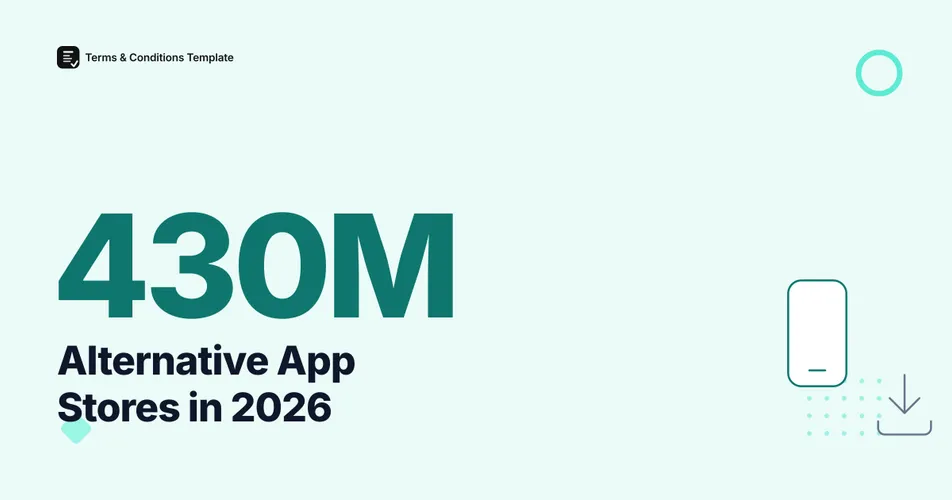
More than 430 million people now install apps through Aptoide alone, the largest of a fast-growing set of alternative app stores that exist largely because of antitrust pressure on Apple and Google. Aptoide’s 2026 figures put it at over 1 million apps across platforms, and it is only one of at least four named marketplaces now live on iPhone in the EU under the Digital Markets Act.
How big are alternative app stores in 2026?
Scale varies enormously between the largest and smallest players. Aptoide reports more than 430 million users and over 1 million apps across the platforms it serves, making it the largest alternative marketplace by a wide margin. Epic Games Store’s separate mobile storefront, distributed on Android globally and on iOS within the EU, passed 40 million installs by June 2025, with Epic publicly targeting 70 million installs by the end of that year.
Figure 1: Reported user and install counts for the two largest named alternative marketplaces. Both figures are company-reported, not independently audited. Sources: Aptoide company data via TechCrunch; Epic Games company data.
The gap between 430 million and 40 million is mostly a story about age and platform reach: Aptoide has served Android users for over a decade across emerging markets, while Epic’s iOS storefront has only existed in the EU since August 2024.
Which alternative app stores are live in the EU right now?
The EU became the first market where Apple had to allow third-party iOS marketplaces, starting March 2024. Epic Games Store arrived first, in August 2024, bringing Fortnite, Rocket League Sideswipe, and Fall Guys. AltStore PAL followed, gaining wider recognition in 2024 when Apple’s policy change allowed emulators, driving adoption through the Delta Nintendo emulator. Onside launched in the EU and, as of February 17, 2026, in Japan as well. Not every entrant stayed: MacPaw’s Setapp Mobile shut down on February 16, 2026, citing Apple’s “still-evolving” and complex business terms.
Figure 2: Key EU alternative iOS marketplace launches and closures. Sources: TechCrunch; company announcements, 2024-2026.
A market with both new entrants and a closure in the same month is a genuinely open one, not a settled one. If you generate a EULA for an app you plan to distribute outside a single app store, you need license terms that hold up regardless of which marketplace, or how many, end up carrying your app.
Is downloading from an alternative store actually riskier?
The clearest risk data available comes from Android, where alternative stores have existed far longer than on iOS. Google reported in March 2025 that apps installed from outside Google Play are 50 times more likely to contain malware than apps from Play, with a 3% malware rate outside Play versus 0.03% on Play itself.
Figure 3: How distribution channel relates to measured malware rate. Source: Google Android Developers Blog, March 2025.
Warning
This risk data is measured on Android, where “outside Google Play” includes both alternative app stores and completely unverified direct APK installs. iOS alternative marketplaces work differently: every app distributed through one still has to pass Apple’s mandatory notarization security review before it reaches a device. We could not find an equivalent, disclosed malware-rate study specific to notarized iOS alternative marketplaces; treat the Android figures above as the best available reference point, not a direct substitute.
What does it cost developers to distribute outside the App Store?
Apple’s EU compliance terms include a Core Technology Fee (CTF) of 0.50 euros for each first annual install once an app passes 1 million installs distributed outside Apple’s own App Store. Alternative marketplace commission structures vary by operator: Epic offers developers 100% of the first $1 million in annual net revenue per product, then its standard 88/12 revenue share applies; Aptoide charges 10% to 20% commission on iOS in-app purchases.
| Channel | Fee or commission | Trigger |
|---|---|---|
| Apple Core Technology Fee | 0.50 euros per install | After 1 million annual installs outside the App Store |
| Epic Games Store | 0% up to $1M/year, then 12% | Per product, per year |
| Aptoide (iOS) | 10% to 20% of in-app purchases | All transactions |
Starting October 1, 2026, a developer must also meet a financial-stability bar before it can operate its own alternative marketplace at all, such as holding a standby letter of credit of 1,000,000 US dollars or an equivalent, a threshold that keeps marketplace operation limited to well-capitalized companies.
How does market position compare across stores?
Plotting known and emerging marketplaces by scale and openness shows why Google Play and the App Store still dominate even as alternatives multiply.
Figure 4: Illustrative positioning of major app stores by relative openness and scale, based on the user/install figures and policy details cited throughout this article. Sources: as cited above, not a single unified dataset.
How do the named alternative stores compare by reported size?
Figure 5: Relative scale of named alternative marketplaces where company-reported figures exist. “Other” is a placeholder bucket, not a measured figure, since AltStore, Onside, and similar marketplaces do not publish comparable user counts. Sources: Aptoide, Epic Games company data.
Even acknowledging that gap in disclosed data, the app store market as a whole remains dominated by the two original platforms; alternative marketplaces are a genuine new distribution option, not yet a replacement for either.
The Bottom Line
The single figure that best captures alternative app stores in 2026 is Aptoide’s 430 million users, a scale most of its newer iOS-focused competitors are nowhere close to matching yet. The EU’s Digital Markets Act created the legal opening for iOS alternatives specifically, but company-reported install counts, Apple’s Core Technology Fee, and the incoming October 2026 financial-stability requirement all point to the same conclusion: this is a market for well-capitalized operators, not a free-for-all. If you distribute software through more than one channel, keep your EULA current and consistent across every store you list in, since license terms do not automatically carry over between marketplaces. For the security angle specific to the EU’s sideloading rules, see the EU DMA sideloading effects data, and for how many apps actually publish a EULA at all, see the App EULA prevalence data.
Frequently Asked Questions
How many users do alternative app stores have? Aptoide, the largest alternative Android and iOS marketplace, reports more than 430 million users and over 1 million apps across platforms as of 2026. Epic Games Store’s mobile store separately passed 40 million installs by June 2025.
How many alternative app stores are available on iPhone in the EU? At least 4 named alternative iOS marketplaces, Epic Games Store, AltStore PAL, Aptoide, and Onside, operate in the EU under the Digital Markets Act as of 2026, up from zero before March 2024. MacPaw’s Setapp Mobile closed in February 2026, showing the market is not guaranteed to keep every entrant.
Do alternative app stores still require Apple’s security review? Yes. Every app distributed through an alternative iOS marketplace still has to pass Apple’s mandatory notarization review, the same security check that applies to App Store apps and direct web downloads.
Has Google Play lost significant market share to alternative Android stores? Not by download volume. Google Play still accounts for an estimated 77% of global app downloads even with alternative Android stores like Aptoide, Huawei AppGallery, and Cafe Bazaar serving hundreds of millions of users combined.
Sources and References
- TechCrunch. (2026). “Move Over, Apple: Meet the Alternative App Stores Available in the EU and Elsewhere.” Aptoide user/app figures, marketplace fee structures.
- Google Android Developers Blog. (2025). “Keeping Google Play Safe.” Malware-rate comparison, apps outside Play versus Play Store.
- Apple Developer. (2026). “Changes for Apps in the European Union.” Core Technology Fee and alternative marketplace terms.
- Tech Times. (2026). “Apple EU Settlement Locks In 5% App Store Rate With Notarization Still in Place.” October 2026 marketplace operator financial-stability requirements.
Note: All figures verified as of August 2026. Alternative app store adoption and fee structures are changing quickly under active EU regulatory proceedings; figures are refreshed at least twice a year.