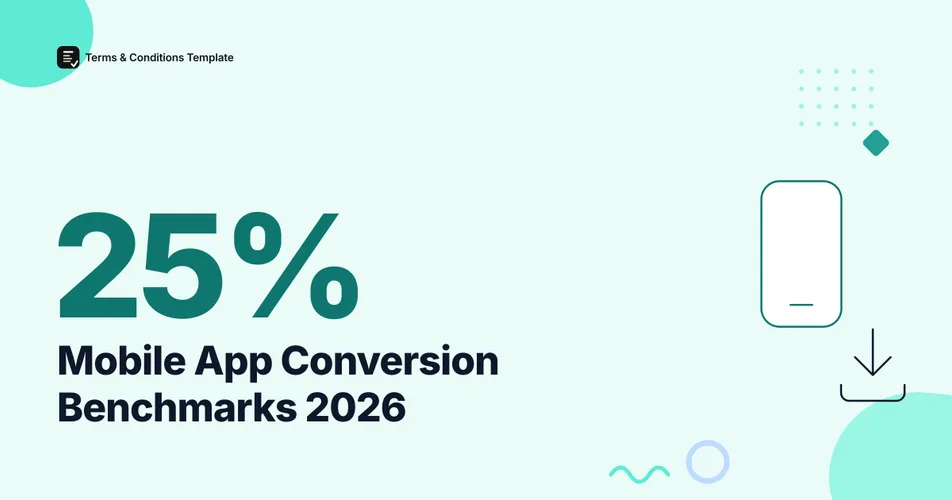
The average US App Store product page converts 25% of visitors into installs, according to AppTweak’s H1 2025 conversion-rate methodology research. That single figure hides a roughly 65-percentage-point spread between categories, and it is only the first of several conversion gates a mobile app clears before a visitor becomes a paying subscriber in 2026.
What is the average app store conversion rate?
The US App Store averaged a 25% conversion rate from product page visit to install across all apps in H1 2025, per AppTweak’s own CVR methodology research. Category spread is wide: Business apps convert at up to 66.7%, iOS Utilities apps target 33 to 38%, Finance apps sit at 18 to 22%, and Board Games apps scrape along at roughly 1.2%. Storemaven’s separate benchmark data puts the typical range at 26 to 33% for a well-optimized listing, and found that a strong first impression on the product page can lift conversion by up to 35%.
Google Play benchmarks tend to run 3 to 5 percentage points higher than iOS for equivalent categories, a gap generally attributed to differences in how each store surfaces ratings, screenshots, and preview video above the fold.
Figure 1: Business apps convert more than 50 times better than Board Games apps on the same App Store surface. Source: AppTweak CVR methodology research, H1 2025.
Does traffic source change the conversion rate?
Yes, dramatically. Sensor Tower’s late-2024 data shows iOS App Store search traffic converting at a 41% median, versus just 18% for browse traffic landing on the same product pages. A visitor who searched a specific term already has purchase intent the store’s own browse and discovery surfaces cannot replicate, which is why App Store Optimization work on keywords and search ranking tends to move the conversion needle more than product page redesigns alone.
That gap also explains why paid user-acquisition campaigns that route through a search-intent landing experience routinely outperform generic browse placements on cost per install, even before accounting for the App Store’s algorithmic search ranking.
What percentage of downloads convert to a trial start?
Once a visitor installs, the next gate is starting a free trial. RevenueCat’s 2025 dataset, drawn from more than 115,000 apps with active subscription revenue, $16 billion in tracked revenue, and over 1 billion transactions, puts North America’s median download-to-trial-start rate at 7.1%, with the top quartile of apps clearing 15%-plus. Business apps convert downloads to trials at 9.1%, more than double Gaming’s 4.4%.
| Category | Download-to-trial rate |
|---|---|
| Business | 9.1% |
| North America (all categories, median) | 7.1% |
| Gaming | 4.4% |
Source: RevenueCat, State of Subscription Apps 2026, 2025 dataset.
Figure 2: Business apps convert more than twice the share of downloads into trials that Gaming apps do. Source: RevenueCat, State of Subscription Apps 2026.
Our mobile commerce statistics for 2026 cover the wider purchase-conversion picture across mobile shopping, which sits downstream of the same install and trial-start funnel this section measures. Commerce-adjacent categories add their own wrinkle: apps built around live shopping formats, for instance, often skip a formal trial step entirely and convert straight from a live stream view to a purchase.
Does trial length change how many people convert to paid?
Trial length has one of the largest measurable effects on conversion in RevenueCat’s entire dataset. Trials running 17 to 32 days convert to paid at a 42.5% median, trials of 5 to 9 days convert at 37.4%, and trials of 4 days or fewer convert at just 25.5%. RevenueCat describes trials of 17-plus days as converting roughly 70% better than short trials.
Figure 3: Longer trials convert substantially better, even though they also delay the first billing event. Source: RevenueCat, State of Subscription Apps 2026.
The tradeoff is timing: a longer trial defers revenue recognition and gives a user more time to churn before ever being billed, which is exactly why apps in fast-decision categories, like utilities or games, often prefer short trials or hard paywalls over long free-use windows. If your app collects any personal data during onboarding or a trial period, an EULA generator keeps the license terms a trialing user agreed to in sync with what they actually experience once they convert.
How does the freemium model compare to a hard paywall?
Freemium apps, meaning apps where a free tier stays usable indefinitely rather than expiring into a paywall, convert far worse on a pure percentage basis. RevenueCat’s day-35 data shows freemium apps converting 2.1% of downloads to paid, versus 10.7% for hard-paywall apps, a roughly 5x gap that has held steady since 2025. Overall app usage and download volume, the traffic feeding every gate in this funnel, is covered in our broader mobile app usage and download statistics for 2026.
Figure 4: The full mobile conversion funnel, store listing through paid subscriber. Source: authors’ synthesis of AppTweak, RevenueCat, and Sensor Tower data, 2025 to 2026.
The Bottom Line
A visitor who lands on an app’s store page in 2026 clears roughly four separate conversion gates before becoming a paying subscriber: a 25% average chance of installing, a 4.4% to 9.1% chance of starting a trial depending on category, and a 25.5% to 42.5% chance of converting that trial to paid depending on trial length. Each gate responds to a different lever, App Store Optimization for the first, onboarding and paywall placement for the second, and trial-length strategy for the third, so a single “conversion rate” metric for an app usually hides which specific gate is actually holding growth back.
Frequently Asked Questions
What is a good app store conversion rate? The US App Store averaged a 25% conversion rate from product page visit to install in H1 2025, per AppTweak. Top performers reach far higher: Business apps convert up to 66.7%, while Board Games apps average around 1.2%.
What percentage of app downloads convert to a free trial? North America’s median download-to-trial-start rate is 7.1%, per RevenueCat’s 2025 dataset of 115,000-plus apps. Business apps lead at 9.1%, while Gaming trails at 4.4%.
Do longer free trials convert better than short ones? Yes. Trials running 17 to 32 days convert to paid at a 42.5% median, compared to 25.5% for trials of 4 days or fewer, per RevenueCat’s 2026 benchmarks.
Does traffic source affect app store conversion rates? Yes. iOS App Store search traffic converted at a 41% median in late 2024, versus 18% for browse traffic, per Sensor Tower data.
Sources and References
- AppTweak CVR methodology research, cited via Digital Applied’s 2026 ASO statistics compilation. US App Store, H1 2025, all-app and category-level conversion rates.
- RevenueCat. (2026). “State of Subscription Apps 2026: Business.” Dataset of 115,000-plus apps, $16 billion in tracked revenue, over 1 billion transactions, primarily 2025 metrics.
- Sensor Tower iOS search-versus-browse conversion data, late 2024, cited via Kirro’s 2026 app store conversion rate benchmark compilation.
- Storemaven app store product page benchmark data (26 to 33% typical range, first-impression lift), cited via Screenfast’s 2026 benchmark compilation.
Note: All figures verified as of August 2026. AppTweak and Sensor Tower figures reached this article through secondary compilations rather than direct access to the original reports; the RevenueCat figures are sourced directly from RevenueCat’s own published report. Headline figures are refreshed at least twice a year.