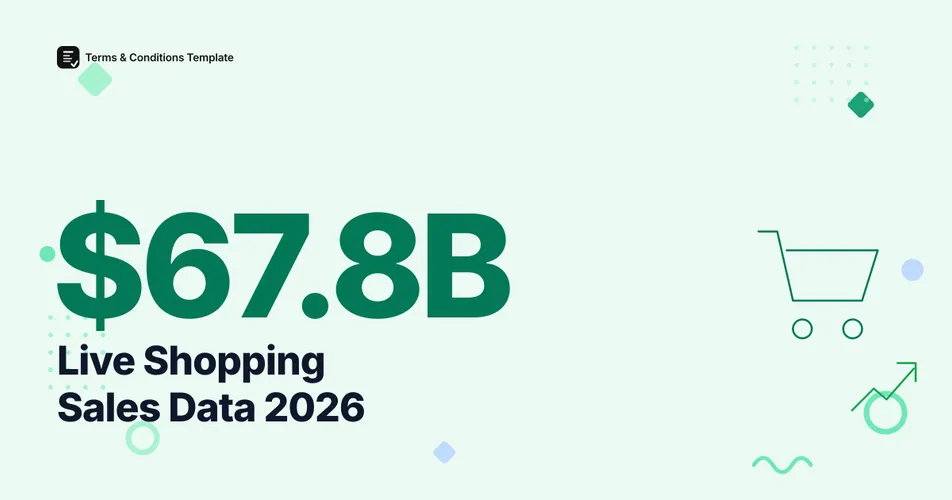
US live shopping sales are projected to reach $67.8 billion in 2026, more than double the $31.7 billion recorded in 2023, according to a Coresight Research and Bambuser forecast. That growth is real, but it is running well ahead of shopper trust: most people who watch a live sale still do not buy, and most who do buy say they are not confident the purchase can be returned if it goes wrong.
For a store owner, the practical question is not whether to try live shopping, it is whether the checkout and return terms are as fast and clear as the sale itself. The data below covers the market size, the conversion numbers, who is actually buying, and what shoppers say is stopping them.
How big is the live shopping market in 2026?
US live shopping sales are projected to reach $67.8 billion in 2026, more than double the $31.7 billion recorded in 2023, according to a joint forecast from Coresight Research and Bambuser based on two US consumer surveys and a B2B survey of retailers, brands, and manufacturers in North America and Western Europe. Coresight does not publish the exact sample size for these surveys in its public summary. Live shopping’s share of total US ecommerce is projected to cross 5% in 2026, up from 3.5% in 2023 and under 1% in 2020.
Figure 1: US live shopping sales, actual 2023 vs. Coresight and Bambuser’s 2026 forecast. Source: Coresight Research and Bambuser, 2023 report.
Warning
Treat live shopping market-size figures as directional, not comparable across firms. eMarketer separately reports US livestream ecommerce sales of $14.64 billion in 2025, a much narrower figure than Coresight’s trajectory implies for the same period. The two firms scope “live shopping” and “livestream ecommerce” differently, so their numbers should not be added together or read as the same measurement.
Even eMarketer’s narrower measure shows fast growth: US livestream ecommerce sales reached $14.64 billion in 2025, up nearly 50% year over year, and the number of buyers grew 21.5% in the same period. Either way you measure it, live shopping is one of the fastest-growing corners of US ecommerce heading into 2026.
What is the average conversion rate for live shopping?
Live commerce converts far better than a standard product page. McKinsey found conversion rates, meaning the share of live shows a viewer attended and then bought from during or after, of 33% in the United States, 32% in China, 30% in Europe, and 36% in Latin America. McKinsey does not disclose the underlying survey sample size in its public summary of this finding. That compares with a typical 2% to 3% conversion rate for standard online shopping, so live shopping is converting at roughly 10 times the baseline rate.
Figure 2: Live commerce conversion rate by region compared with standard ecommerce. Source: McKinsey, “Realizing the potential of live commerce,” 2023.
A separate 2021 McKinsey analysis projected that live-commerce-initiated sales could account for 10% to 20% of all ecommerce by 2026. The conversion numbers above are the mechanism behind that forecast: a shopper who watches a live demo and asks a question in the chat is already most of the way to a purchase decision by the time the segment ends.
How many people actually buy through live shopping?
Despite the conversion numbers, most US shoppers still are not participating. Only 21.7% of US digital buyers made a purchase through a livestream in 2025, and 43% of US adults say they have not used live shopping and are not interested in trying it, according to eMarketer. That gap between high conversion once someone tunes in and low overall participation is the defining tension in the US market right now.
Figure 3: Share of US adults who had participated in live shopping, as of 2022. Source: Whatnot, 2026 State of Live Selling Report, citing 2022 baseline adoption data.
As recently as 2022, 80% of US adults had never participated in live shopping at all, per Whatnot’s own 2026 State of Live Selling Report. The category has grown fast since, but it started from a small base, and most American shoppers have still never bought anything during a livestream. Most of that watching and buying happens on a phone rather than a desktop, following the same shift covered in our mobile commerce data for 2026.
Which platforms lead US live shopping?
Whatnot generated $8 billion in gross merchandise value from live sales in 2025, more than doubling year over year, and now holds close to 60% of an overall live shopping industry Whatnot estimates at $22 billion across Europe and North America. The platform runs 500,000 hours of live programming a week. eMarketer separately reports TikTok Shop holding close to 20% of the US livestream ecommerce market in 2025.
| Platform | 2025 metric | Source |
|---|---|---|
| Whatnot | $8B GMV from live sales, ~60% of industry | Whatnot, 2026 report |
| TikTok Shop | ~20% of US livestream ecommerce | eMarketer |
| All US live shopping (broad) | $14.64B in sales, 21.5% buyer growth | eMarketer |
| US market, 2026 forecast | $67.8B, >5% of ecommerce | Coresight Research/Bambuser |
Category growth inside live shopping is uneven. Whatnot reports beauty sales up 791% year over year in 2025, women’s fashion up 223%, and electronics up more than 400%, evidence that live selling is spreading well beyond the collectibles and trading-card niches it started in. Social platforms with an established shopping layer, like Instagram, are feeding this growth too; see our Instagram Shopping data for 2026 for how that channel’s checkout numbers compare.
Figure 4: Key live shopping market milestones. Sources: McKinsey (2021, 2023), Coresight Research and Bambuser (2023), Whatnot (2026).
Do shoppers trust that a live shopping purchase can be returned?
Not fully, and this is the gap most store owners underestimate. In an AfterShip and Ipsos survey of 1,000 US shoppers fielded in September 2024, 52% said they don’t trust social media platforms for shopping, and 41% named trust and security as their top concern with social and live commerce. 76% of respondents said they browse on a social platform but complete the actual purchase on a retailer’s own website, a pattern the survey’s authors tie directly to uncertainty over what happens if the order arrives wrong.
Figure 5: Share of surveyed US shoppers citing each trust concern with social and live commerce. Source: AfterShip and Ipsos, Shopper Sentiment Report, September 2024, n=1,000.
That trust gap is a policy problem as much as a platform problem. Live sales close in seconds, with far less time to read fine print than a normal checkout page, so the return window and process need to be obvious before the sale, not buried afterward.
Figure 6: The minimum test a live seller’s return terms should pass to avoid disputes. Source: synthesized from Whatnot’s published dispute-window policy and the AfterShip/Ipsos trust findings above.
Whatnot’s own policy illustrates the stakes: buyers can open a dispute within 3 days of delivery, and the platform tells sellers to keep their dispute rate under 1% of total orders or risk an account review. A written return and refund policy that states the window, the condition requirements, and the process in plain language, matched to that dispute clock, is the fastest way to close the trust gap the AfterShip and Ipsos data describes. Our Refund Policy Generator builds that exact document from your store’s actual return window and process rather than a generic template that ignores how fast a live sale actually closes.
The Bottom Line
Live shopping is growing fast, $67.8 billion in projected 2026 US sales, conversion rates 10 times higher than standard ecommerce, and a $22 billion cross-border industry led by Whatnot. But adoption is still shallow: fewer than 1 in 4 digital buyers have made a livestream purchase, and half of shoppers say they don’t trust social platforms for shopping at all. The sellers who close that gap fastest will be the ones who pair a fast, entertaining live sale with a return policy just as fast and just as clear. Get the refund terms right, publish them where the sale happens, and the conversion advantage live shopping already has stops being undercut by trust concerns at checkout.
Frequently Asked Questions
How big is the live shopping market in 2026? US live shopping sales are projected to reach $67.8 billion in 2026, more than double the $31.7 billion recorded in 2023, according to a Coresight Research and Bambuser forecast, and will account for over 5% of total US ecommerce.
What is the average conversion rate for live shopping? McKinsey found live commerce conversion rates of 33% in the US, 32% in China, 30% in Europe, and 36% in Latin America in 2023, roughly 10 times higher than the 2 to 3% conversion rate of standard online shopping.
How many people actually buy through live shopping? Only 21.7% of US digital buyers made a purchase through a livestream in 2025, and 43% of US adults say they have not used live shopping and are not interested, according to eMarketer.
Do shoppers trust that a live shopping purchase can be returned? Not fully. 52% of US shoppers say they do not trust social media platforms for shopping and 41% cite trust and security as their top concern, per an AfterShip and Ipsos survey of 1,000 US shoppers in September 2024.
Sources and References
- Coresight Research and Bambuser. (2023). US livestream commerce forecast, reported by Retail Dive. Projects $67.8 billion in US live shopping sales by 2026, up from $31.7 billion in 2023, based on two US consumer surveys and a B2B survey of retailers, brands, and manufacturers.
- eMarketer. (2026). “Livestreaming Trends and Statistics.” US livestream ecommerce sales, buyer growth, digital buyer adoption, and TikTok Shop market share data.
- McKinsey. (2023). “Realizing the potential of live commerce.” Regional conversion rate data for live commerce.
- McKinsey. (2021). “It’s showtime! How live commerce is transforming the shopping experience.” Forecasts live-commerce-initiated sales at 10-20% of all ecommerce by 2026.
- Whatnot. (2026). “2026 State of Live Selling Report,” reported by Tubefilter. GMV, platform activity, and 2022 baseline adoption data.
- AfterShip and Ipsos. (2024). “Shopper Sentiment Report.” Survey of 1,000 US shoppers, fielded September 18-20, 2024.
- Whatnot Help Center. Buyer Protection Policy, including the 3-day dispute window.
Note: All figures verified as of September 2026. Live shopping platform data and market forecasts change quickly, so headline figures here are refreshed at least twice a year.