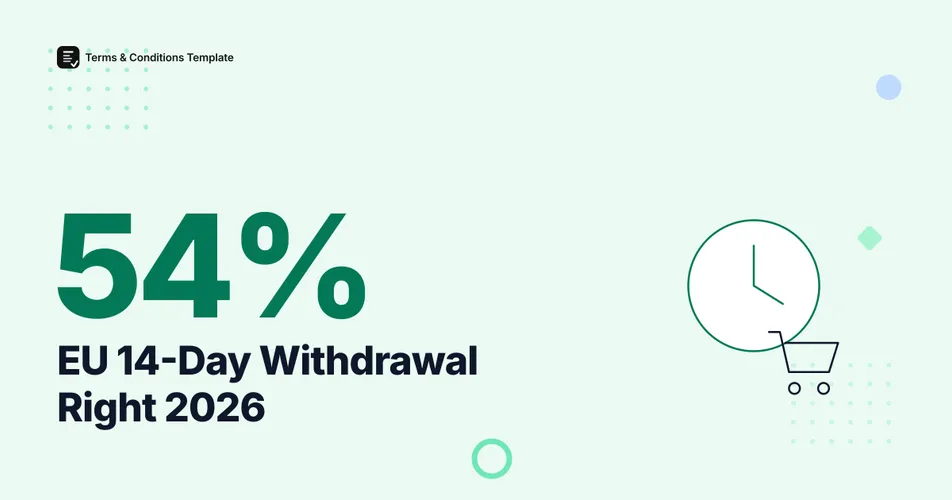
Only 54% of the digital subscription traders checked gave information about the EU’s 14-day withdrawal right, according to the sweep behind the European Commission’s October 2024 Fitness Check on digital fairness. That is a coin flip on a right that has existed since Directive 2011/83/EU. Every figure here comes from the Commission, Eurostat, or the directive text, and was checked in November 2026.
You sell to EU shoppers, or you plan to. So here is the short version: the right is simple, the way sellers present it is not, and the rules got stricter in June 2026.
What does the EU 14-day withdrawal right actually say?
Consumers can withdraw from a distance contract within 14 days without giving a reason. That is Article 9(1) of Directive 2011/83/EU, the Consumer Rights Directive. For a sale of goods, the 14 days start the day the consumer, or a third party they name, takes physical possession. For a service contract, they start the day the contract is concluded.
Once the shopper withdraws, the trader must refund all payments, including delivery costs, without undue delay and no later than 14 days after hearing about the decision (Article 13). The shopper must send goods back within 14 days of telling the trader, and normally pays only the direct cost of returning them (Article 14). These are the rules as originally adopted in 2011, so check your national law for later amendments.
| Rule | Deadline | Directive article |
|---|---|---|
| Consumer may withdraw | 14 days | Article 9 |
| Trader refunds after notice | 14 days | Article 13 |
| Consumer sends goods back | 14 days | Article 14 |
| Window if trader never mentions the right | 14 days plus 12 months | Article 10 |
Figure 1: Share of digital subscription traders giving information about the 14-day right in the Fitness Check sweep. The 46% is the remainder of the reported 54%. Source: European Commission SWD(2024) 230.
The deadlines are short and the same everywhere in the EU. Learn the three 14s and you know the skeleton of the whole right.
How many traders explain the right clearly?
Only 54%. The sweep run for the Commission’s supporting study looked at digital subscriptions. The Commission’s summary says traders gave clear information about the 14-day right of withdrawal in only 54% of cases. Its detailed section is stricter: just 54% of traders gave consumers information about the right before purchase, and among those, only 41.7% presented it in a way rated clear or very clear. The same sweep found the procedure for canceling after the 14 days was fairly clear in only 34.7% of cases. The Commission’s staff working document does not give the sweep’s sample size in the passages we read, so treat these numbers as a Commission snapshot of subscription sellers, not a census of every trader.
The same document records a more upbeat view from the industry side. In the Commission’s targeted stakeholder survey, respondents rated compliance as high for the 14-day right of withdrawal (71%). Put that next to the 54% from the subscription sweep and you see the gap. People who work with the rules think compliance is good. A look at live sites says it is patchy.
The Commission also credits the right itself. Its Fitness Check says the 14-day right for online purchases has directly increased consumer confidence in buying online. Clear wording helps a stranger click Buy.
Clear information is the cheapest part of compliance, and about half of the subscription sellers checked still missed it.
What happens if you never tell customers about the right?
The window grows by 12 months. Under Article 10, a trader that has not provided the information on the right of withdrawal faces a period that expires 12 months from the end of the initial withdrawal period. If the trader supplies the information within those 12 months, the period ends 14 days after the consumer receives it.
Figure 2: How missing information stretches the withdrawal window. Source: Directive 2011/83/EU, Article 10.
So a missing line in your terms can turn a two-week return window into a 13-month one. The fix takes minutes. A refund policy generator gives you a page where the window, the refund timing, and the return cost sit in plain sight.
If you want the numbers on how long returns windows run in practice, our return window data covers the 30, 60, and 90 day split.
An unclear policy lengthens your risk for up to 12 months.
What problems do consumers report with withdrawal?
46% of the Fitness Check survey respondents who had used digital content, services or subscriptions in the previous 12 months reported issues relating to the right of withdrawal. The survey covered 10,000 consumers in 10 Member States (DE, EE, ES, FR, IT, HU, PL, PT, RO, SE) in 2023. The Commission lists sample sizes of 2,745 and 1,250 for the withdrawal questions, so the follow-up percentages rest on smaller groups than the full panel.
Among those reporting issues, the pattern points at process:
Figure 3: Problems reported by consumers with withdrawal issues, 2023 survey. Source: European Commission SWD(2024) 230.
74% found it hard to tell the trader they wanted to withdraw, and 74% found it hard to reach the seller about a missing refund. 73% said the design or language of the site made it hard to see they had 14 days. 72% did not get clear information on whether they had the right or an exception applied.
You can fix these four problems with a visible link, a plain sentence, and a refund that arrives.
Who buys online in the EU, and what goes wrong?
78% of EU internet users bought or ordered goods or services online in 2025, according to Eurostat. That is up from 62% in 2015, a rise of 16 percentage points. Eurostat’s e-commerce page is a rolling source, so the figures here are as of November 2026.
Ireland and the Netherlands had the smallest gap between internet use and online buying, at 5 percentage points each. Cyprus (30%), Italy (28%), Bulgaria (27%), and Portugal (26%) had the highest share of people who never bought online. The EU average for that group was 15%.
Most shoppers had a smooth time. Eurostat reports that 63% of e-shoppers had no problems in 2025. The rest hit these:
Figure 4: Problems reported by EU online shoppers (delivery slower than expected, website hard to use, wrong or damaged goods, hard to find rights information, redress difficulty, costs higher than shown, fraud). Source: Eurostat, E-commerce statistics for individuals, 2025 data.
8% said it was hard to find information on guarantees or legal rights. That number sits right next to the Commission’s finding on clear withdrawal information. Both point at the same shelf: shoppers cannot find the page that explains their rights.
Wrong or damaged goods were reported by 10% of e-shoppers, and those parcels are the ones that come back. Our look at ecommerce return rates shows how big that flow gets, and the reverse logistics costs show what each return costs you to process.
Most EU shoppers buy online, so most of your EU orders come with this right attached.
Which purchases are exempt from the 14 days?
Article 16 lists 13 exceptions, from (a) to (m), and they decide whether the right applies at all. The main ones for small online sellers are goods made to the consumer’s specifications, goods that spoil quickly, sealed hygiene goods once unsealed, sealed software or recordings once unsealed, and digital content where performance began with the consumer’s prior express consent and acknowledgment of losing the right.
Figure 5: A simplified exception check. Source: Directive 2011/83/EU, Article 16 (original text). Not legal advice.
The Fitness Check found that digital subscriptions are where the argument gets loud. Traders told the Commission that applying the 14-day right to some entertainment subscriptions would be hard to square with content costs. Whether an exception applies to your product is a question for your national law and your lawyer.
State the exceptions in your own terms in the same breath as the right. Silence reads as a gap, and gaps get the 12-month treatment.
What changed on 19 June 2026?
A mandatory withdrawal function applies from 19 June 2026. Directive (EU) 2023/2673 was adopted on 22 November 2023 and amended the Consumer Rights Directive. The Commission’s Fitness Check notes that the co-legislators introduced the mandatory withdrawal functionality, in other words a button, so consumers could withdraw from online contracts more easily.
Figure 6: Key dates for the EU withdrawal right. Sources: European Commission consumer rights directive page; SWD(2024) 230.
The Commission’s staff document says traders worry about overly prescriptive rules on how their sites should look, and that Germany and France developed their own approaches with different levels of detail. National transposition varies, so read your own market’s version of the rule before you ship the button.
We do not have an EU-wide count of how many withdrawals consumers actually make. We looked and found none in the Commission or Eurostat material we reviewed. If you see one quoted without a named source, skip it. For a US view of the same idea, see our guide to state cooling-off period laws.
The right is old. The button is new. Your page needs to meet both.
The Bottom Line
The strongest number in this data is 54%. That is the share of digital subscription traders in the Commission’s sweep giving information about a right that is 14 days long, applies to most online sales, and stretches by 12 months when you stay quiet. The weak spot sits in the wording and the layout: 74% of consumers with withdrawal issues struggled to tell the trader they wanted out, and 73% said the design hid their 14 days.
If you sell to EU shoppers, do four things. State the 14 days and when they start. State the refund deadline. List your exceptions. Make withdrawing as easy as buying, which is what the June 2026 function is for. Then check your national transposition. This article is data, not legal advice.
Frequently Asked Questions
How long is the EU withdrawal period for online purchases? 14 days. Under Article 9 of Directive 2011/83/EU, a consumer can withdraw from a distance contract within 14 days without giving a reason. For goods, the clock starts the day the consumer takes physical possession.
What happens if a seller never mentions the right of withdrawal? The withdrawal period runs 12 months longer. Article 10 of the directive says it expires 12 months from the end of the initial 14-day period, unless the trader supplies the information within that window.
How fast must a trader refund a withdrawal? Without undue delay and no later than 14 days after the trader learns of the consumer’s decision to withdraw (Article 13). The consumer then has 14 days to send goods back (Article 14).
How many traders explain the 14-day right clearly? 54%. The sweep behind the European Commission’s 2024 Fitness Check on digital fairness found clear information about the 14-day right in only 54% of cases. The Commission’s published passage does not state the sweep’s sample size.
Sources and References
- European Commission. (2024). Commission Staff Working Document SWD(2024) 230 final, Fitness Check of EU consumer law on digital fairness, 3 October 2024. Source of the 54% sweep figure (digital subscriptions) and the 41.7% clarity figure, the 34.7% cancellation figure, the 71% stakeholder compliance view, and the 46%, 74%, 74%, 73%, 72% withdrawal-issue figures (consumer survey of 10,000 respondents in 10 Member States, 2023).
- Directive 2011/83/EU, Article 9. Original EU text of the 14-day withdrawal period and start dates.
- Directive 2011/83/EU, Article 10. Original EU text on omission of information and the 12-month extension.
- Directive 2011/83/EU, Article 13. Original EU text on reimbursement within 14 days.
- Directive 2011/83/EU, Article 14. Original EU text on return of goods and costs.
- Directive 2011/83/EU, Article 16. Original EU text on exceptions from the right of withdrawal.
- European Commission. Consumer Rights Directive page, listing Directive (EU) 2023/2673 (adopted 22 November 2023, applied from 19 June 2026) and Directive (EU) 2019/2161.
- Eurostat. E-commerce statistics for individuals (2025 data). Rolling Statistics Explained page, read November 2026.
Note: All figures verified as of November 2026. The Eurostat page updates each year, and the directive text cited is the original 2011 wording, so check national law for later amendments.