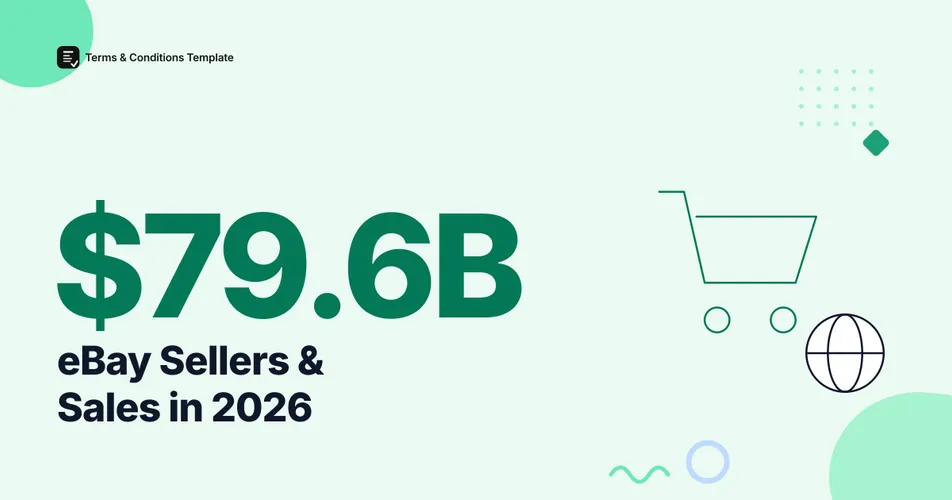
eBay moved $79.6 billion in gross merchandise volume in 2025, up 7% year over year, according to eBay Inc.’s FY2025 Form 10-K and its February 2026 results release. By Q3 2026 the company reported 147 million active buyers and $23.2 billion of quarterly GMV. These are eBay’s own numbers, taken from its SEC filings and earnings releases, with the gaps marked where eBay publishes nothing.
How much does eBay sell in a year?
eBay’s gross merchandise volume hit $79.6 billion in 2025, up from $74.7 billion in 2024 and $73.2 billion in 2023. The FY2025 10-K calls it “nearly $80 billion.” Net revenues rose to $11.1 billion, up 8% from $10.3 billion. GMV is the total value of items sold on the platform, so it is not eBay’s own income.
Figure 1: eBay annual GMV. Source: eBay Inc. FY2025 Form 10-K.
2025 was the first year in this window with real growth. 2024 added only 2% over 2023, and 2025 added 7%.
The run-rate is still climbing. Q4 2025 GMV was $21.2 billion, up 10% as reported, and Q3 2026 came in at $23.2 billion, up 15%. Part of that jump is Depop, which eBay bought in July 2026, and eBay does not split Depop’s GMV out. For the full year 2026, eBay guides to $91.5 to $91.9 billion. Treat that as a forecast from the company’s Q3 2026 release, not a result.
Figure 2: eBay’s 2025 GMV. Source: eBay Inc., FY2025 results.
Takeaway: eBay is a $80 billion marketplace that grew faster in 2025 than at any point in the previous two years.
How many active buyers does eBay have?
eBay had 135 million active buyers at the end of 2025, per its 10-K. By Q3 2026 the reported count was 147 million, up 10% year over year. That headline hides a split. Strip out Depop and Tise and the number is 136 million, up just 1%.
Figure 3: Reported versus organic active buyers, Q3 2026. Source: eBay Inc., Q3 2026 results release.
The Q4 2025 release said the same thing in smaller form: 135 million buyers, up 1%, or 134 million without Tise. So most of the buyer growth you see in 2026 was bought, not earned. eBay does not publish a count of active sellers in the 10-K or results releases we reviewed, so any “number of eBay sellers” figure you see elsewhere is not coming from eBay’s filings.
| Period | Active buyers | Growth year over year |
|---|---|---|
| Q3 2026, as reported | 147 million | 10% |
| Q3 2026, excluding Depop and Tise | 136 million | 1% |
| Q4 2025, as reported | 135 million | 1% |
| Q4 2025, excluding Tise | 134 million | Not stated |
Source: eBay Inc. Q4 2025 and Q3 2026 results releases.
Takeaway: if you sell on eBay, your buyer pool is growing about 1% a year on its own.
What is eBay’s market share?
No primary source we could open gives a clean eBay share of US e-commerce, so we are not printing one. The percentages that circulate (3% to 4%) trace back to eMarketer estimates behind a paywall and to aggregator sites that do not show their method. What eBay itself reports is a split by geography, and it is worth more than a shaky share figure.
51% of eBay’s 2025 GMV came from outside the United States, per the 10-K. On net revenue the US is slightly ahead: $5.79 billion, or 52%, against $5.31 billion, or 48%, for the rest of the world.
Figure 4: Where eBay’s 2025 net revenues came from. Source: eBay Inc. FY2025 Form 10-K.
Figure 5: The geographic split of GMV. Source: eBay Inc. FY2025 Form 10-K.
Warning
Be careful with “eBay market share” numbers. Some pages quote the US share of eBay’s own revenue as if it were eBay’s share of the US market. Those are different things: one splits eBay’s sales by country, the other compares eBay with all US online retail.
That is why a seller shipping to Germany or the UK needs return terms that work in more than one country. For the bigger rival, see our Amazon statistics for 2026.
Takeaway: about half of eBay’s volume is international, so a US-only return policy leaves half the platform unaddressed.
What does eBay’s take rate look like?
eBay’s take rate was 13.94% in 2025, versus 13.77% in 2024 and 13.81% in 2023. Take rate is net revenues divided by GMV, and eBay reports it in its 10-K. Put plainly, of every $100 sold, eBay keeps about $13.94.
Figure 6: eBay’s take rate by year. Source: eBay Inc. FY2025 Form 10-K.
That is well under Etsy, which reported a 24.2% take rate for 2025 in our Etsy statistics for 2026 post. The two companies define the figure in their own ways, so compare them with care.
Advertising is a growing slice. eBay’s first-party ad products earned $517 million in Q4 2025, up 19% as reported, and $575 million in Q3 2026, up 16%.
Takeaway: eBay takes about 14 cents of each dollar sold, about 58% of Etsy’s rate.
What does it cost to sell on eBay?
For most categories eBay charges a 13.6% final value fee on the total sale up to $7,500, then 2.35% on any part above that. Add a per-order fee of $0.30 for orders of $10.00 or less, or $0.40 for larger orders. The first 250 listings each month are free; check eBay’s live fees page for the charge above that, which we could not confirm.
Figure 7: The fee on a $50 sale. This is our own arithmetic from eBay’s published rates, before ads, store subscriptions, or category exceptions.
| Fee | Rate | Applies to |
|---|---|---|
| Final value fee | 13.6% | Total sale amount up to $7,500 per item |
| Final value fee, high end | 2.35% | Portion of a sale over $7,500 |
| Per-order fee | $0.30 or $0.40 | $0.30 up to $10.00, $0.40 above |
| Listings | First 250 free each month | Charge above 250 not confirmed; see eBay’s fees page |
Source: eBay selling fees page. eBay sets some categories and stores at different rates, and its fee page shows no effective date, so check it before you price.
On a $50 item you pay $6.80 plus $0.40, or $7.20. That is 14.4%, close to the 13.94% blended take rate. Our Amazon fees statistics for 2026 post shows how that compares with the other big marketplace.
Takeaway: budget about 14 cents of every dollar before shipping, ads, or returns.
Do eBay sellers have to accept returns?
It depends on why the buyer wants to send the item back. For a change of mind, you choose. If the listing offers returns, you must honor them. If it says no returns, you may decline. But the eBay Money Back Guarantee overrides your listing when the item arrives damaged, faulty, or not as described. In that case the buyer can return it for a refund even if you offer no returns, and you pay the return shipping.
Figure 8: How an eBay return request resolves. Source: eBay Money Back Guarantee policy.
The deadlines are tight. Buyers have 30 calendar days after delivery to request a return for an item not as described, or longer if your return window is longer. You must respond to a return request or a not-received report within 3 business days, and refund within 2 business days of receiving the item back. eBay can step in 3 business days after a request, and no later than 21 business days.
Those clocks are the reason to write your own policy before a dispute starts. A Refund Policy Generator gives you a page that states your window, who pays for shipping, and what counts as a faulty item. For wider return data, see our Amazon returns statistics for 2026.
Takeaway: you can say no to a change of mind, but you cannot say no to a damaged or misdescribed item.
What is happening with Depop and secondhand?
eBay agreed to buy Depop from Etsy for about $1.2 billion in cash, announced with its Q4 2025 results in February 2026. The deal closed on July 30, 2026, and eBay’s Q3 release says it paid $1.4 billion in cash, subject to a final price adjustment. Depop is a secondhand fashion marketplace. For the bigger picture, see our recommerce statistics for 2026.
Figure 9: Key eBay milestones. Source: eBay Inc. results releases, February and October 2026.
Takeaway: eBay is buying growth in buyers, and its own marketplace is adding about 1% a year.
The Bottom Line
eBay moved $79.6 billion in 2025 and is guiding to more than $91 billion in 2026, but a lot of that jump comes from Depop. The buyer base on eBay proper grows about 1% a year. A seller pays roughly 14 cents on the dollar in fees, and half the volume is international. If you sell on eBay, set your price to the real fee, write down your return terms before a buyer asks, and remember that the Money Back Guarantee wins over your listing when an item is wrong. A clear policy shortens every dispute.
Frequently Asked Questions
How much does eBay sell in a year? eBay’s gross merchandise volume (GMV) was $79.6 billion in 2025, up 7% from $74.7 billion in 2024, according to eBay Inc.’s FY2025 Form 10-K. eBay guides to $91.5 to $91.9 billion for 2026, which is a forecast, not a result.
How many active buyers does eBay have? eBay reported 147 million active buyers in Q3 2026, up 10% year over year. Without the Depop and Tise acquisitions the figure is 136 million, up 1%. At the end of 2025 it was 135 million.
How much does eBay charge sellers? For most categories eBay charges a 13.6% final value fee on sales up to $7,500, plus a per-order fee of $0.30 on orders of $10.00 or less or $0.40 on larger orders. The first 250 listings a month are free. On a $50 sale that comes to $7.20, or 14.4%.
Do eBay sellers have to accept returns? Not for a change of mind. Sellers choose their own return policy, but under the eBay Money Back Guarantee a buyer can return an item that is not as described within 30 calendar days of delivery, even if the seller offers no returns, and the seller pays the return shipping.
Sources and References
- eBay Inc.. (2026). Form 10-K for fiscal year 2025. GMV, net revenues, take rate, geographic split, active buyers, live listings, markets.
- eBay Inc.. (2026). “eBay Inc. Reports Fourth Quarter and Full Year 2025 Results.” Q4 GMV, active buyers, advertising revenue, Depop agreement.
- eBay Inc.. (2026). “eBay Inc. Reports Third Quarter 2026 Results.” Q3 GMV, active buyers, Depop closing, 2026 guidance.
- eBay. “Selling fees.” Live help page, final value fee, per-order fee, and free listings, read in November 2026.
- eBay. “eBay Money Back Guarantee policy.” Live help page, return deadlines and seller responsibilities, read in November 2026.
Note: All figures verified as of November 2026. eBay reports quarterly, and its fee and policy pages change without a dated notice, so these figures are refreshed at least twice a year. Guidance figures are forecasts and are labeled as such.