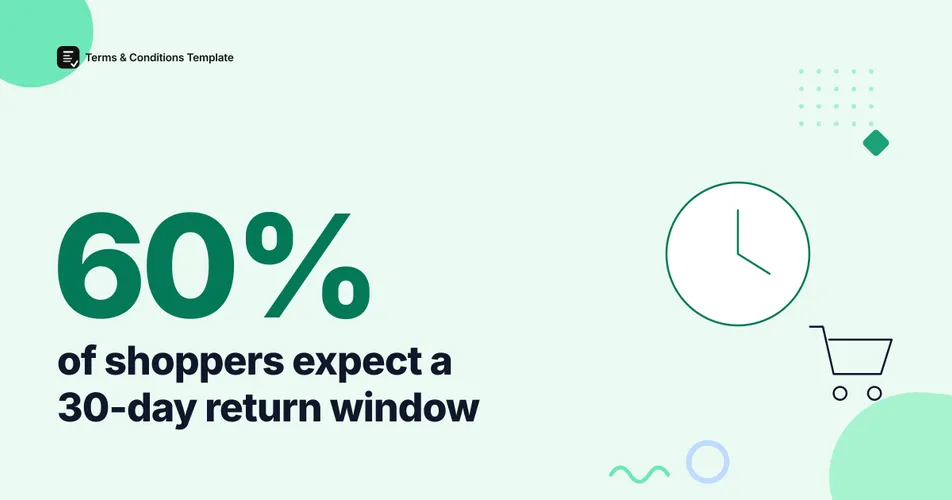
Most shoppers do not read the fine print of a return policy, but they do have a firm number in mind before they click buy. According to Radial’s 2026 consumer return research, 60% of shoppers expect a traditional 30-day return window, while 28% expect 60 days and 12% expect a full 90 days. That expectation gap is where a store’s return window either builds trust or costs a sale.
The window you publish is a design decision, not a legal formality. Shoppers use it as a proxy for how much a retailer stands behind what it sells, and the data below shows that a short, unclear window carries a real cost.
How long a return window do shoppers actually expect?
60% of shoppers expect a store to offer at least a 30-day window before a return option is cut off, and a meaningful minority want more. Radial’s research puts 28% at 60 days and 12% at a full 90 days, meaning nearly two in five shoppers now consider 30 days the bare minimum rather than the generous default it used to be.
Figure 1: The return window length shoppers say they expect before buying. Source: Radial consumer return research, 2026.
The shift matters because a policy written to the old default, 30 days and nothing more, now reads as short to 40% of shoppers before they have added a single item to their cart. That is a meaningful chunk of buyers forming a negative first impression of a store’s policy before they have picked a product, let alone reached checkout. A window is one of the few policy terms a shopper can compare across stores in seconds, which is exactly why it carries outsized weight relative to how little space it usually takes up on the page.
How do major retailer return windows compare?
Retailers have already moved past the 30-day default in practice, even where shopper expectations lag behind their own published policies. Amazon offers a 30-day window for most items purchased directly from the platform, while Target and Home Depot both extend that to 90 days with a receipt or proof of purchase. Both retailers publish the window prominently on their own return policy pages rather than burying it in a longer terms document, which matches what shoppers say they actually look for first.
Figure 2: Published return window length at three major US retailers. Source: retailer return policy pages, compiled August 2026.
A store that still caps returns at 14 or 21 days is now competing against a market where large retailers routinely offer 90. Generate a refund policy that states your window in the first two sentences so shoppers do not have to hunt for it, the same way our ecommerce return rate data shows they will hunt for the return rate itself before buying from an unfamiliar store.
Smaller and independent stores tend to run shorter windows than the enterprise retailers above, often 7 to 14 days, which puts them below what 60% of shoppers now say they expect before they will commit to buying from an unfamiliar brand. A shorter window is not a compliance problem by itself, since there is no US federal law requiring any specific return period, but it is a conversion problem when the window is both short and undisclosed until after checkout. Matching or exceeding what a shopper would find at a large retailer costs nothing beyond the policy text itself, which is why it is one of the cheapest trust signals a smaller store can offer.
Does return window length change whether shoppers buy?
Figure 3: Share of shoppers who call free returns a major factor in where they buy. Source: NRF and Happy Returns, 2025 Retail Returns Landscape Report.
Shoppers increasingly treat a generous, clearly stated return window as a purchase condition rather than a bonus. According to NRF and Happy Returns’ 2025 Retail Returns Landscape report, based on a survey of 2,006 consumers who had returned an online purchase in the past year, 82% say free returns are a major factor in where they shop, up from 76% in 2024.
The flip side has gotten sharper too. 57% of shoppers say they will not shop with a retailer again after being charged for a return, a jump from 40% just one year earlier. That is not a slow drift; it is a one-year swing of 17 percentage points in how punishing shoppers are toward paid or restrictive return terms.
Are shoppers getting less tolerant of return costs, year over year?
The two figures above did not move by chance. Both climbed together between 2024 and 2025, which suggests shoppers are applying the same underlying pressure, free and flexible returns as a baseline expectation, to two different questions: whether they will buy at all, and whether they will buy again.
Cost sensitivity runs alongside window length as a second, related pressure point. Radial’s research found that 48% of shoppers avoid making a return specifically because of shipping costs, and another 43% remain hesitant depending on how large the fee is. Neither figure comes with a disclosed sample size in Radial’s published summary, so treat them as directional rather than a precise national estimate, but they point the same direction as the NRF and Happy Returns numbers above: cost and window length are now evaluated together, not separately.
Figure 4: Two shopper sentiment measures, 2024 versus 2025. Source: NRF and Happy Returns, 2024 and 2025 data.
A store that shortened its window or added a return fee in the last two years is now working against a shopper base that has gotten measurably less forgiving of exactly that change.
What return window should your store actually choose?
The right window depends on two things a store already knows: its own margin on returned goods, and how clearly it can state the policy up front. A short, vague window fails on both counts. A long window only works if the policy itself is easy to find and read.
A longer window is not automatically riskier. The 9% fraud share the National Retail Federation measured in 2025 covers all return activity, not specifically the retailers with generous windows, and Target and Home Depot, both at 90 days, are large enough that a spike tied purely to window length would be visible in their own reporting. What actually drives fraud and abuse is a vague policy that leaves condition requirements, restocking terms, and proof-of-purchase rules unstated, not the number of days on the calendar. A store that pairs a longer window with explicit condition and receipt requirements gets the trust benefit of the longer window without opening the door most return abuse actually walks through.
Figure 5: A simple test for whether a published return window matches current shopper expectations. Source: synthesized from Radial and NRF/Happy Returns data above.
Stores that fail the first test, a window under 30 days, are competing against a market where 60% of shoppers now treat 30 days as the floor, not the ceiling.
Return window length compared
| Return window | Share of shoppers who expect it | Example retailer | Return shipping cost avoidance |
|---|---|---|---|
| 30 days | 60% | Amazon | 48% avoid returns over shipping cost |
| 60 days | 28% | Mid-market retailers | 43% remain fee-hesitant |
| 90 days | 12% | Target, Home Depot | Lower hesitation with longer windows |
Source: Radial consumer return research, 2026; retailer return policy pages, compiled August 2026.
The Bottom Line
The 30-day return window is no longer the generous default it once was. 60% of shoppers still call it acceptable, but 40% now expect more, and the retailers setting the pace, Target and Home Depot among them, have already moved to 90 days. The bigger risk is not the window itself but how you present it: 82% of shoppers weigh free returns heavily in their buying decision, and 57% will not come back after being charged for one. A short window paired with a hidden fee is now a two-part reason to lose a repeat customer, not just a one-time sale.
Frequently Asked Questions
What return window do most shoppers expect? 60% of shoppers expect a traditional 30-day return window, while 28% expect 60 days and 12% expect a 90-day window, according to Radial’s consumer return research.
Does a longer return window increase sales? There is no controlled study proving a direct causal link, but 82% of shoppers say free returns are a major factor in where they buy, up from 76% in 2024, and 57% will not shop with a retailer again after being charged for a return, up from 40% in 2024 (NRF and Happy Returns, 2025).
What return window do major retailers actually offer? Amazon offers 30 days for most items, while Target and Home Depot both offer 90 days with a receipt, based on each retailer’s published return policy.
How much do retailers lose to return fraud? 9% of all returns were classified as fraudulent in 2025, according to the National Retail Federation and Happy Returns, based on a survey of 358 e-commerce professionals at large US merchants.
Sources and References
- Radial. (2026). “Radial Research: Returns Create Retailer Challenges.” Consumer return window expectations and fee sensitivity.
- National Retail Federation. (2025). “Consumers Expected to Return Nearly $850 Billion in Merchandise in 2025.” Consumer survey of 2,006 respondents; retailer survey of 358 e-commerce professionals at merchants over $500 million in revenue.
- Happy Returns. (2025). “2025 Retail Returns Landscape Report.” Joint research with the National Retail Federation.
- Amazon. Return policy, standard 30-day window for most items.
- Target. Return policy, 90-day window with receipt for most items.
- The Home Depot. Return policy, 90-day window with receipt for most items.
Note: All figures verified as of August 2026. Return window expectations shift with holiday-season promotions and retailer policy changes, so headline figures are refreshed at least twice a year.