The American Arbitration Association (AAA) recorded 88 unique mass arbitrations in 2025, down from 92 in 2024, and new demands dropped from about 280,000 to just under 105,000. The campaign count barely moved. The size of the biggest filings did. If your terms contain an arbitration clause, this data tells you what you are signing up for.
How many mass arbitrations did the AAA see in 2025?
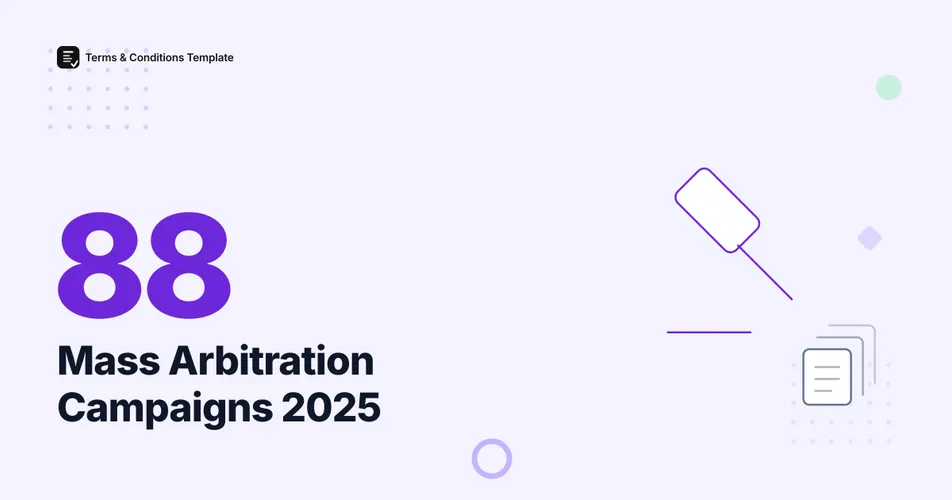
The AAA counted 88 unique mass arbitrations in 2025 and 92 in 2024, and close to 250 since 2023. Individual demands fell harder: about 280,000 in 2024 against just under 105,000 in 2025. The AAA defines a mass arbitration as 25 or more similar demands filed together against one business by coordinated counsel.
Figure 1: New individual demands filed in AAA mass arbitrations. 2024 is “about 280,000” and 2025 is “just under 105,000,” so both bars are rounded. Source: American Arbitration Association, 2025 data review.
Consumer demands fell by more than 142,000 and employment demands by about 33,000. One employment mass arbitration of roughly 30,000 cases in 2024 had no match in 2025. A few huge filings swing the totals, so one year is not a trend line.
Campaigns held steady while volume dropped, so the risk of being targeted did not fall.
Which industries get hit with the most mass arbitration demands?
Entertainment and gaming took the most consumer demands in 2025 with 42,299, per the AAA. Retail followed with 32,203, then financial services with 8,584, hospitality and travel with 8,527, and telecommunications with 5,978. Those five sectors cover most of the 104,556 new consumer demands.
Figure 2: Share of 104,556 new consumer demands by industry. “All other industries” is our subtraction from the AAA total. Source: American Arbitration Association, 2025 data review.
The mix moved a lot from 2024. Gaming and entertainment filed about 59,000 fewer demands in 2025, and telecommunications about 32,000 fewer. Technology had more than 50,000 demands across consumer and employment in 2024 and did not make the 2025 top list. Retail went the other way, with more than 32,000 demands and no top-sector spot in 2024.
A sector that was quiet last year can be the target this year. Check your own clause before that happens.
How do mass arbitrations end?
Most settle, and almost none end in a consumer win. The AAA reports that 72% of the 6,360 consumer merits cases closed in 2025 settled, and 96% of those settlements came before a merits arbitrator was appointed. Under 1% of those consumer cases were decided by award. Individual consumer cases that are not part of a mass filing end in an award about 14% of the time.
Dismissals almost vanished. About 30% of consumer mass arbitration merits cases were dismissed in 2024, against under 1% in 2025, while withdrawals rose from 10% to 21%.
Employment looks different. The AAA reports 33,008 employment merits cases in total, with over 32,000 in transportation, and about 7% of closed employment cases ended in an award in 2025, up from about 2% in 2024.
AAA mass arbitration outcomes, 2025
Settlement is the normal ending, and it usually happens early, before an arbitrator hears anything on the merits.
How much does a mass arbitration cost?
Under the AAA’s Consumer Mass Arbitration Fee Schedule (arbitration costs effective January 15, 2024, still the posted version in 2026), the business pays an $8,125 initiation fee and the individuals pay $3,125. Add $600 per case as a final fee, paid by the business. Those two lines are only the start. Every case that moves forward also carries per-case administration fees.
The AAA’s per-case fees in 2024 stepped down with volume, per the same summary: $325 for the first 500 cases, $250 for cases 501 to 1,500, $175 for 1,501 to 3,000, and $100 after that. The initiation fee is credited toward those per-case fees.
Figure 3: AAA per-case fee tiers in the 2024 mass arbitration schedule. Source: AAA Consumer Mass Arbitration and Mediation Fee Schedule (2026 posting of the January 15, 2024 arbitration costs).
JAMS uses a different model. For 75 or more similar demands it charges a flat $7,500 filing fee, with the consumers paying up to $2,500 together and the business paying the rest, plus a case management fee of 13% of the arbitrator and process administrator fees, per a Skadden summary.
The individuals’ side is capped: a flat $3,125 at filing, then $125 per case, dropping to $75 after the first 500, per the same schedule and the AAA’s 2025 review. Fee schedules change, so check the provider’s current page before you rely on any figure here.
Fees are the business’s biggest line item, and they keep running for every case.
When does a mass arbitration start, and what are the thresholds?
A group of claimants, usually with one law firm, files many near-identical demands at once. The AAA starts counting at 25 similar demands. JAMS starts at 75, unless the parties’ own agreement sets a different number. For matters that are neither consumer nor employment, the AAA threshold is 100.
Figure 4: How a filing moves into the mass arbitration track. Source: AAA 2025 data review; Skadden summary of the JAMS procedures.
If you run a store, app, or SaaS tool, your terms are the document that decides which provider and which rules apply. A Terms and Conditions Generator gives you a dispute section to start from, and you can edit it to match the provider and rules you choose.
For a wider look at how arbitration clauses and clickwrap acceptance hold up, see clickwrap statistics for 2026.
Your clause sets the threshold. Read it before a claimant’s lawyer does.
What are courts saying about mass arbitration in 2025 and 2026?
Courts have mostly sided with arbitration clauses on fee disputes. In September 2025 the Second Circuit reversed an order that had required X Corp. to pay more than $10 million in a mass employment arbitration. It held that fee payment is a procedural question for the arbitrator, per the National Law Review’s 2025 review. Other circuits had reached similar results.
Courts are less settled on “bellwether” clauses, which test a few cases first. A federal court in California upheld one in July 2025 partly because claimants could opt out, in Burkhardt v. Extra Space Management. In October 2025 another California federal court, in Rios v. HRB Digital, said one bellwether provision gave no relief for unreasonable delay, which hints it may be unconscionable.
Figure 5: Key rule and court milestones. Sources: National Law Review, AAA, Skadden.
Pennsylvania took a harder line on one acceptance method, and our write-up of the Pennsylvania clickwrap arbitration ruling covers it. Rulings still vary by state, so a clause that holds in one court may fail in another.
No clause is bulletproof, and courts keep testing the edges.
Where are mass arbitration claims filed?
California dominates the AAA caseload. California had 3,345 consumer merits cases in 2025, against 103 in Utah and 29 in Missouri. In employment merits cases California led with 17,217, followed by Illinois at 13,546 and Massachusetts at 1,846.
Counting merits cases includes ones carried over from earlier years, so these figures show where the pipeline sits, not only what was filed in 2025. If your customers or staff are in California, expect your clause to meet California law first.
Mass arbitration at a glance
| Metric | 2024 | 2025 | Source |
|---|---|---|---|
| Unique AAA mass arbitrations | 92 | 88 | AAA |
| New demands, all types | About 280,000 | Just under 105,000 | AAA |
| Consumer merits cases | Over 24,000 | 3,665 | AAA |
| Consumer settlement rate | 59% | 72% | AAA |
| Employment settlement rate | 77% | 70% | AAA |
| Employment award rate | About 2% | About 7% | AAA |
Source: American Arbitration Association, 2025 data review.
The Bottom Line
The AAA saw 88 mass arbitration campaigns in 2025, one fewer than the 92 it saw the year before, even as new demands fell from about 280,000 to just under 105,000. Volume is lumpy and a few huge filings drive it. The campaign count is what matters for your odds, and it stayed flat. Settlements are the usual ending, awards are rare, and the business carries the larger share of the fees, from an $8,125 initiation fee at the AAA to a $7,500 flat filing fee at JAMS. Read your arbitration clause, check which provider and fee schedule it names, and look at how it handles batching claims and fee disputes. A short, plain dispute section is easier to defend than a long one nobody read. Talk to a lawyer before you rely on any clause.
Frequently Asked Questions
How many mass arbitrations did the AAA see in 2025? The American Arbitration Association recorded 88 unique mass arbitrations in 2025, down from 92 in 2024. New demands fell from about 280,000 to just under 105,000 over the same period.
What does a mass arbitration cost the business? Under the AAA’s fee schedule the business pays an $8,125 initiation fee and the claimants pay $3,125, plus a $600 final fee per case. JAMS charges a flat $7,500 filing fee for 75 or more demands, with the consumers paying up to $2,500.
How often do consumers win a mass arbitration? Rarely. Fewer than 1% of consumer mass arbitration cases that reached the merits phase and closed in 2025 ended in an award, against about 14% of individual consumer arbitrations, per the AAA.
How many claims make an arbitration a mass arbitration? The AAA treats 25 or more similar demands from coordinated counsel as a mass arbitration (100 for cases that are neither consumer nor employment). JAMS sets its threshold at 75 or more similar demands.
Sources and References
- American Arbitration Association: AAA 2025 Data Highlights the Changing Landscape of Mass Arbitration. Filings, campaigns, industries, outcomes, thresholds, and 2025 consumer fee notes.
- American Arbitration Association: Consumer Mass Arbitration and Mediation Fee Schedule. Initiation ($8,125 business, $3,125 individuals), per-case tiers, appointment and $600 final fees.
- Skadden: JAMS Adopts Mass Arbitration Procedures and Guidelines (May 2024). JAMS 75-demand threshold and fee schedule.
- National Law Review: Year in Review: Mass Arbitration in 2025. Court rulings (Frazier v. X Corp., Burkhardt, Rios).
Note: All figures verified as of November 2026. Fee schedules and provider data change, so confirm current numbers on the AAA and JAMS sites. We refresh this page at least twice a year.