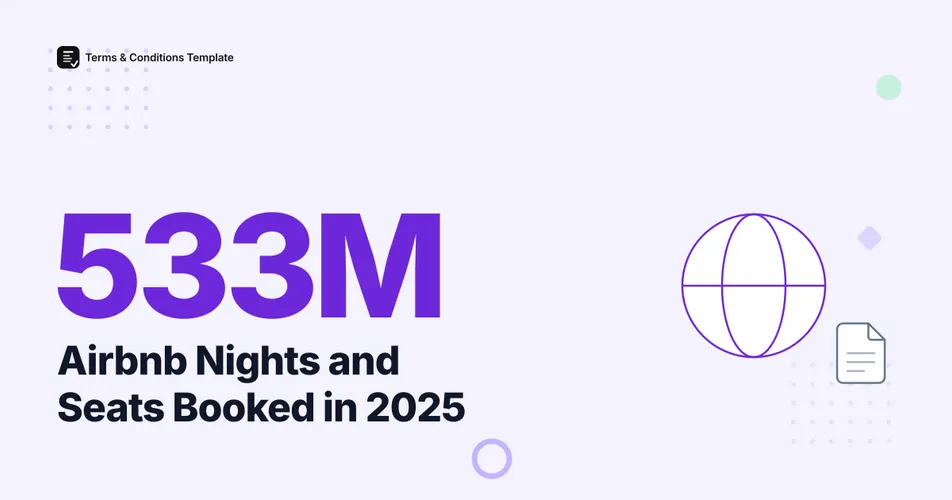
Airbnb booked 533 million nights and seats in 2025, according to its Form 10-K filed with the SEC in February 2026, and guests spent $91.273 billion doing it. Those are the numbers behind a marketplace that sits on top of one contract: the Terms of Service. All figures below come from that filing and were checked in November 2026.
If you run a marketplace, or plan to, Airbnb is the closest thing to a case study. It has 5 million hosts, a payments flow, a cancellation rule, and a fee model that changed in 2025. All of that is written down in terms.
How many nights and seats does Airbnb book?
533 million in 2025. That is the sum of nights booked for stays and seats booked for experiences and services, and the 10-K describes it as a key measure of the scale of the platform. The count is adjusted for cancellations and alterations in the same period, so it is not simply the number of reservations made.
| Year | Nights and seats booked | Gross booking value | Revenue |
|---|---|---|---|
| 2025 | 533 million | $91.273 billion | $12.241 billion |
| 2024 | 492 million | $81.784 billion | $11.102 billion |
| Change | 8% | 12% | 10% |
Figure 1: Airbnb annual revenue in billions of dollars, 2023 to 2025. Source: Airbnb Form 10-K for fiscal 2025, consolidated statements of operations.
Revenue grew from $9.917 billion in 2023 to $12.241 billion in 2025, a rise of 23.4% over two years (our calculation). The 10-K says 2025 growth came mainly from more check-ins and a modest rise in average daily rate, which was up 3%.
Airbnb’s own average booking is short. The company reports 3.7 average nights per booking in 2025, down from 3.8 in 2024, excluding experiences and services.
Volume grew faster than price, which is how a mature marketplace usually grows.
Where does Airbnb’s business come from?
Europe, the Middle East and Africa (EMEA) books the most nights, North America earns the most money. In 2025 EMEA accounted for 215 million of the 533 million nights and seats (40%), against 158 million for North America (30%). North America still led gross booking value with $40.295 billion, or 44% of the total.
Figure 2: Share of the 533 million nights and seats booked in 2025, by Airbnb region. Source: Airbnb Form 10-K for fiscal 2025.
The growth is somewhere else. Latin America grew nights and seats 18% and Asia Pacific 15%, compared with 7% in EMEA and 3% in North America. Revenue followed the same pattern: Latin America up 20%, Asia Pacific up 17%, EMEA up 14%, North America up 4%.
| Region | Nights and seats, 2025 | Gross booking value, 2025 | Revenue, 2025 |
|---|---|---|---|
| North America | 158 million | $40.295 billion | $5.196 billion |
| EMEA | 215 million | $34.162 billion | $4.729 billion |
| Latin America | 90 million | $8.542 billion | $1.160 billion |
| Asia Pacific | 70 million | $8.274 billion | $1.156 billion |
A platform that grows fastest outside its home market needs terms that work in many legal systems. If your product is heading the same way, read our guide to terms and conditions for a marketplace platform.
The money is in North America, the momentum is in Latin America and Asia Pacific.
How much of each booking does Airbnb keep?
About 13.4%. Divide 2025 revenue of $12.241 billion by gross booking value of $91.273 billion and you get 13.4%. The same calculation for 2024 gives 13.6%. These are our ratios from the 10-K, not a figure Airbnb publishes.
Gross booking value counts host earnings, service fees, cleaning fees and taxes, net of cancellations. So the 13.4% is Airbnb’s cut of a number that already includes the host’s money and the taxes. It is not a fee rate on the nightly price.
The fee structure moved in 2025. The 10-K says Airbnb historically operated only a split-fee structure, charging a percentage of the booking amount to both hosts and guests. In October 2025 it began transitioning to a single-fee structure that charges only the host. Bookings that remain under the split-fee model still carry both fees.
Payments processing is a visible cost. Merchant fees and chargebacks were $1.666 billion in 2025, which is 13.6% of revenue by our calculation. If you take payments in your own marketplace, our chargeback statistics show what that line can look like.
A fee model is a term of the contract. Change it and you change your terms.
What do hosts and guests agree to?
The Terms of Service, and nothing happens without them. The 10-K says Airbnb’s customers are both hosts and guests, and that customers must agree to the Terms of Service to use the platform. On a booking, the host agrees to provide use of the property and both sides agree to the booking amount, which excludes taxes and Airbnb’s service fees.
Figure 3: How money and obligations move on a booking. Source: Airbnb Form 10-K for fiscal 2025, revenue recognition note.
Two details matter for anyone drafting marketplace terms. First, the Terms let a host cancel a confirmed booking up to the point of check-in, so for accounting purposes the 10-K treats each booking as a separate contract between host and guest that is not enforceable until check-in. Second, Airbnb holds guest money until check-in. At that point it recognizes its service fee as revenue and starts to remit payment to the host, generally on the business day after the scheduled check-in.
Cancellation, holding periods and fee timing are the three clauses that decide who bears the risk. Write them in plain words, and put them where both sides see them before paying. Our guide to marketplace seller commission and payout terms shows how those clauses are usually laid out.
Airbnb’s whole fee model hangs on one accepted contract.
What rules does Airbnb say it has to follow?
A long list, and the 10-K names several. On consumer law it cites the EU Consumer Rights Directive, the Unfair Commercial Practices Directive and the UK Digital Markets, Competition and Consumers Act 2024, the last of which it says raises enforcement risk because of the UK regulator’s enhanced powers. It also notes that the Collective Redress Directive allows class actions across the European Union.
On platform liability it names the Digital Millennium Copyright Act, the Communications Decency Act, the EU Digital Services Act and the EU short-term rental regulation. On local rules, it says New York City passed regulations in 2023 that resulted in a de facto ban on short-term rental activity.
Figure 4: Milestones drawn from Airbnb’s Form 10-K for fiscal 2025.
This is Airbnb’s own risk disclosure, not a legal opinion. But it shows what a marketplace carries once it grows: consumer protection in the EU and UK, intermediary liability rules, and city by city licensing. A small marketplace does not face all of it on day one, though the same laws apply once you sell to those buyers. For the EU rule in particular, see our data on the EU 14-day withdrawal right.
Large platforms spend heavily on staying inside the rules. Airbnb had about 8,200 employees at the end of 2025, and also relied on roughly 13,000 third-party workers to handle most community support contacts.
The contract is the same size at any scale. The paperwork around it is not.
How profitable is the platform?
Profit slipped even as revenue rose. Net income was $2.511 billion in 2025 against $2.648 billion in 2024, a margin of 21% compared with 24%. Adjusted EBITDA was $4.297 billion, a 35% margin, and free cash flow was $4.613 billion, a 38% margin. Costs grew faster than revenue: product development rose from $2.056 billion to $2.354 billion and sales and marketing from $2.148 billion to $2.588 billion.
Figure 5: Airbnb cost and expense lines for 2025 in billions of dollars (sales and marketing, product development, cost of revenue, general and administrative, operations and support). Source: Airbnb Form 10-K for fiscal 2025, consolidated statements of operations.
| Measure | 2024 | 2025 |
|---|---|---|
| Net income | $2.648 billion | $2.511 billion |
| Net income margin | 24% | 21% |
| Adjusted EBITDA | $4.041 billion | $4.297 billion |
| Free cash flow | $4.484 billion | $4.613 billion |
Adjusted EBITDA and free cash flow are non-GAAP measures that Airbnb defines in its filing. The company’s mix of fees, taxes and one-off items moves the headline net income from year to year, so compare margins, not single lines.
For a marketplace owner, the lesson is the cost of trust. Payments, support and legal exposure scale with volume.
The Bottom Line
The headline is 533 million nights and seats booked, up 8%, on $91.273 billion of gross booking value. Airbnb kept about 13.4% of it as $12.241 billion of revenue, and profit margin slipped from 24% to 21%. Growth now comes from Latin America (up 18%) and Asia Pacific (up 15%) far more than North America (up 3%).
What it means for you: a marketplace is a contract business. The Terms of Service define the cancellation rule, the fee, the holding period and the payout. Airbnb changed its fee model in October 2025, and that is a change to its terms. If you are building a platform, put those four clauses in plain English and use a terms and conditions generator to set up the rest, then have a lawyer review it for your markets. This article is data, not legal advice.
Frequently Asked Questions
How many nights and seats did Airbnb book in 2025? 533 million, up 8% from 492 million in 2024. Airbnb’s 2025 Form 10-K counts nights booked for stays plus seats booked for experiences and services, and reports them net of cancellations in the period.
How much revenue did Airbnb make in 2025? $12.241 billion, up 10% from $11.102 billion in 2024. Gross booking value was $91.273 billion, so Airbnb kept about 13.4% of what guests paid, by our calculation from the 10-K figures.
How does Airbnb earn money from a booking? Through service fees. Airbnb historically charged a percentage fee to both hosts and guests, and in October 2025 it began moving to a single-fee model that charges only the host. It recognizes the fee as revenue at check-in, not at booking.
Do Airbnb hosts and guests have to accept the Terms of Service? Yes. The 10-K states that customers, meaning both hosts and guests, must agree to Airbnb’s Terms of Service to use the platform, and that the Terms let a host cancel a confirmed booking up to the point of check-in.
Sources and References
- Airbnb, Inc.. (2026). Annual Report on Form 10-K for the fiscal year ended December 31, 2025, filed 12 February 2026. Source of all nights and seats, gross booking value, revenue, regional, net income, fee-model, Terms of Service and regulatory figures and statements in this article.
- U.S. Securities and Exchange Commission. EDGAR filing index for Airbnb, Inc., used to confirm the filing date and fiscal period.
- UK Parliament. Digital Markets, Competition and Consumers Act 2024, the statute the 10-K cites for UK consumer enforcement.
Note: All figures verified as of November 2026 against Airbnb’s fiscal 2025 Form 10-K. Revenue-to-booking-value ratios, two-year growth and merchant-fee share are our own calculations from the filing’s figures. Later quarterly reports will update these numbers.