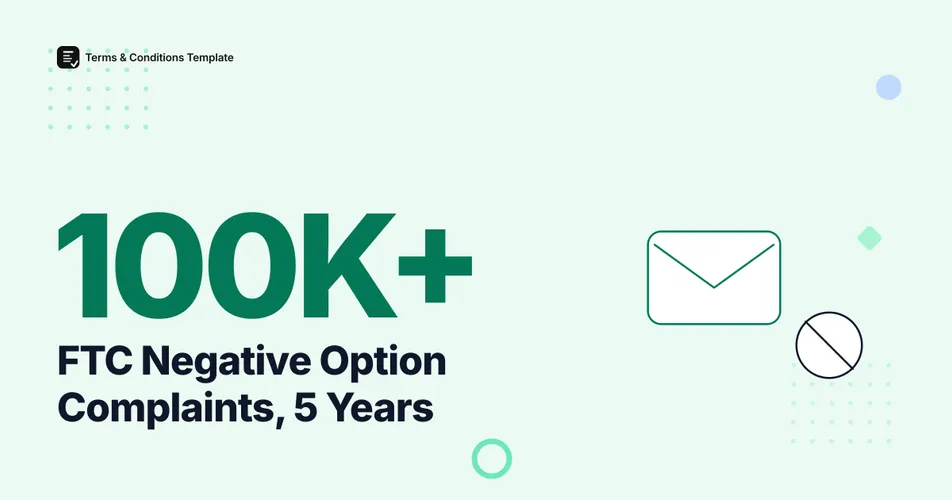
More than 100,000 complaints about negative options and related practices reached the Federal Trade Commission in the five years before March 2026, according to the agency’s own announcement. The FTC’s Click to Cancel rule was meant to answer them. A federal appeals court threw the rule out on July 8, 2025, and this page tracks where the numbers stand as of November 2026.
If you sell anything on a subscription, the short version is simple. The rule is gone for now. The pressure is not.
How many complaints did the FTC get about subscriptions?
The FTC says it received more than 100,000 complaints about negative options and related practices over the past five years. A negative option is any deal where silence counts as a yes, such as a free trial that turns into a paid plan unless you cancel.
The daily rate was climbing before the agency wrote its rule. In 2024 the FTC averaged nearly 70 consumer complaints per day on this topic. In 2021 it averaged 42. That is about 67% more complaints per day in three years, by our arithmetic from the FTC’s two figures.
Seventy a day works out to roughly 25,500 a year if the pace held, though the FTC does not publish that total. Treat it as a back-of-envelope number, not an agency count.
Subscription cancellation is one of the most complained-about moments in online buying. For the wider picture, see our look at how subscription cancellation and churn numbers stack up in 2026.
Takeaway: the complaint count is the reason a federal rule existed at all.
What did the FTC’s Click to Cancel rule require?
The rule required sellers to make canceling as easy as signing up. The FTC announced the final version on October 16, 2024, and it was published in the Federal Register on November 15, 2024, as an update to the Negative Option Rule (16 CFR Part 425).
It had four main duties. Sellers could not misrepresent material facts. They had to disclose key terms before collecting billing details. They needed express informed consent before charging. And they had to give a simple way to cancel that stops charges right away.
Figure 1: The three checks the 2024 Negative Option Rule put on a subscription sign-up and cancel flow. Source: FTC press release, October 16, 2024.
The Commission voted 3-2 to publish it. Commissioners Melissa Holyoak and Andrew Ferguson voted no. The FTC also dropped two ideas from its 2023 draft: yearly reminders, and a ban on pitching a save offer before asking whether the customer wants to hear it.
Takeaway: the rule was narrow and clear, and it passed on a split vote.
Why was the Click to Cancel rule vacated?
The U.S. Court of Appeals for the Eighth Circuit vacated the rule on July 8, 2025. According to Crowell and Moring’s 2026 client alert, the court found the FTC had failed to comply with mandatory procedural requirements. The court did not rule that easy cancellation is a bad idea.
The history shows how much work was lost. The FTC published its proposal on April 24, 2023, and drew more than 16,000 public comments. That process, per Crowell and Moring, took about three years to reach a final rule.
Figure 2: Timeline of the FTC’s negative option rulemaking. Sources: FTC Negative Option Rule page, FTC press releases, Crowell and Moring (2026).
One more detail. On January 30, 2026, the FTC sent a draft Advance Notice of Proposed Rulemaking to the White House’s regulatory office for review. A three-year process now starts over from an early stage.
Takeaway: the rule fell on procedure, and the clock reset to the beginning.
What is the FTC doing about negative options in 2026?
It restarted the process. The FTC announced a new Advance Notice of Proposed Rulemaking on March 11, 2026, and the notice appeared in the Federal Register on March 13, 2026. The comment deadline was April 13, 2026.
The notice asks whether the FTC should keep the current rule, bring back parts of the vacated 2024 rule, or rely on education instead. It also asks how often businesses use negative option programs and how common deceptive sign-ups and hard cancellations are. The FTC has not said which way it will go, so no replacement rule exists as of this writing.
| Date | Step | Status |
|---|---|---|
| October 16, 2024 | Final Click to Cancel rule announced, 3-2 vote | Vacated |
| July 8, 2025 | Eighth Circuit vacates the rule | Final |
| March 11, 2026 | FTC announces new ANPRM | Complete |
| April 13, 2026 | Public comment window closes | Closed |
Source: FTC Negative Option Rule page and FTC press releases. Rolling proceeding, status as of November 2026.
Our deeper write-up of auto-renewal and negative option disclosure requirements covers what sellers must show customers today.
Takeaway: the FTC asked the question again, and the answer is still pending.
How much has the FTC collected from hard-to-cancel subscriptions?
The FTC still enforces under the Restore Online Shoppers’ Confidence Act, or ROSCA, and the dollar figures are large. Amazon agreed in September 2025 to a $1 billion civil penalty, the largest ever in a case involving an FTC rule violation, plus $1.5 billion in refunds. The FTC says about 35 million consumers were affected by unwanted Prime enrollment or deferred cancellation.
The smaller cases show the same pattern. Match Group agreed to pay $14 million in August 2025 over deceptive advertising, billing, and cancellation practices. Chegg agreed to pay $7.5 million in September 2025. The FTC said nearly 200,000 Chegg consumers were charged after asking to cancel, from October 2020 onward.
Figure 3: Dollar amounts in four 2025 FTC settlements tied to enrollment and cancellation. Source: FTC press releases, August and September 2025.
Notice what the FTC did not need. None of these cases rested on the vacated rule. The agency used ROSCA and the FTC Act, which are still on the books.
Takeaway: $2.5 billion in the Amazon case alone shows the rule’s absence did not end enforcement.
How common are dark patterns in subscription sign-ups?
Very common. A 2024 sweep reviewed 642 subscription websites and apps, using dates from January 29 to February 2, 2024. Nearly 76% used at least one possible dark pattern, and nearly 67% used more than one. The review involved 27 authorities in 26 countries, working through the International Consumer Protection and Enforcement Network.
Figure 4: Dark pattern use among 642 reviewed subscription sites and apps. The “exactly one” and “none” slices are derived from the sweep’s “nearly 76%” and “nearly 67%” figures. Source: FTC and ICPEN, July 2024.
The sweep ran before the rule was vacated, and it shows the behavior regulators were targeting. If your cancel button sits three screens deep, your flow looks like the 67%.
Takeaway: two sites in three used more than one dark pattern.
Do states and cities fill the gap?
Some do. New York City’s Click to Cancel rule took effect on October 1, 2026. It requires clear disclosure of subscription terms and a cancellation process at least as easy as enrollment. Civil penalties begin at $525 per violation, plus restitution. The city cites a Roosevelt Institute estimate that the rule could save New Yorkers between $21.5 million and $162.5 million a year.
For the detail, read our guide to the NYC Click to Cancel rule.
Figure 5: A cancel path that matches the “as easy as sign-up” test used by the 2024 rule and the NYC rule. Source: synthesized from the FTC and NYC rule requirements above.
Your cancel flow should work the same way in every state, because customers do not stop at borders. Writing it into a clear refund and cancellation policy helps you keep it consistent. You can build one with the refund policy generator and match it to your actual cancel steps.
Takeaway: a federal gap does not mean a legal gap, and local rules now carry their own penalties.
What the numbers say at a glance
Click to cancel by the numbers
For related market data, our subscription economy numbers show how many people this affects.
The Bottom Line
The FTC has logged more than 100,000 negative option complaints in five years, and a court has vacated its answer. That leaves a gap in federal rules, not in enforcement. Amazon’s $2.5 billion settlement, the Match Group and Chegg orders, and New York City’s rule all landed after or alongside the vacatur.
If you run a subscription business, cancel in as few clicks as you used to sign up. Show the price and renewal terms before you take a card. Put those promises in plain words in your policy and keep the policy current. The FTC’s new rule may look like the old one or it may not, and the safe plan is the same either way.
Frequently Asked Questions
Is the FTC Click to Cancel rule in effect in 2026? No. The Eighth Circuit vacated the rule on July 8, 2025, after the FTC adopted it by a 3-2 vote in October 2024. The FTC opened a new rulemaking in March 2026 and the comment window closed on April 13, 2026.
How many complaints has the FTC received about negative option billing? More than 100,000 over the past five years, according to the FTC’s March 2026 announcement. In 2024 the agency averaged nearly 70 complaints per day, up from 42 per day in 2021.
Can the FTC still punish hard-to-cancel subscriptions without the rule? Yes. It uses the Restore Online Shoppers’ Confidence Act. In September 2025 Amazon agreed to pay a $1 billion civil penalty plus $1.5 billion in refunds to settle Prime enrollment and cancellation claims.
Do any local laws require easy online cancellation in 2026? Yes. New York City’s Click to Cancel rule took effect on October 1, 2026, with civil penalties starting at $525 per violation.
Sources and References
- Federal Trade Commission. (2026). “FTC Seeks Public Comment in Response to Advance Notice of Proposed Rulemaking Regarding Negative Option Marketing Practices.” Press release, March 11, 2026.
- Federal Trade Commission. (2026). “Negative Option Rule.” Rule history page, a rolling proceeding.
- Federal Trade Commission. (2024). “Federal Trade Commission Announces Final ‘Click-to-Cancel’ Rule.” Press release, October 16, 2024.
- Crowell and Moring. (2026). “Clicking All the Right Boxes: FTC Moves to Revive Click-to-Cancel Rule Following Eighth Circuit Vacatur.” Client alert covering the July 8, 2025 vacatur.
- Federal Trade Commission. (2025). “FTC Secures Historic $2.5 Billion Settlement Against Amazon.” Press release, September 25, 2025.
- Federal Trade Commission. (2025). “Ed Tech Provider Chegg to Pay $7.5 Million to Settle FTC Allegations Concerning Unlawful Cancellation Practices.” Press release, September 15, 2025.
- Federal Trade Commission. (2025). “Match Group Agrees to Pay $14 Million to Resolve FTC Charges.” Press release, August 12, 2025.
- Federal Trade Commission. (2024). “FTC, ICPEN, GPEN Announce Results of Review of the Use of Dark Patterns Affecting Subscription Services and Privacy.” 642 sites and apps, sweep of January 29 to February 2, 2024.
- NYC Office of the Mayor. (2026). “Mayor Mamdani Announces Landmark Click-To-Cancel Consumer Protection Rules.” Press release, July 10, 2026.
Note: All figures verified as of November 2026. The FTC proceeding is ongoing, so rule status may change after this date.