Law360 reported on July 31, 2026 that the Pennsylvania Superior Court again refused to enforce a clickwrap arbitration clause, this time in a class action against Kennywood’s parent company, Festival Fun Parks LLC. The underlying dispute is about a closed roller coaster, not a privacy violation or a data breach, but the arbitration ruling is the part every site owner running a checkbox-style terms agreement should pay attention to.
The case, Miller v. Festival Fun Parks LLC, started when Allegheny County Judge Alan Hertzberg denied the company’s motion to compel arbitration on March 31, 2025, holding that Kennywood’s online season-pass agreement did not clearly enough tell buyers they were giving up their right to a jury trial. Festival Fun Parks appealed to the Superior Court, docketed as 92 WDA 2025, and lost again. That is now three times in about three years that Pennsylvania courts have struck down the same basic setup: a checkbox next to a hyperlink, with the arbitration language sitting unread inside it.
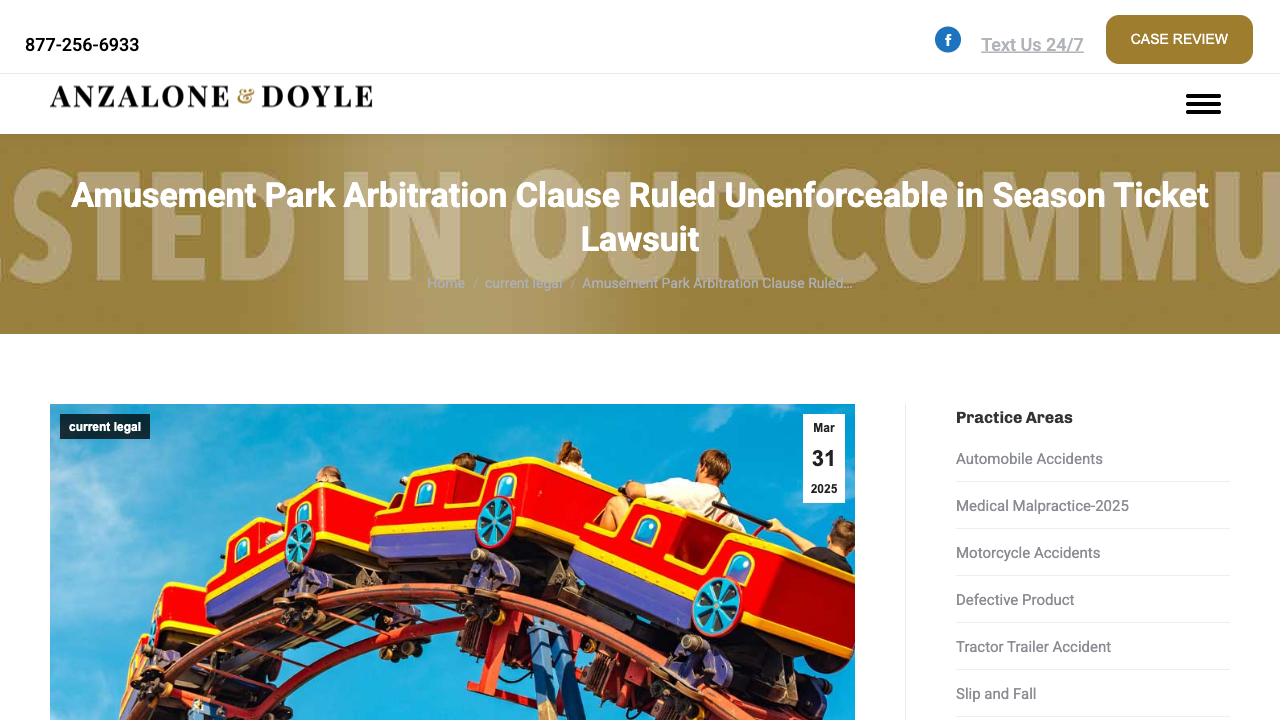
Source: Anzalone & Doyle Trial Lawyers, captured August 4, 2026. Law360’s report of the Superior Court’s affirmance sits behind a subscription paywall, so this screenshot shows the law firm client alert covering the same case and the same two-part test.
What actually happened at Kennywood
The lawsuit itself is about a ride, not a contract clause. Lead plaintiff Joshua Miller alleges that Kennywood sold season passes for the 2024 season without disclosing that its marquee attraction, the Steel Curtain roller coaster, would stay closed the entire year, and that the omission violates Pennsylvania’s Unfair Trade Practices and Consumer Protection Law. Festival Fun Parks tried to route that claim into arbitration under the terms and conditions buyers agreed to when they checked a box during online checkout.
That checkbox is where the case turned. According to coverage of the trial court’s order, the purchase page never told buyers they were waiving a jury trial, and the arbitration clause itself was reachable only through a hyperlink, buried inside a longer terms and conditions document nobody was required to open. Judge Hertzberg applied a two-part test drawn from the Pennsylvania Superior Court’s 2023 decision in Chilutti v. Uber Technologies: an online agreement has to explicitly tell the customer they are giving up their right to a jury trial, and that disclosure cannot be hidden inside lengthy terms and conditions. Kennywood’s agreement failed both parts, so the court kept the case in front of a jury instead of an arbitrator.
Why “again” is the real story
Chilutti itself has had a strange year. On January 21, 2026, the Pennsylvania Supreme Court vacated the Superior Court’s en banc Chilutti decision, but on procedural grounds only, ruling that an order compelling arbitration is not immediately appealable as a collateral order in the first place. The justices never reached whether the underlying two-part test was right or wrong.
That gap did not stay open long. In Duffy v. Tatum, 2026 PA Super 41, a Superior Court panel revived essentially the same standard on independent state constitutional grounds, this time against Dolly Inc., a moving-services booking site whose checkout let customers proceed without ever opening the linked terms of service. The Duffy panel held that only a scrollwrap agreement, one that makes a customer actually scroll through the terms before they can continue, gives a business a realistic case that the customer had a chance to see what they were agreeing to. A checkbox next to an unopened link does not.
Miller v. Festival Fun Parks LLC is the panel applying that same logic a second time in 2026, against a different business, in a different industry, over a different underlying dispute. For a Pennsylvania business relying on a plain clickwrap checkout, that is the pattern that matters more than any single ruling: whatever happens to Chilutti on further review, Pennsylvania’s appellate courts keep reaching the same result through the same reasoning.
Figure: Duffy v. Tatum and Miller v. Festival Fun Parks LLC are two separate Pennsylvania Superior Court rulings in 2026 alone, both voiding a clickwrap arbitration clause under the same two-part disclosure test. Source: Law360, White and Williams LLP.
Clickwrap versus scrollwrap under the current Pennsylvania standard
| Plain clickwrap (checkbox + hyperlink) | Scrollwrap (forced scroll through terms) | |
|---|---|---|
| Jury trial waiver stated on the purchase screen itself | Usually no | Can be, if drafted in |
| Arbitration clause reachable without opening a link | No | Yes, by definition |
| Outcome in Chilutti, Duffy, and Miller | Unenforceable | Not at issue; courts have signaled it fares better |
| What a site owner controls today | The checkout flow and the terms document itself | The checkout flow and the terms document itself |
What this means for your terms and conditions
None of these rulings say arbitration clauses are dead in Pennsylvania. They say a specific, common shortcut, a checkbox next to a hyperlink with the waiver language sitting unread inside it, keeps losing in front of the same court on the same reasoning. A business that wants an arbitration clause to actually hold up in Pennsylvania needs two things at minimum: the jury-trial waiver stated in plain terms where the customer sees it during checkout, not just inside the linked document, and a checkout flow that gives the customer a real chance to encounter that language before they can complete a purchase, rather than a link they are never required to open.
That second requirement is a product decision as much as a legal one, and it sits outside what a document generator can build for you. What a generator controls is the first half: whether the document itself states the waiver clearly, in its own section, rather than folding it into a longer arbitration clause where a plaintiff’s attorney can argue it was concealed. Our Terms & Conditions Generator builds a dedicated, plainly labeled arbitration and dispute-resolution section rather than burying that language inside a wall of boilerplate, which is the exact gap Pennsylvania courts have now flagged three separate times.
Bottom line
Miller v. Festival Fun Parks LLC is not a privacy case or a data case, but it is the third Pennsylvania appellate ruling in about three years to strike down the same clickwrap shortcut on the same two-part reasoning, and the second in 2026 alone. If your business operates in Pennsylvania, or sells to Pennsylvania customers, and your arbitration clause lives behind an unopened hyperlink next to a checkout checkbox, this is not a hypothetical risk anymore. Pairing a clearly labeled arbitration section in your terms with a checkout flow that actually surfaces it is the difference between an arbitration clause that holds up and one that becomes the next entry in this same line of cases.
The information in this article is for informational purposes only and should not be construed as legal advice on any matter, and does not create an attorney-client relationship.