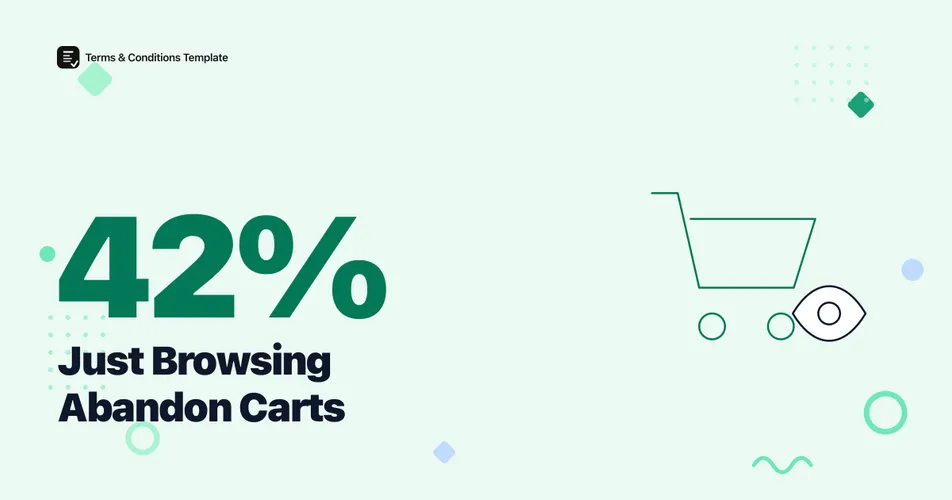
42% of shoppers who abandon a cart say they were just browsing and were not ready to buy, according to Baymard Institute’s checkout abandonment reasons survey. That makes “just browsing” the single most-cited reason of the 12 Baymard tracks, narrowly ahead of extra costs at 40%. Ranked from most to least common, the list of reasons splits cleanly into two groups: intent (shoppers who were never going to buy) and friction (shoppers who wanted to buy but the checkout stopped them).
What is the single biggest reason shoppers abandon their cart?
Just browsing tops the list at 42%, ahead of extra costs at 40%, delivery speed at 20%, and credit card security concerns at 19%, per Baymard Institute’s survey of US online shoppers who abandoned a cart in the past quarter. Respondents could select more than one reason, so the shares do not sum to 100%, and a single abandoned cart often has several causes stacked on top of each other.
Figure 1: The seven most-cited reasons shoppers abandon a cart, ranked by share of respondents. Source: Baymard Institute, checkout abandonment reasons survey.
That ranking matters for where a store should spend effort. “Just browsing” cannot be fixed by any checkout redesign, since those shoppers were never going to convert on that visit. Every reason below it, from extra costs down to site errors, is a friction point a store controls directly.
Which reasons can a store actually fix?
Not every entry on Baymard’s list responds to the same kind of fix, and lumping them together wastes effort. Extra costs, forced account creation, and an unclear returns policy are all things a store can change this week. Just browsing and credit card decline sit largely outside a store’s control, since one reflects shopper intent and the other reflects a shopper’s own bank.
Figure 2: The 12 tracked reasons plotted by how common they are against how directly a store can address them. Source: Baymard Institute, reason categorization by TCT editorial.
Extra costs sits in the top-right quadrant on purpose. It is both the second most common reason and one of the easiest to fix, which is why checkout transparency work usually produces the fastest measurable gain of anything on this list.
Do shoppers abandon carts because of forced account creation?
Yes. 18% of shoppers name mandatory account creation as their reason for abandoning a cart, and the friction is still widespread on the store side. Baymard Institute’s 2025 checkout UX benchmark, built from a manual review of more than 41,000 checkout performance scores across leading US and European ecommerce sites, found that 62% of sites fail to make guest checkout the most prominent option, even when the option technically exists somewhere in the flow.
Figure 3: How account-creation prominence at checkout maps to the 18% abandonment reason. Source: Baymard Institute, 2025 checkout UX benchmark.
A visible, one-click guest path removes an entire category of abandonment before a shopper ever has to decide whether to trust a store with a password. Sites that bury guest checkout behind a login prompt are effectively opting into the 18% figure rather than fixing it.
Does payment method selection affect cart abandonment?
Yes, and the effect is sharpest among younger shoppers. 54% of Gen Z shoppers and 41% of Millennials say they have skipped completing a purchase entirely when a business did not accept a digital wallet such as Apple Pay or Google Pay, according to GoDaddy’s Consumer Pulse survey fielded in March 2025 among 1,500 US consumers. That sits alongside Baymard’s own finding that 9% of abandoners cite insufficient payment methods generally and 10% abandon after a card is declined.
Figure 4: Share of each generation who report skipping a purchase when a business did not accept a digital wallet. Source: GoDaddy Consumer Pulse, March 2025, n=1,500 US consumers.
Payment method coverage is one of the cheaper fixes on this entire list. Adding Apple Pay or Google Pay support does not touch pricing or shipping terms, and it directly addresses a reason that skews toward the youngest, most digitally native shoppers a store is trying to reach.
What about the smaller reasons further down the list?
Below the top tier, five more reasons still account for a meaningful share of abandoned carts: forced account creation, checkout length, site errors, an unsatisfactory returns policy, and insufficient payment methods.
| Reason for abandonment | Share citing this reason |
|---|---|
| Just browsing, not ready to buy | 42% |
| Extra costs too high (shipping, tax, fees) | 40% |
| Delivery was too slow | 20% |
| Security concerns with credit card | 19% |
| Forced account creation | 18% |
| Checkout too long or complicated | 17% |
| Site errors or crashes | 17% |
| Unsatisfactory returns policy | 13% |
| Couldn’t see total cost upfront | 12% |
| Credit card declined | 10% |
| Insufficient payment methods | 9% |
| Unknown reasons | 7% |
Source: Baymard Institute, checkout abandonment reasons survey.
Figure 5: The five reasons that rank below the top tier but still shape a meaningful share of abandoned carts. Source: Baymard Institute, checkout abandonment reasons survey.
An unsatisfactory returns policy sits at 13%, low compared to just browsing or extra costs, but it is one of the few reasons on the entire list that a store can fix in an afternoon rather than a checkout redesign. Publishing a clear, plain-language return window removes that reason from the table before a shopper ever has to go searching for it. You can generate a refund policy that states the return window and conditions clearly enough to answer that question before a shopper abandons the cart to look for it elsewhere.
For the fuller picture of the overall abandonment rate, how it has held steady near 70% for over a decade, and the industry-by-industry breakdown, see our cart abandonment rate statistics for 2026, which digs into the 70.22% long-run average this reasons list sits underneath.
The Bottom Line
Ranked from most to least common, the 12 reasons Baymard Institute tracks split cleanly into two groups: intent and friction. Just browsing (42%) is intent, and no checkout change fixes it. Everything else, extra costs, delivery speed, forced accounts, checkout length, site errors, and an unclear returns policy, is friction a store controls directly. The fastest wins sit in the middle of the list rather than at the top: adding a guest checkout path, supporting a digital wallet, and publishing a clear return policy each address a specific, named reason without touching price or product.
Frequently Asked Questions
What is the single biggest reason shoppers abandon their cart? Just browsing. 42% of cart abandoners say they were not ready to buy and were only browsing, ahead of extra costs at 40%, according to Baymard Institute’s checkout abandonment reasons survey.
How many reasons are there for cart abandonment? Baymard Institute tracks 12 distinct reasons shoppers give for abandoning a cart, ranging from just browsing (42%) down to unknown reasons (7%). Respondents can select more than one reason, so the shares do not sum to 100%.
Do shoppers abandon carts because of forced account creation? Yes. 18% of shoppers cite mandatory account creation as a reason for abandoning a cart, and Baymard’s 2025 checkout UX benchmark of 41,000+ checkout scores found 62% of sites still fail to make guest checkout the most prominent option.
Does payment method selection affect cart abandonment? Yes. 54% of Gen Z shoppers and 41% of Millennials say they have skipped completing a purchase when a business did not accept a digital wallet like Apple Pay or Google Pay, according to GoDaddy’s March 2025 Consumer Pulse survey of 1,500 US consumers.
Sources and References
- Baymard Institute. “Checkout Abandonment Reasons Survey.” Ranked list of 12 reasons US online shoppers give for abandoning a cart, part of Baymard’s ongoing checkout usability research program.
- Baymard Institute. (2025). “Current State of Checkout UX.” Manual benchmark of 41,000+ checkout performance scores across leading US and European ecommerce sites.
- GoDaddy. (2025). “Consumer Pulse Survey.” Fielded March 2025, n=1,500 US consumers.
- Baymard Institute. Checkout usability research program, underlying methodology for the abandonment reasons survey.
Note: All figures verified as of August 2026. Reason percentages come from a survey where respondents may select more than one answer, so shares do not sum to 100%; headline figures are refreshed at least twice a year.