Google’s Play Catalog Access Program and Third-Party App Store on Play Program both went live on July 22, 2026, opening the Google Play Store to rival Android app stores in the United States for the first time. The launch followed a fast-moving final stretch in Epic Games’ long-running antitrust case against Google: on July 15, 2026, the two companies jointly withdrew their request to have the court adopt a narrower, negotiated settlement, clearing the way for the original October 7, 2024 permanent injunction, entered by Judge James Donato in Epic Games, Inc. v. Google LLC (N.D. Cal., No. 3:20-cv-05671), to take effect on schedule instead.
That injunction, upheld by the Ninth Circuit on September 12, 2025, requires Google to let rival app stores access the Play Store’s catalog of apps and to stop entering deals that make Google Play the exclusive place an Android app can be downloaded. Google and Epic had negotiated a competing settlement in March 2026 that would have replaced parts of that remedy with a different, sideloading-based model. When it became clear the court was not going to accept that alternative, both sides walked away from it rather than keep litigating, and the injunction’s original terms took over instead.
For a developer, the headline change is not a new law or a new disclosure requirement. It is a change in how many separate storefronts can now distribute the same app, under what terms, and by whose default. That matters directly for a EULA, since license-grant, distribution, and update language in most EULAs is still written as if Google Play were the only door an Android install comes through.
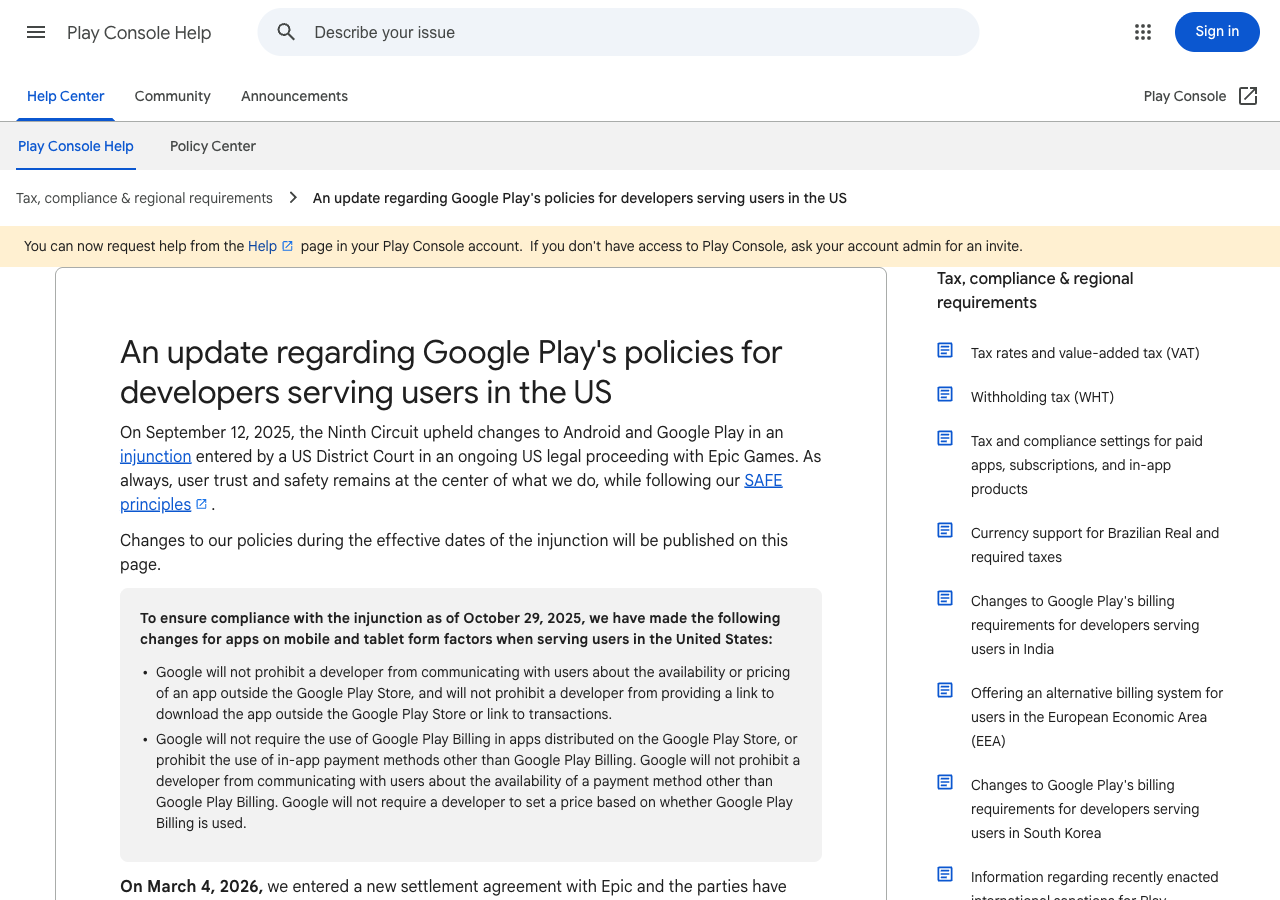
Source: Google Play Console Help, “An update regarding Google Play’s policies for developers serving users in the US”, captured August 4, 2026.
What the Two New Programs Actually Do
Google’s developer help pages describe two related but distinct programs, and the distinction matters for what a developer needs to check.
The Play Catalog Access Program lets a qualifying third-party US Android app store show a developer’s existing Play Store listing inside its own storefront. The install itself still runs “through Google Play on the same terms as any other download that is made directly through the Google Play Store,” per Google’s own program page, and Google’s standard service fee still applies to that download. Google notified developers on June 22, 2026 that their listings would be included by default unless they opted out before July 22, 2026, when the program took effect.
The Third-Party App Store on Play Program is the other half: it lets an entire rival app store, not just individual app listings, get discovered and downloaded from inside the Google Play Store itself. Interested store operators could begin onboarding on July 15, 2026, and the program went live alongside Play Catalog Access on July 22, 2026.
A store operator applying to either program has to meet real requirements, not just pay a fee: operating as an open, non-discriminatory marketplace with clear IP-dispute handling, disclosing app details and getting explicit user consent before installs or updates, meeting security and privacy obligations, and refreshing its catalog against the current Play snapshot at least weekly. On top of that, Google charges an upfront $5,000 service fee for the security and policy review during onboarding, then the same $5,000 annually to keep catalog access.
Figure: the annual fee Google charges a third-party app store operator, not a developer, to keep Play catalog access.
Separately, and on the same July 22, 2026 date, Google gave notice that developers already enrolled in its external content links and alternative billing programs, both of which launched back on December 9, 2025, will need to report transactions and pay the relevant service fees starting October 1, 2026.
What Changes in Your App’s EULA
None of this changes copyright or license law. It changes the facts a EULA is describing, and a few clauses that assumed a single distribution channel are now worth a second look.
Distribution-channel language is the most common miss. A EULA that states an app is “available exclusively through Google Play” or “the only authorized source for this software is the Google Play Store” is no longer accurate for a developer who has not opted out, since the same listing may now also surface through an onboarded third-party store. This is a factual-accuracy problem more than a legal one, but a EULA that misdescribes how a user obtained the software undermines the document’s credibility on everything else in it.
License-grant scope is usually fine as written, since most EULAs grant a license to use “the software” rather than to a specific store’s copy of it, but it is worth confirming the grant is not accidentally tied to “installation via the Google Play Store” language left over from when that was the only option.
Update and patch clauses need a closer look than most developers expect. Program rules only require a third-party store to refresh its catalog snapshot daily or weekly, not in real time, so a user who installs through a rival store could be running a build that lags what is current on Google Play. A EULA that promises “you will always receive the latest version automatically” or that ties support obligations to “the current published version” should account for that lag rather than assume every install is instantly current.
Billing and payment references are worth auditing too, separate from the license terms themselves. Alternative billing systems have been permitted in the US since December 2025, so EULA or purchase-terms language that still describes Google Play Billing as the only available payment method for in-app purchases is already out of date, and the new October 1, 2026 fee-reporting obligation is another reason to keep that section current rather than treat it as boilerplate.
EULA Assumptions Before vs. After July 22, 2026
| Before | After July 22, 2026 | |
|---|---|---|
| Distribution channel | Google Play only | Play plus opted-in third-party US stores |
| In-app billing | Google Play Billing assumed | Alternative billing since Dec 2025 |
| Update currency at install | Near real-time via Google Play | May lag up to a week on rival stores |
| Who pays for catalog access | Not applicable | Store pays Google, not developer |
Bottom Line
Nothing about this launch forces a developer to change what their app does or how it is licensed. What it does is make a EULA that describes distribution, updates, and billing in single-storefront terms factually stale, and a stale EULA is the kind of document that quietly stops matching reality until a support ticket or a dispute forces someone to reread it. Reviewing those sections now, while the change is fresh, costs less than fixing them under pressure later. Our EULA Generator is built to keep license-grant, distribution, and update language current with exactly this kind of shift, rather than locking a developer into wording written for a single-store world that no longer exists.
The information in this article is for informational purposes only and should not be construed as legal advice on any matter, and does not create a lawyer-client relationship.