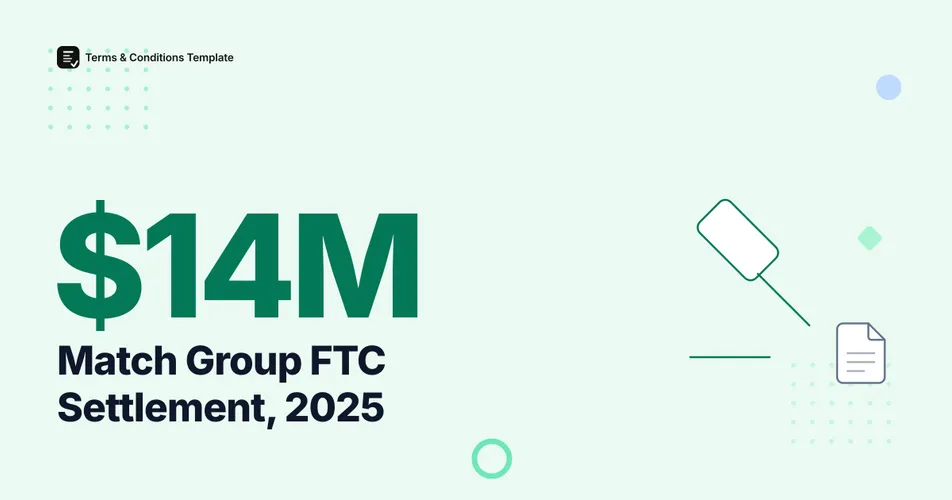
Match Group paid $14 million to settle a Federal Trade Commission lawsuit that had sought up to approximately $257 million, according to its Form 10-K filed with the SEC in February 2026. The case was about subscription terms: how a guarantee was disclosed, how hard cancellation was, and how chargebacks were handled. Every figure below comes from that filing and was checked in November 2026.
If you sell subscriptions, this is the clearest recent example of what the FTC looks at in your terms.
What did the FTC case against Match Group challenge?
Three things about the subscription terms, plus an allegation about notifications. The FTC filed its lawsuit on 25 September 2019 in federal court in Texas against the company then known as Match Group, Inc. The complaint alleges that, before mid-2018, Match.com notified non-paying users that other users were trying to communicate with them even though it had identified those accounts as potentially fraudulent. The complaint also challenges the adequacy of Match.com’s disclosure of the terms of its six-month guarantee, the efficacy of its cancellation process, and its handling of chargeback disputes.
These are the FTC’s allegations. Match Group says it believed it had strong defenses, and the 10-K describes no finding of liability.
The court narrowed the case in 2022. On 24 March 2022 it granted Match Group’s motion to dismiss with prejudice the claims about communication notifications, and dismissed requests for monetary damages on the claims about the guarantee offer and chargeback policy. The FTC filed an amended complaint on 19 July 2022 adding Match Group, LLC as a defendant, and was still seeking up to approximately $257 million in damages and penalties. Both sides moved for summary judgment on 11 September 2023.
Figure 1: Key dates in the FTC lawsuit against Match Group. Source: Match Group Form 10-K for fiscal 2025, legal proceedings note.
A subscription dispute can run nearly six years before it ends. Your terms are the evidence you will have to put in front of a regulator.
How was it settled?
For $14 million. The 10-K says the parties reached an agreement in principle on 9 June 2025, the court approved the settlement, and payment of $14 million was made in the quarter ended 30 September 2025. In its general and administrative expense discussion, Match Group lists a $14.0 million settlement with the FTC related to certain Evergreen & Emerging applications among the items that raised expense in 2025.
Figure 2: The FTC’s claimed ceiling (about $257 million), the Tinder class settlement ($60.5 million), the top of the reasonably possible Irish DPC exposure ($60 million) and the FTC settlement paid ($14 million). The first and third are claims and estimates, not payments. Source: Match Group Form 10-K for fiscal 2025.
The payment is about 5.4% of the ceiling the FTC was seeking (our calculation: 14 divided by 257). The two numbers are not like for like, because the ceiling was a claim and the $14 million was a negotiated payment.
The practical reading for you: the headline exposure in an FTC case is rarely the number paid. It is still a number that sits on your books for years.
What other legal exposure does Match Group list?
A $60.5 million class settlement over pricing and a possible GDPR fine. In the Candelore case, the complaint alleges that Tinder violated California’s Unruh Civil Rights Act by charging users over a certain age more than younger users for premium subscriptions. On 15 July 2024 the court certified a class of California Tinder Plus and Tinder Gold subscribers age 29 and over. On 17 January 2025 it denied Match Group’s motion to compel the class and plaintiff to arbitration. On 10 September 2025 the parties agreed to settle on a class-wide basis for $60.5 million, and on 13 January 2026 the court preliminarily approved the settlement.
The 10-K also describes an inquiry by the Irish Data Protection Commission into Tinder’s handling of access and deletion requests and data retention. A January 2024 preliminary draft decision alleged violations of GDPR requirements, and Match Group says a reasonably possible exposure to loss could be anywhere between a nominal amount and $60 million, which it does not believe would be material. It reports no provision for a loss.
Two lessons for terms. First, in that case a court declined to compel the class and plaintiff to arbitration, and Match Group appealed before settling, so an arbitration clause does not guarantee a private forum. Second, your price list is part of your terms: age, location and plan tiers can all draw a claim. Our guide to governing law and dispute resolution clauses covers the arbitration choices, and our data on mass arbitration shows how they can backfire.
A pricing rule and an arbitration clause both belong in writing, and both can end up in court.
How big is Match Group?
14.2 million payers in 2025 and $3.487 billion in revenue. Payers are unique users at brand level in a given month from whom Match Group earned direct revenue, and the figure is the average of monthly values. Duplicate payers may exist across brands, because Match Group cannot identify unique individuals across brands.
| Measure | 2023 | 2024 | 2025 |
|---|---|---|---|
| Payers (thousands, average) | 15,602 | 14,898 | 14,165 |
| Total revenue | $3.365 billion | $3.479 billion | $3.487 billion |
| Operating income | $916.9 million | $823.3 million | $872.5 million |
| Revenue per payer, total | $17.67 | $19.12 | $20.09 |
Figure 3: Match Group annual revenue in billions of dollars, 2023 to 2025. Source: Match Group Form 10-K for fiscal 2025, consolidated statement of operations.
Revenue was flat, up $7.8 million or under 1% in 2025, while payers fell 5%. Revenue per payer rose 5%, which offset the loss of payers.
Fewer people are paying more each, so each lost subscriber matters more.
Which brands are growing?
Hinge is growing and Tinder is shrinking. Hinge direct revenue grew $140.4 million, or 26%, to $690.9 million in 2025, with payers up 18% and revenue per payer up 7%. Tinder direct revenue fell $77.7 million, or 4%, to $1,862.9 million, driven by a 7% decrease in payers partly offset by a 3% rise in revenue per payer.
Figure 4: Match Group 2025 direct revenue by business unit in millions of dollars. Source: Match Group Form 10-K for fiscal 2025, disaggregated revenue note.
Hinge direct revenue was $396.5 million in 2023 and $690.9 million in 2025, which is up 74% in two years (our calculation). It made up about 20% of direct revenue in 2025.
Figure 5: Average payers in 2025 by business unit, in millions (E and E is Evergreen and Emerging). Source: Match Group Form 10-K for fiscal 2025.
Growth moved from one brand to another. The same terms must work for each one.
What should a subscription seller take from this?
Disclose, make cancellation easy, and answer chargebacks consistently. Those are the three subjects the FTC complaint named. A guarantee or free offer needs its terms stated where the buyer sees them. A cancellation route has to work as well as the sign-up route. And chargeback disputes should follow the rules you told the buyer.
Our look at the Click to Cancel rule covers where the federal rule stands, and our data on subscription cancellation shows how many subscribers say they struggle to leave. For a written policy, a refund policy generator is a quick start.
Match Group’s case ended in a settlement, with no ruling on the merits in the 10-K. That means nothing in it proves the allegations. It does show the price of having to defend the terms.
The rules the FTC cited are plain. Meeting them is cheaper than defending them.
The Bottom Line
The FTC sought up to about $257 million from Match Group over a guarantee, a cancellation process and chargeback handling, and the matter settled for $14 million in 2025. Tinder separately agreed to $60.5 million over age-tiered pricing, and Match Group reports a possible Irish GDPR exposure of up to $60 million. Meanwhile payers fell 5% to 14.2 million, and revenue held flat at $3.487 billion.
If you sell a subscription, write the guarantee terms, the cancellation steps and the chargeback rules in plain words, in the place buyers actually look. Do not count on an arbitration clause to keep a dispute out of court. Then have a lawyer check them against the rules where you sell. This article is data, not legal advice.
Frequently Asked Questions
How much did Match Group pay to settle the FTC lawsuit? $14 million. Match Group’s Form 10-K says the parties reached an agreement in principle on 9 June 2025, the court approved the settlement, and the payment was made in the quarter ended 30 September 2025. The FTC had been seeking up to approximately $257 million in damages and penalties.
What did the FTC case against Match Group challenge? The complaint, filed 25 September 2019, challenged the adequacy of Match.com’s disclosure of the terms of its six-month guarantee, the efficacy of its cancellation process and its handling of chargeback disputes, and alleged misleading notifications to non-paying users before mid-2018. Match Group says it had strong defenses.
How many payers does Match Group have? An average of about 14.2 million payers in 2025, down 5% from 14.9 million in 2024. Tinder had 9.0 million (down 7%) and Hinge 1.8 million (up 18%). Total revenue was $3.487 billion, up less than 1%.
What was the Tinder age-tiered pricing settlement? $60.5 million. In the Candelore case, plaintiffs alleged that Tinder charged users over a certain age more for premium subscriptions, violating California’s Unruh Civil Rights Act. The parties agreed to settle on a class-wide basis in September 2025, and the court preliminarily approved the settlement on 13 January 2026.
Sources and References
- Match Group, Inc.. (2026). Annual Report on Form 10-K for the fiscal year ended December 31, 2025, filed 26 February 2026. Source of all payer, revenue, legal proceedings, settlement and regulatory figures and statements in this article.
- U.S. Securities and Exchange Commission. EDGAR filing index for Match Group, Inc., used to confirm the filing date and fiscal period.
- U.S. Securities and Exchange Commission. XBRL company concept data for Match Group revenue, used to cross-check the 2023 to 2025 revenue figures.
Note: All figures verified as of November 2026 against Match Group’s fiscal 2025 Form 10-K. The settlement-to-claim ratio, two-year Hinge growth and Hinge revenue share are our own calculations. The FTC complaint’s claims are allegations, and the 10-K does not describe any finding of liability.