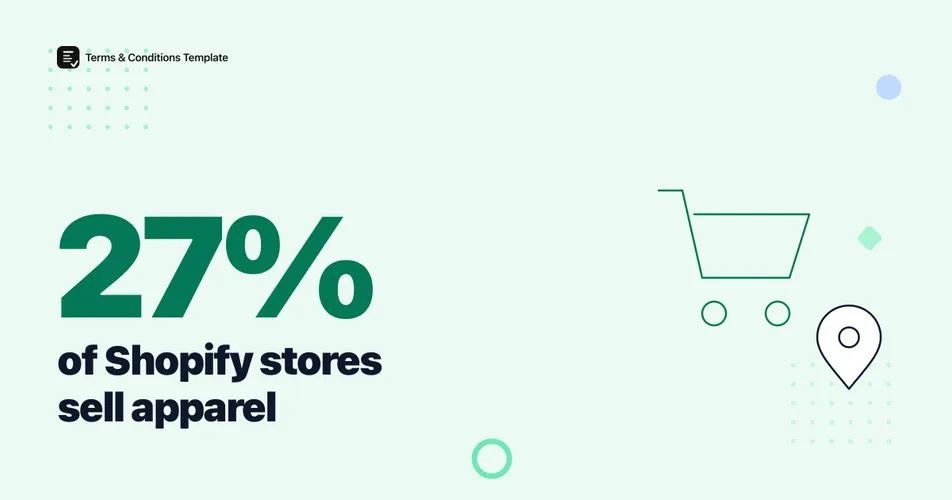
Apparel is the single most common product category on Shopify, run by 27.1% of the platform’s 2.92 million live stores, according to Store Leads’ mid-2026 Shopify report. The United States hosts 38.1% of all those stores, more than the next four countries combined. Together, category and geography answer the two questions a journalist or a new seller actually asks about Shopify: who sells on it, and where. For the store-count and revenue side of the same platform, see our Shopify statistics for 2026 and Shopify revenue statistics for 2026 breakdowns; this article focuses specifically on who those stores belong to and what they sell.
Those two facts are not independent of each other. Apparel is also the return-heaviest major category in retail, and a platform where more than a quarter of stores sell clothing is a platform where refund and returns terms matter more than the average generic policy admits.
What category of products do most Shopify stores sell?
Apparel leads every other category by a wide margin: 27.1% of Shopify’s 2.92 million live stores, or 790,521 individual stores, sell clothing and fashion items, per Store Leads’ mid-2026 report. Home & Garden is a distant second at 12.0% (348,750 stores), followed by Beauty & Fitness at 10.9% (318,357 stores).
The gap between first and second place is larger than the gap between second and eighth. No other single category on the platform comes close to apparel’s share, which matters for anyone building a Shopify-specific tool, benchmark, or template: designing for “the average Shopify store” without accounting for apparel’s outsized weight in the sample means designing for a category that is not actually representative of the categories below it.
Figure 1: Share of live Shopify stores by top-level product category. Source: Store Leads, “The State of Shopify,” mid-2026 report (2,917,946 stores analyzed).
Apparel’s dominance is also the reason category-specific refund terms matter more on Shopify than on a platform with a flatter category mix.
Which countries have the most Shopify stores?
The United States hosts 38.1% of all live Shopify stores, 1,111,335 storefronts, more than the next four countries on the list added together, according to Store Leads. The United Kingdom is a distant second at 7.5% (219,820 stores), followed by Canada at 4.9%, Australia at 4.5%, and India at 4.2%.
Geographic concentration follows a similar pattern to category concentration: the top 10 countries account for roughly 62.5% of all Shopify stores, and the remaining 37.5% is spread across every other country where the platform operates. France, Germany, the Netherlands, Spain, and Italy round out the rest of the top 10, each under 4% individually.
Figure 2: Percentage of live Shopify stores headquartered in each country. Source: Store Leads, mid-2026 report.
That concentration in English-speaking, high-income markets tracks with where Shopify has invested longest in localized payments and shipping integrations, though Store Leads’ report does not break down the reasons behind the ranking itself.
How many products does the typical Shopify store sell?
Most Shopify stores run small, focused catalogs rather than large multi-category storefronts. 26.9% of live stores sell 1 to 9 distinct products, and another 16.9% sell 10 to 24 products, according to Store Leads’ mid-2026 report. Combined, 43.8% of all live Shopify stores list fewer than 25 products.
The chart above shows the full distribution: it drops off steadily from there, with 12.6% of stores selling 25 to 49 products, 11.3% selling 50 to 99, another 11.3% selling 100 to 249, and just 9.7% reaching 250 to 999 products. Very few stores run catalogs in the thousands.
A small catalog is not a sign of a small business by revenue, and Store Leads’ report does not publish revenue data alongside catalog size, so the two should not be conflated. What the catalog-size data does confirm is that the typical Shopify store looks more like a focused brand with a handful of core products than a general marketplace, which is one reason a generic multi-category return policy template tends to fit Shopify sellers poorly.
Does what a store sells change how it should handle refunds?
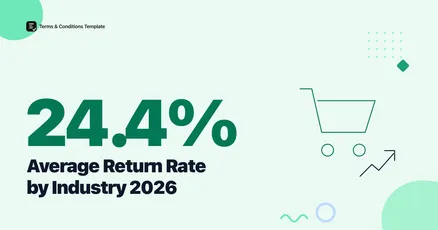
Yes. Apparel and footwear, Shopify’s largest category at 27.1% of stores, return online at 24.4%, well above the 19.3% blended ecommerce average, according to Coresight Research’s 2023 survey and the National Retail Federation’s 2025 returns research. Since more than a quarter of Shopify stores sell apparel, a meaningful share of the platform’s merchants are operating in the highest-return category in retail, not the average one.
Store Leads’ category report does not include return-rate data broken down by category on Shopify specifically, so that comparison draws on separate industry-wide research rather than a single unified dataset. It still points in one direction: a Shopify store selling apparel needs a return window and condition policy built around sizing and fit issues, while a store in a lower-return category like home goods or food can typically run a tighter policy without losing sales. For the full return-rate breakdown by industry, see our return rate by industry benchmarks.
Figure 3: How the product category a Shopify store sells typically shapes its return policy design. Source: authors’ synthesis of Store Leads category data (mid-2026) and Coresight Research / NRF return-rate benchmarks.
Merchants who sell apparel or another high-return category can generate a refund policy that spells out the return window, condition requirements, and restocking terms up front, rather than adapting a generic template written for a lower-return category.
Shopify merchants by the numbers: category and country side by side
| Metric | Leader | Share | Store count |
|---|---|---|---|
| Top category | Apparel | 27.1% | 790,521 |
| 2nd category | Home & Garden | 12.0% | 348,750 |
| Top country | United States | 38.1% | 1,111,335 |
| 2nd country | United Kingdom | 7.5% | 219,820 |
Table 1: Leading product category and leading country by share of live Shopify stores, mid-2026. Source: Store Leads.
Shopify’s own reach extends well beyond its top 10 countries. The company says businesses on its platform have generated more than $1 trillion in cumulative sales since launch, a lifetime total rather than a single year’s GMV, and offers localized checkout across 70-plus regions worldwide.
The Bottom Line
Shopify’s 2.92 million live stores are not evenly spread across categories or countries. Apparel alone accounts for more than a quarter of every store on the platform, and the United States alone accounts for more than a third, both far ahead of any single competitor in their respective rankings. For anyone building tools, benchmarks, or policy templates aimed at “the average Shopify store,” that average is disproportionately a small-catalog US apparel brand, not a representative sample across categories.
That concentration has a practical consequence for store owners: a return policy that assumes low-return categories like home goods or electronics will underserve the majority of stores in Shopify’s largest category, where sizing and fit drive roughly a quarter of all purchases back. Matching refund terms to the category a store actually sells in, rather than copying a generic template, is the more defensible starting point given how the platform’s merchant base is actually distributed.
Frequently Asked Questions
What is the most common product category on Shopify? Apparel is the largest single category, run by 27.1% of Shopify’s 2.92 million live stores (790,521 stores), according to Store Leads’ mid-2026 report. Home & Garden is second at 12.0%, and Beauty & Fitness third at 10.9%.
Which country has the most Shopify stores? The United States hosts 38.1% of all live Shopify stores (1,111,335 stores), more than the next four countries combined. The United Kingdom is second at 7.5%, followed by Canada at 4.9%, Australia at 4.5%, and India at 4.2%, per Store Leads’ July 2026 report.
How many products does the average Shopify store sell? Most Shopify stores run small catalogs: 26.9% sell 1 to 9 products and 16.9% sell 10 to 24 products, meaning 43.8% of all live stores list fewer than 25 items, according to Store Leads’ mid-2026 report of 2.92 million stores.
Do apparel sellers need a different refund policy than other Shopify stores? Apparel and footwear return at 24.4% online, well above the 19.3% blended ecommerce average, per Coresight Research’s 2023 survey. Since apparel is Shopify’s largest category at 27.1% of stores, a large share of Shopify merchants need a return window built around fit and sizing issues rather than a generic policy.
Sources and References
- Store Leads. (2026). “The State of Shopify,” mid-2026 report. DNS-verified live store counts by country, category, and product catalog size (2,917,946 stores analyzed).
- National Retail Federation / Happy Returns (UPS). (2025). “2025 Retail Returns Landscape.” Blended online return rate of 19.3% for 2025.
- Shopify Inc.. “About Shopify.” Cumulative platform sales and regional checkout coverage figures.
- Coresight Research. (2023). “The True Cost of Apparel Returns.” Survey of 100 US apparel and footwear brand and retailer decision-makers, margin of error plus-or-minus 10%. Full category breakdown in our return rate by industry post.
Note: All figures verified as of September 2026. Store Leads updates its Shopify report quarterly; category, country, and catalog-size figures here will be refreshed at least twice a year alongside the source report.