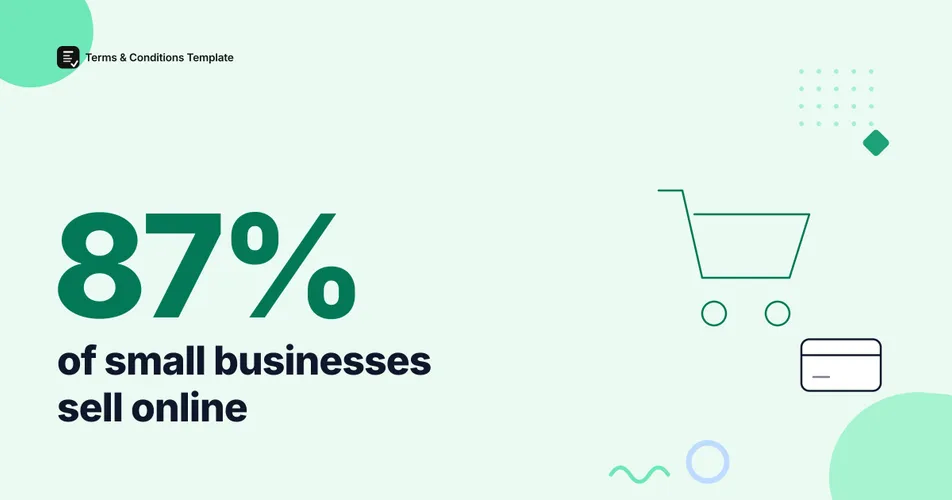
Most small businesses with a website now sell something online. According to Clutch’s August 2025 survey of 406 US small business owners, 87% sell online in some form, yet a separate NFIB survey the same year found only 19% of those sites actually accept payment directly. That gap between selling online and actually processing a sale is the real story behind small business ecommerce heading into 2026.
For a store owner, the numbers worth tracking are not just who sells online, but what happens after checkout: how often something gets returned, what shoppers expect from that process, and where a small seller is exposed if a posted policy does not match the reality shoppers now assume.
How many small businesses actually sell online?
87% of small businesses with a website sell something online, based on Clutch’s survey of 406 US small business owners conducted in August 2025. Broken down by category, 38% sell physical products, making traditional ecommerce the largest single slice, while 30% sell digital products and 19% sell services through or alongside their website. The remaining 13%, the arithmetic gap left once those three categories are subtracted from the 87% total, run a site that does not sell anything at all.
Figure 1: What small business websites sell, by category. Source: Clutch, August 2025 survey of 406 US small business owners.
Selling “online” in this survey is a broad definition that includes bookings, digital downloads, and service inquiries submitted through a site, not just a shopping cart with a checkout button. That distinction matters more than it looks, and the next section shows exactly why.
Do most small business websites actually accept payment?
No. Only 19% of small business websites accept payment directly on their own site, while 81% do not, according to NFIB’s survey of 521 small business owners fielded March 6 to 31, 2025, across a mix of services, retail, construction, and manufacturing firms. That is a wide gap from Clutch’s 87% online-selling figure, and the two surveys together suggest most small businesses that “sell online” are doing so through a marketplace, an invoice link, a phone call, or a third-party checkout rather than a payment form built into their own website.
For a business that does take payment on-site, the transaction does not end at checkout. A written refund policy has to be visible before the sale, not drafted after the first dispute. A refund policy generator that matches your actual return window and shipping terms closes that gap the same day the payment form goes live.
The 81% who route payment elsewhere are not off the hook either. Marketplaces, invoicing tools, and payment processors each carry their own dispute and chargeback rules, and a seller who has not read them is finding out the terms during their first refund request instead of before it.
How big is ecommerce for the US economy overall?
Ecommerce made up 16.4% of total US retail sales in 2025, according to the US Census Bureau’s Quarterly Retail E-Commerce Sales reports, up from 16.1% in 2024 and 15.3% in 2023. The share kept climbing through the year, reaching 16.6% in the fourth quarter of 2025 alone.
Figure 2: Ecommerce as a share of total US retail sales. Source: US Census Bureau, Quarterly Retail E-Commerce Sales reports, 2023 to 2025.
The Census Bureau does not break this figure out by business size, so it is a directional signal of overall online-shopping growth rather than a small-business-specific number. Read alongside Clutch’s 87% adoption figure, it points the same direction: small businesses are entering a channel that keeps taking a larger share of every retail dollar spent.
How much of what small ecommerce sellers ship comes back?
19.3% of online sales were returned in 2025, well above the 15.8% overall retail return rate across every sales channel, according to the National Retail Federation and Happy Returns’ 2025 Retail Returns Landscape report. Total returns across US retail reached an estimated $849.9 billion for the year. Returns run even higher during the holidays, with NRF projecting a 17% return rate for the November-December 2025 season.
Figure 3: Return rate by sales channel. Source: National Retail Federation and Happy Returns, 2025 Retail Returns Landscape report.
Warning
NRF and Happy Returns’ merchant-side findings come from a survey of 358 ecommerce professionals at retailers with more than $500 million in annual revenue, not small businesses specifically. Treat the return-rate figures above as broad benchmarks a small seller should plan against, not a small-business-only sample. For the full return-rate breakdown by product category and year-over-year trend, see our dedicated ecommerce return rate data.
A return rate near one in five online orders is not a rounding error for a small store. It is a cost line that has to be priced into margins and covered by a policy customers can actually find before they buy.
What do shoppers expect from a small store’s return policy?
Consumer expectations around returns have hardened, not loosened. 82% of shoppers say free returns are a major factor in where they choose to buy, up from 76% a year earlier, based on NRF and Happy Returns’ 2025 consumer survey of 2,006 US shoppers who had returned an online purchase. 76% say they prefer an instant refund at the point of return over waiting for a retailer to process it later, and 71% say a poor return experience makes them less likely to buy from that retailer again, up from 67% the year before.
Figure 4: A simple test against the two return-policy factors shoppers rank highest. Source: synthesized from NRF and Happy Returns’ 2025 Retail Returns Landscape findings.
A small seller cannot always match a large retailer’s free-shipping economics, but a policy that states the return window, who pays for shipping, and how fast a refund lands closes most of the trust gap those numbers describe. Vague or missing terms cost more in repeat business than a clearly stated, less generous policy does.
What has changed for small business ecommerce since 2023?
Figure 5: Key small business ecommerce and adoption milestones. Sources: US Census Bureau, Clutch, NFIB, National Retail Federation and Happy Returns.
Every marker in that timeline points the same direction: more small businesses are entering ecommerce, the channel keeps growing as a share of retail overall, and the return-and-refund expectations shoppers bring to every purchase keep getting stricter, not looser.
How does small business ecommerce adoption compare across these data points?
| Metric | 2025 figure | Source |
|---|---|---|
| Small business websites selling something online | 87% | Clutch, August 2025 (n=406) |
| Small business websites accepting payment on-site | 19% | NFIB, March 2025 (n=521) |
| Ecommerce share of total US retail sales | 16.4% | US Census Bureau, 2025 |
| Online sales returned | 19.3% | NRF / Happy Returns, 2025 |
| Shoppers who say free returns are a major purchase factor | 82% | NRF / Happy Returns, 2025 |
Ecommerce adoption for small businesses is not the bottleneck the numbers used to suggest. The bottleneck now sits after the sale, in whether a store’s payment setup and return policy can hold up to shopper expectations that keep rising every year.
The Bottom Line
The headline number for 2026 is 87%: most small businesses with a website already sell something online, and the real gap is not adoption, it is infrastructure. Only 19% of those sites take payment directly, ecommerce keeps taking a larger share of total US retail every year, and nearly one in five online orders now comes back. Shoppers have made their expectations explicit: 82% weigh free returns when deciding where to buy, and 71% will not return to a retailer after a bad return experience. A small seller who adds on-site payment without a matching, clearly published refund policy is building the exact gap those numbers warn about. A refund policy generator that states the return window, shipping responsibility, and refund timing up front closes that gap before the first dispute, not after it. For the businesses still building out their online presence in the first place, see our data on small business website adoption in 2026 and small business marketing budgets in 2026; for what is driving losses on the other side of the return counter, see our ecommerce fraud data for 2026.
Frequently Asked Questions
What percentage of small businesses sell online? 87% of small businesses with a website sell something online in some form, per Clutch’s August 2025 survey of 406 US small business owners. 38% sell physical products, 30% sell digital products, and 19% sell services.
Do most small business websites accept payment directly? No. Only 19% of small business websites accept payment on-site, according to NFIB’s March 2025 survey of 521 small business owners; the remaining 81% rely on marketplaces, invoicing, or other payment methods.
What is the average online return rate small ecommerce sellers should plan for? 19.3% of online sales were returned in 2025, well above the 15.8% overall retail return rate, according to the National Retail Federation and Happy Returns’ 2025 Retail Returns Landscape report.
Do free returns actually influence where shoppers buy? Yes. 82% of shoppers say free returns are a major factor in choosing where to buy, up from 76% a year earlier, and 71% say a bad return experience makes them less likely to buy from that retailer again, per the same NRF and Happy Returns report.
Sources and References
- Clutch. (2025). “The State of Small Business Websites in 2025.” Survey of 406 US small business owners, conducted August 2025.
- NFIB. (2025). “NFIB Survey Sheds Light on New Technologies for Small Business.” Survey of 521 US small business owners, fielded March 6 to 31, 2025.
- National Retail Federation and Happy Returns. (2025). “2025 Retail Returns Landscape.” Consumer survey of 2,006 US shoppers and retailer survey of 358 ecommerce professionals.
- National Retail Federation. (2025). “Consumers Expected to Return Nearly $850 Billion in Merchandise in 2025.” Press release.
- US Census Bureau. (2026). “Quarterly Retail E-Commerce Sales.” Historical and current release data, 2023 to 2025.
Note: All figures verified as of September 2026. Small business ecommerce adoption and returns data move with each new Clutch, NFIB, Census, and NRF release, so headline figures are refreshed at least twice a year.