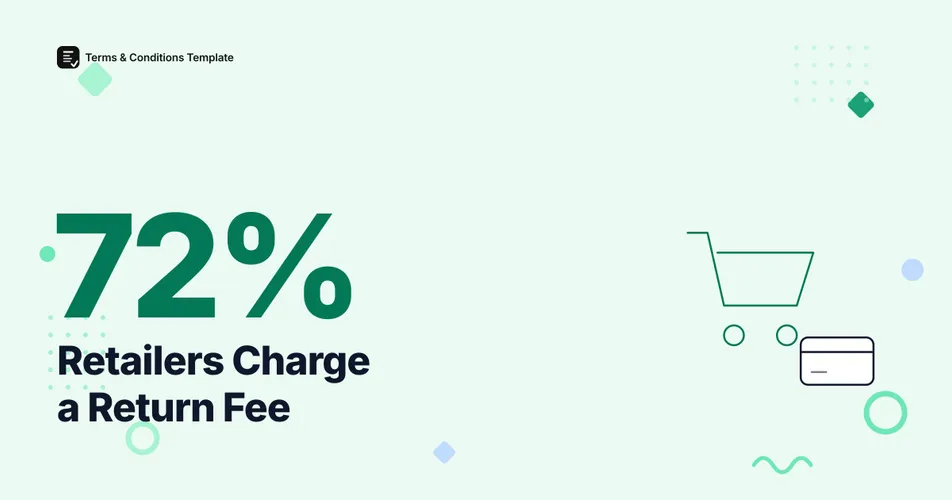
72% of US retailers charged a fee on at least one type of return in 2025, up from 66% in 2024, according to the National Retail Federation and Happy Returns’ joint survey of 358 ecommerce professionals. Free shipping both ways used to be the default; for most stores in 2026, it is now the exception rather than the rule.
That shift did not happen quietly. Consumers still expect free returns more than ever, retailers say the fees are working, and the two sides disagree about almost everything else. Here is what the current data says, category by category.
How many retailers still offer free returns in 2026?
An estimated 28% of US retailers charged no fee on any type of return in 2025, the direct complement of the 72% who charged a fee on at least one return type. Both figures come from the same National Retail Federation and Happy Returns retailer survey of 358 ecommerce professionals at large US merchants, fielded in summer 2025. A year earlier, in 2024, 66% of retailers charged at least one kind of fee, so the fully-free-returns group shrank from roughly a third of the market to a little over a quarter in a single year.
Figure 1: Share of US retailers charging at least one kind of return fee in 2025. Source: National Retail Federation and Happy Returns, 2025 Retail Returns Landscape, retailer survey of 358 ecommerce professionals.
The trend line matters more than the single-year snapshot. If the pace of the last two years holds, fully free returns will be a minority practice within another year or two, not a baseline shoppers can assume.
Why are retailers charging for returns now?
Retailers point to costs, not customer experience, as the driver. The top three reasons cited in the NRF and Happy Returns retailer survey are rising return-processing costs (40%), rising carrier shipping costs (40%), and tariffs or general economic uncertainty (33%). None of the leading reasons involve trying to change shopper behavior directly; they are cost-recovery decisions.
Figure 2: Reasons retailers gave for charging return fees. Source: National Retail Federation and Happy Returns, 2025 Retail Returns Landscape, retailer survey of 358 ecommerce professionals.
Rising shipping and processing costs are largely outside a store’s control, which is why a written, current refund policy matters more now than when returns were simply free by default. A policy that names the fee, the reason, and the exceptions up front avoids the dispute costs that come from a shopper discovering a fee only after the box ships.
Do return fees actually work for retailers?
Retailers who added fees report meaningful upside: 53% say their overall return rate dropped, 52% saw more shoppers choose an exchange instead of a refund, 51% saw shoppers switch to a cheaper free return method, 43% recouped direct revenue from the fee itself, and 42% say fraud declined. Those numbers explain why fees keep spreading even as they are unpopular.
The downside is just as real. Among retailers that started charging return fees, 47% report more customer complaints, 37% lost customers outright, 34% saw average order value decline, and 24% saw an overall sales decrease, per the same NRF and Happy Returns retailer survey. Fees change behavior in both directions at once, and the survey does not show which effect wins for any individual store.
| Outcome after adding return fees | Retailers reporting it |
|---|---|
| Return rate dropped | 53% |
| More shoppers chose exchanges | 52% |
| Lost customers | 37% |
| Average order value declined | 34% |
Source: National Retail Federation and Happy Returns, 2025 Retail Returns Landscape, retailer survey of 358 ecommerce professionals.
A fee that quietly reduces returns and a fee that quietly loses customers can both be true for the same store at the same time; the net effect depends on the category and the customer base, not the fee alone.
How do shoppers react to return fees?
84% of consumers globally say they would stop shopping at a favorite retailer if it introduced stricter return policies, according to Blue Yonder’s 2025 Global Consumer Retail Returns Survey, fielded by a third-party provider in July 2025 across more than 6,000 consumers in the US, UK, Australia and New Zealand, France, Germany, and the Middle East. Reaction varies by age: Millennials (74%) and Gen Z (71%) report being more deterred by stricter policies than the global average (66%) or the US alone (59%).
Figure 3: Share of shoppers who say tighter return policies make them less likely to buy, by segment. Source: Blue Yonder 2025 Global Consumer Retail Returns Survey, 6,000+ respondents, fielded July 2025.
US shoppers are not immune to the fees themselves either: 36% say they are unlikely to return an item at all once a fee applies, and among Baby Boomers specifically that figure rises to 45%, per the same Blue Yonder survey. Some of that “unlikely to return” behavior almost certainly overlaps with bracketing, where shoppers who once ordered several sizes with a plan to return most of them now think twice before doing so.
A retailer’s fee policy does not just change who returns items; it changes who buys in the first place.
How does this compare with the broader return rate picture?
Return fees are rising at the same time overall return volume keeps climbing. Online orders were returned at a 19.3% rate in 2025, the subject of our full ecommerce return rate breakdown, while category return rates vary widely underneath that headline number.
| Category | Typical return rate, 2025 |
|---|---|
| Apparel | 20% to 40% |
| Footwear | 17% to 30% |
| Electronics | 8% to 15% |
| Beauty | 4% to 12% |
Source: National Retail Federation and Happy Returns, 2025 Retail Returns Landscape.
Figure 4: The minimum disclosure test a return policy should pass before a fee reaches checkout. Source: synthesized from the NRF/Happy Returns and Blue Yonder findings above.
The categories with the highest return rates, apparel and footwear, are also the categories where a fee is riskiest to introduce, since fit-driven buying already assumes the shopper can send back what does not work.
Where is this heading?
The shift away from free returns did not start in 2025, and it did not happen only at large retailers. Loop Returns, whose platform processes returns for thousands of Shopify merchant brands, reports that 63% of its merchants now charge a return fee, up sharply from a small minority when Loop’s fee tools first launched around 2020. Loop does not publish the exact size of its merchant panel for this figure, so treat the trend direction as the reliable part and the precise percentage as directional.
Figure 5: Milestones in the shift away from free returns. Sources: Loop Returns 2025 merchant data; National Retail Federation and Happy Returns, 2024 and 2025 Retail Returns Landscape reports.
If both the large-merchant NRF data and Loop’s smaller-merchant data are moving the same direction at the same time, free returns look less like a temporary pullback and more like a reset of the baseline shoppers should expect going forward.
The Bottom Line
Free returns are not gone, but they stopped being the default sometime in the last two years. 72% of retailers now charge a fee on at least one type of return, up from 66% in 2024, and the retailers that added fees report real cost savings alongside real customer losses. Shoppers have not adjusted their expectations to match: 82% still call free returns a major purchase factor, and 84% say a stricter policy would send them elsewhere. The stores that come out ahead are the ones that pick a policy and state it plainly before checkout, using a clear, current refund policy rather than letting shoppers discover the fee at the worst possible moment.
Frequently Asked Questions
What percentage of retailers still offer free returns in 2026? An estimated 28% of US retailers charged no fee on any type of return in 2025, the mirror image of the 72% who charged a fee on at least one return type, according to the National Retail Federation and Happy Returns’ survey of 358 ecommerce professionals.
Why are retailers charging for returns now? The top reasons retailers cite are rising return-processing costs (40%), rising carrier shipping costs (40%), and tariffs or economic uncertainty (33%), per NRF and Happy Returns’ 2025 Retail Returns Landscape report.
Do return fees actually work for retailers? Results are mixed. 53% of retailers that added fees say it cut their return rate and 52% saw more exchanges, but 37% lost customers and 34% saw average order value decline, according to the same NRF and Happy Returns retailer survey.
How do shoppers react to return fees? 84% of shoppers say they would stop shopping at a favorite retailer if it introduced stricter return policies, according to Blue Yonder’s 2025 Global Consumer Retail Returns Survey of more than 6,000 consumers.
Sources and References
- National Retail Federation and Happy Returns. (2025). “2025 Retail Returns Landscape.” Retailer survey of 358 ecommerce professionals at large US merchants; consumer survey of 2,006 shoppers, fielded summer 2025.
- Blue Yonder. (2025). “Blue Yonder Survey: Stricter Returns Policies Deter Global Consumer Spending.” Third-party fielded survey of 6,000+ consumers across the US, UK, Australia/New Zealand, France, Germany, and the Middle East, July 2025.
- Loop Returns. (2025). “Who Pays for Return Shipping: The Merchant or the Customer?” Loop’s own merchant-platform data; exact panel size not disclosed.
- National Retail Federation. (2025). “Consumers Expected to Return Nearly $850 Billion in Merchandise in 2025.” Press release summarizing the 2025 Retail Returns Landscape findings.
Note: All figures verified as of September 2026. Return-fee policy is moving quickly enough that headline figures here are scheduled for a refresh at least twice a year.