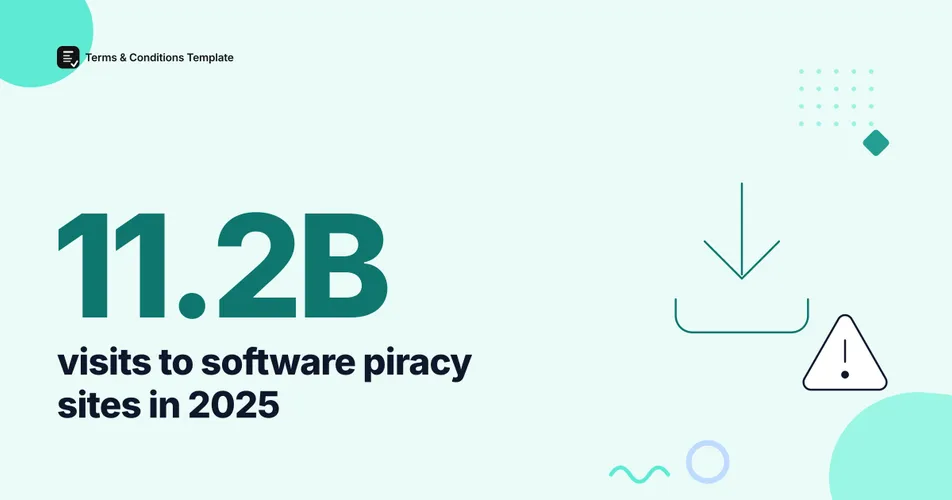
Software piracy is shrinking, and fast. Visits to software piracy sites fell 24.5% in 2025, to 11.23 billion, according to MUSO’s 2025 Piracy Trends and Insights report, published in June 2026. The last global survey of unlicensed installs is older, so this page pairs MUSO’s fresh traffic data with BSA’s 2018 rates, and says which is which.
How much software piracy is there in 2026?
MUSO counted 11.23 billion visits to software piracy sites in 2025. That is 3.65 billion fewer than the 14.88 billion it logged in 2024. MUSO’s dataset tracks visits to piracy websites, not copies installed, so one visit can mean one app or a whole catalog.
Software did not fall alone. Every sector MUSO tracks dropped in 2025, but music, film, and software fell the hardest. MUSO ties the software decline to the shift toward cloud-based, subscription software.
Figure 1: Year-over-year decline in visits to piracy sites, by sector. Source: MUSO Piracy by Industry data, 2025 vs 2024.
Software sits in the middle of the pack. It lost nearly a quarter of its traffic in one year.
Total piracy traffic across all five sectors fell 14.2%, from 216.3 billion visits in 2024 to 185.6 billion in 2025. MUSO calls it the steepest annual decline since 2020.
Fewer visits does not mean zero piracy. It means the easy reasons to pirate are fading.
How does software piracy compare with other kinds of piracy?
Software is a small slice. It drew 11.23 billion of the 185.6 billion visits MUSO counted in 2025, or about 6.05%. TV is the giant at 83.42 billion visits, which is 45% of all piracy traffic, and publishing follows at 65.79 billion.
Figure 2: Visits to piracy sites by sector in 2025, in billions. Source: MUSO 2025 Piracy Trends and Insights, June 2026.
| Sector | 2025 visits (billions) | 2024 visits (billions) | Change |
|---|---|---|---|
| TV | 83.42 | 96.79 | -13.8% |
| Publishing | 65.79 | 66.38 | -0.9% |
| Film | 16.77 | 24.27 | -30.9% |
| Software | 11.23 | 14.88 | -24.5% |
| Music | 8.35 | 13.98 | -40.3% |
Source: MUSO Piracy by Industry data, 2025 vs 2024.
Software is the fourth-largest sector by visits. Its drop beats TV and publishing by a wide margin.
How do people find pirated software?
Mostly through search. Software is the only sector in MUSO’s 2025 data where search traffic, at 47.5%, beats direct traffic, at 44.6%. Across all sectors, direct visits make up 57% of traffic.
MUSO reads that as opportunistic behavior. MUSO says software pirates search for a specific app or game rather than return to a known site.
Figure 3: Traffic sources for software piracy sites. The 7.9% remainder is our subtraction from MUSO’s search and direct shares. Source: MUSO 2025 Piracy Trends and Insights.
The sector is also 100% download-based, with no streaming. MUSO says the top sites split between mobile software and APK platforms and PC game repack sites. Mobile software and games stay active in markets where price is a barrier.
Companies face the other side of the same market. Our look at enterprise software spend and seat counts shows what legitimate buying looks like at scale.
Software pirates search first. That makes the first page of results the place where the risk starts.
What share of installed software is unlicensed?
37% of software installed on personal computers worldwide was unlicensed, according to BSA’s 2018 Global Software Survey, a two-point drop from the prior edition. The survey drew on more than 23,000 consumers, employees, and CIOs across more than 110 countries and markets, fielded in 2017. We found no newer global edition as of November 2026, so treat the rates as historical.
The spread between countries is huge. Japan reported the lowest rate at 16%. Libya reported the highest at 90%, with Venezuela at 89% and Nicaragua at 81%.
| Country | Unlicensed share of installed software | Survey year |
|---|---|---|
| Libya | 90% | 2017 data |
| Venezuela | 89% | 2017 data |
| Nicaragua | 81% | 2017 data |
| Mexico | 49% | 2017 data |
| Colombia | 48% | 2017 data |
| Brazil | 46% | 2017 data |
| Japan | 16% | 2017 data |
Source: BSA 2018 Global Software Survey, as reported by ABES (Brazilian Association of Software Companies).
Figure 4: Highest and lowest unlicensed-software rates among countries named in BSA’s 2018 release. Source: BSA 2018 Global Software Survey via ABES.
In Brazil, 46% of installed software was unlicensed, worth US$1.7 billion in commercial value.
Piracy is one way license terms get broken. Another is never reading them, which our look at how many people read EULAs covers.
What does pirated software cost?
The headline number is large. BSA’s 2018 survey put the cost of malware from unlicensed software at nearly $359 billion a year worldwide, and the average cyber attack at $2.4 million. ABES reports both figures. The $359 billion is BSA’s estimate, not an audited loss.
The newer evidence is about how infections start. Kaspersky analyzed 5 million infostealer log files found on the dark web in 2025, in a study published June 15, 2026. About 35% of infections began when a user ran a file straight from the Windows temporary folder. Kaspersky says the files posed as software installers, activators, or game mods, and victims were often told to turn off their security software first.
Figure 5: The infection path Kaspersky describes for disguised installers and activators. Source: Kaspersky infostealer log analysis, June 2026 (5 million log files, 2025).
Vendors also check. Our software licensing data shows how often companies face a license audit.
The price of a crack is rarely paid in cash. It is paid in stolen logins.
What are the legal penalties for software piracy?
In the US, civil damages run from $750 to $30,000 per work infringed. If a court finds the infringement willful, the cap rises to $150,000 per work. An innocent infringer can see damages cut to $200 per work. Those ranges come from 17 U.S.C. 504(c).
Criminal law adds a second layer. Under 18 U.S.C. 2319, reproducing or distributing at least 10 copies with a total retail value over $2,500 within 180 days can carry up to 5 years in prison. Other cases carry up to 1 year, and a second felony offense can carry up to 10 years.
| Penalty | Amount or term | Legal source |
|---|---|---|
| Statutory damages, standard | $750 to $30,000 per work | 17 U.S.C. 504(c)(1) |
| Statutory damages, willful | Up to $150,000 per work | 17 U.S.C. 504(c)(2) |
| Statutory damages, innocent | As low as $200 per work | 17 U.S.C. 504(c)(2) |
| Criminal, 10+ copies over $2,500 | Up to 5 years | 18 U.S.C. 2319(b) |
Source: Cornell Legal Information Institute, text of 17 U.S.C. 504 and 18 U.S.C. 2319. This is a summary, not legal advice.
The flip side matters if you sell software. Your license terms are what let you claim a breach in the first place. An EULA generator gives you a starting point for those terms, so you can state what a customer may and may not copy or share.
Copying software carries real legal exposure. Clear license terms are how a vendor puts that exposure on the record.
How has software piracy changed over time?
The numbers move with how software is sold. MUSO links the recent drop to cloud and subscription delivery, and BSA’s unlicensed-install rate was already falling in 2017.
Figure 6: Timeline of the data points used in this post. Sources: BSA 2018 Global Software Survey, MUSO 2025 report, Kaspersky 2026 study.
Open source sits on the other side of the license line. It has its own terms, and our page on open source usage and growth covers how widely it is used.
The trend favors legal access. A good license still decides who can do what with your code.
The Bottom Line
Software piracy is falling. Visits to software piracy sites dropped 24.5% in 2025 to 11.23 billion, per MUSO, and the sector now makes up about 6.05% of piracy traffic. The latest global rate for unlicensed installs, 37%, is from 2017 data and has not been refreshed.
For a software seller, the lesson is simple. Piracy pressure is easing in markets with good legal access, and it is staying high where price or availability is a barrier. For a buyer, Kaspersky’s data points to a different risk than a fine. A crack that skips a fee can hand over saved passwords.
Put your license terms in writing. Say what a customer may copy, install, and share, and what happens when they go past it.
Frequently Asked Questions
How many visits do software piracy sites get? Software piracy sites got 11.23 billion visits in 2025, down 24.5% from 14.88 billion in 2024, according to MUSO’s 2025 Piracy Trends and Insights report (June 2026). That is about 6.05% of the 185.6 billion visits MUSO counted across all five sectors.
What share of installed software is unlicensed? 37% of software installed on personal computers was unlicensed in BSA’s 2018 Global Software Survey, which covered more than 110 countries and markets and drew on 2017 data. The rate ran from 16% in Japan to 90% in Libya. We found no newer global edition as of November 2026.
How much can software copyright infringement cost in the US? Statutory damages run from $750 to $30,000 per work, rising to as much as $150,000 per work when infringement is willful, under 17 U.S.C. 504(c). Criminal penalties reach up to 5 years in prison for 10 or more copies worth over $2,500 within 180 days (18 U.S.C. 2319).
Is pirated software a malware risk? Yes. In a 2026 Kaspersky analysis of 5 million infostealer log files from 2025, about 35% of infections began with a file run from a temporary folder, often disguised as an installer, activator, or game mod. BSA’s 2018 survey put malware costs tied to unlicensed software at nearly $359 billion a year worldwide.
Sources and References
- MUSO. 2025 Piracy Trends and Insights (June 2026). Visits to piracy websites across 192 countries, five sectors.
- MUSO. 2024 Piracy Trends and Insights. 216.3 billion total visits in 2024, Piracy by Industry methodology.
- ABES. Report on BSA’s 2018 Global Software Survey. 37% unlicensed, $359 billion malware cost, country rates, 110+ countries and markets, 23,000+ respondents.
- Kaspersky. Infostealer infections study (June 15, 2026). 5 million dark web log files from 2025.
- Cornell Legal Information Institute. 17 U.S.C. 504, Remedies for infringement: damages and profits.
- Cornell Legal Information Institute. 18 U.S.C. 2319, Criminal infringement of a copyright.
Note: All figures verified as of November 2026. MUSO’s figures are visits to piracy websites, not copies installed. BSA’s rates are 2017 data and no newer global edition was found, so they are labeled as historical throughout.