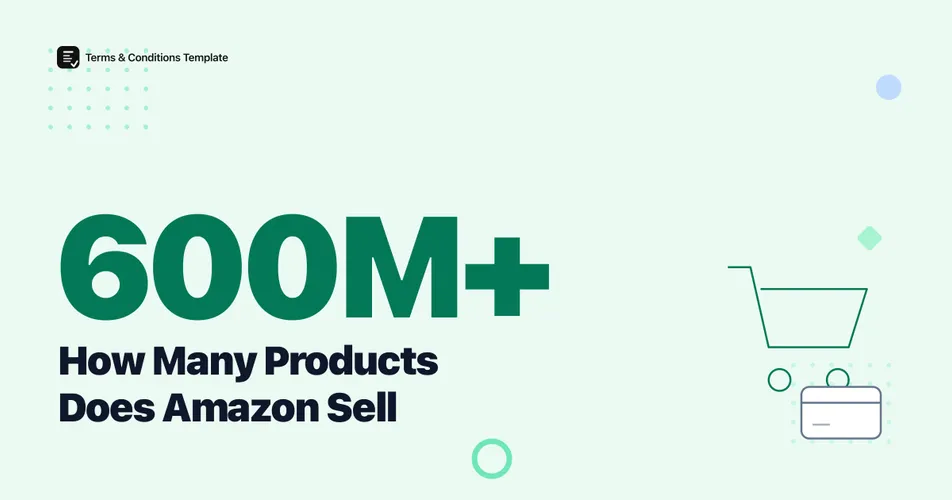
Amazon lists approximately 600 million products for sale as of 2026, according to AMZScout’s Product Database, which crawls live listings across every category on the marketplace. Third-party sellers supply 588 million of those listings, or 97.9% of the total, while Amazon’s own retail and private-label operations account for the remaining 12 million. That split, more than the headline count itself, is the useful fact for anyone trying to work out who actually stocks Amazon’s shelves.
AMZScout does not publish the crawl methodology or sample size behind this count, so treat 600 million as the best available estimate rather than an audited figure. It is still the number cited most consistently across seller-research firms, and it sits on a growth curve that several independent trackers describe the same way.
How many products does Amazon sell in 2026?
Amazon’s marketplace holds an estimated 600 million active product listings as of 2026, per AMZScout, and the overwhelming majority of that catalog does not belong to Amazon at all. Third-party sellers list 588 million products, or 97.9% of the total, compared with roughly 12 million, or 2.1%, sold directly under Amazon’s own retail and private-label brands.
That imbalance did not happen overnight. Amazon opened its marketplace to outside sellers in 2000, and by 2015 third-party listings already outnumbered Amazon’s own by a wide margin. The gap has only widened since.
Figure 1: Share of Amazon’s roughly 600 million product listings by seller type. Source: AMZScout Product Database, 2026 data.
| Seller type | Products listed | Share of catalog |
|---|---|---|
| Third-party sellers | 588 million | 97.9% |
| Amazon direct (retail + private label) | 12 million | 2.1% |
| Total marketplace | 600 million | 100% |
Warning
AMZScout does not disclose the underlying crawl methodology, refresh frequency, or sample size behind its product count. Competing trackers place the current total anywhere from about 590 million to 620 million. Treat 600 million as a directional estimate agreed on by multiple seller-research firms, not an Amazon-audited figure.
How has Amazon’s product catalog grown since 2015?
Amazon’s catalog has grown fast enough that the total roughly doubled in under a decade. Industry tracker Red Stag Fulfillment, citing AMZScout’s historical data, puts the count at 250 million products in 2015, climbing to 320 million by 2017, 440 million by 2019, 520 million by 2021, and 590 to 600 million by 2023 and 2024. None of the trackers behind this series publish a yearly sample size, so read the curve as directional rather than exact to the million.
Figure 2: Estimated total Amazon product catalog size by year. Source: Red Stag Fulfillment, citing AMZScout historical data.
| Year | Products listed (millions) |
|---|---|
| 2015 | 250 |
| 2017 | 320 |
| 2019 | 440 |
| 2021 | 520 |
| 2023 | 590 |
| 2024 | 600 |
Growth did not come only from new sellers signing up. It also came from existing sellers listing deeper into their own catalogs as fulfillment costs fell and product research tools improved. For the wider picture on Amazon’s scale beyond product count, from revenue to Prime membership, see our Amazon statistics overview.
What share of Amazon’s sales come from third-party sellers?
Third-party sellers generated 61% of everything sold on Amazon in 2025, up from 46% in 2015, according to Amazon’s own reporting on its selling partner base. That means most of what customers buy on Amazon, not just most of what is listed, now comes from independent businesses rather than Amazon’s own retail arm.
The listing share and the sales share tell slightly different stories. Third-party products make up 97.9% of the catalog but only 61% of unit sales, so Amazon’s own 12 million direct listings punch well above their weight per item sold.
Figure 3: Third-party seller share of Amazon’s total unit sales, 2015 versus 2025. Source: Amazon selling partner reporting, via Jungle Scout.
How many items does Amazon sell per minute?
Amazon and its third-party sellers move goods fast enough that the pace is usually measured in minutes, not days. Amazon reported that third-party sellers alone sold more than 4.5 billion items in the United States in 2023, working out to about 8,600 items every minute, or roughly 143 per second. This is Amazon’s own reported figure, not a third-party estimate, which makes it one of the more reliable numbers in this article.
Figure 4: Key marketplace milestones from Amazon’s third-party seller program. Sources: Amazon selling partner reporting, Jungle Scout.
Which product categories dominate Amazon’s marketplace?
Home & Kitchen is the single largest category among surveyed Amazon sellers, claimed by 35% of small and mid-sized sellers as a top listing category, according to Jungle Scout’s 2024 State of the Seller report (nearly 2,000 Amazon businesses surveyed). Beauty & Personal Care follows at 26%, and Clothing, Shoes & Jewelry at 20%. Enterprise-scale sellers skew differently, with Appliances as their most common top category.
Figure 5: Most common top listing categories among small and mid-sized Amazon sellers. Source: Jungle Scout, 2024 State of the Seller report, n=~2,000.
These shares describe how many sellers name a category as a top listing area, not a full breakdown of all 600 million products, so they do not need to sum to 100%.
Who handles a return: Amazon or the seller?
With 97.9% of listings belonging to third-party sellers, most Amazon purchases are not actually a transaction with Amazon at all, and that matters most at the return stage. When a product is sold and shipped by a third-party seller, that seller’s own return policy generally governs the refund, not Amazon’s default retail policy. Amazon’s A-to-z Guarantee acts as a backstop when a seller fails to honor reasonable terms, but the seller’s published policy is the first line of the transaction.
Figure 6: How return responsibility splits between Amazon and third-party sellers. Source: Amazon marketplace seller terms.
At the scale this article covers, that is not a small detail. If third-party sellers move a meaningful share of 4.5 billion-plus annual US units, even a low return rate produces a large volume of disputes for sellers with no clear policy of their own. Sellers who publish specific, dated return and refund terms cut down on this dispute path before it starts. If you sell through Amazon or your own storefront, you can generate a refund policy that spells out return windows, condition requirements, and refund timing, so customers know the terms before they buy rather than after they open a case.
How many sellers list products on Amazon?
This is the least settled number in Amazon’s marketplace data. Trackers report the active seller count anywhere from about 1.8 million to 9.7 million total registered accounts, with roughly 2 million considered actively selling at any given time. The wide range comes down to what each source counts: registered accounts versus accounts with a live listing versus accounts with a sale in the last 12 months.
Warning
Seller-count figures vary more than any other number in this article. Some trackers count every registered seller account ever created, including dormant ones, while others count only accounts with at least one active listing or recent sale. We break down the discrepancy and the sourcing behind each figure in how many sellers are there on Amazon.
What is more consistent across sources is how unevenly sellers list. 83% of third-party sellers list fewer than 20 products, and only 3% list more than 500, according to Jungle Scout’s survey of nearly 2,000 Amazon businesses. About 30.4% of active third-party sellers are based in the United States. Most of Amazon’s 600 million-product catalog, in other words, is built by a small number of sellers listing deep catalogs alongside a much larger number of small sellers listing a handful of items each.
The Bottom Line
The number worth remembering from 2026 is not just 600 million, it is 97.9%. Amazon’s catalog is overwhelmingly a third-party marketplace now, and that share has been climbing since at least 2015. If you sell on Amazon, or run any storefront that processes returns at volume, the practical implication is the same one that shows up throughout this data: clear, published terms protect both the transaction and the dispute that sometimes follows it. A catalog this size cannot run on ambiguity, and neither can an individual seller’s return process.
Frequently Asked Questions
How many products does Amazon sell? Amazon lists roughly 600 million products as of 2026, according to AMZScout’s Product Database. Third-party sellers supply 588 million of those listings (97.9%), while Amazon’s own retail and private-label operations account for the remaining 12 million.
What percentage of Amazon’s products come from third-party sellers? Third-party sellers account for 97.9% of Amazon’s product listings (588 million of 600 million) and generated 61% of Amazon’s unit sales in 2025, up from 46% in 2015, based on Amazon’s own reporting.
How many items does Amazon sell per minute? Amazon and its third-party sellers move about 8,600 items every minute, built from Amazon’s reported figure of more than 4.5 billion third-party units sold in the United States in 2023.
How many sellers are there on Amazon? Estimates vary widely depending on what is counted: trackers report anywhere from 1.8 million active sellers to 9.7 million total registered seller accounts, with roughly 2 million considered actively selling at any given time.
Sources and References
- AMZScout. (2026). “Amazon Statistics.” Product Database figures for total listings and seller-type split.
- Capital One Shopping Research. (2026). “Number of Products on Amazon.” Compiles AMZScout and Jungle Scout figures on catalog size and seller distribution.
- Red Stag Fulfillment. (2024-2025). “How Many Products Does Amazon Carry?” Year-by-year catalog growth estimates, 2015 to 2024, citing AMZScout historical data.
- Jungle Scout. (2024). “Amazon Statistics.” State of the Seller report survey data, nearly 2,000 Amazon businesses, plus Amazon-reported unit sales and seller-share figures.
Note: All figures verified as of August 2026. Marketplace-scale figures such as total product count and active seller counts are estimates from third-party trackers rather than Amazon’s own audited disclosures, and are refreshed at least twice a year.